
ChatGPT Never Names More Than Half of Toronto’s Main-Street Businesses. Here’s How to Get Yours Into the Answer
In one minute: A Clixera study found ChatGPT named only 44% of main-street businesses across Canada, and 43% in Toronto. When people asked it to recommend a business, about 29% of the businesses appeared. You can check your own odds in 30 minutes: ask ChatGPT eight real customer questions, log who it names, then fix the gaps in this order. Match your website to your Google profile. Build a page for each service. Earn detailed reviews. Get listed on local sources that AI can read.
Open ChatGPT and ask for the best place near you to buy what you sell. Does it name you?
For most Toronto main-street owners, the honest answer is not often. This guide gives you a 30-minute test to see where you stand, then a short fix list you can work through one step at a time.
What the research found, and what it does not say
Ottawa analytics firm Clixera tested thousands of main-street businesses across almost every province. ChatGPT named 44% of them on average, according to MobileSyrup’s coverage of the report. Prince Edward Island did best at 54%. Newfoundland and Labrador came in at 33%.
An earlier Clixera test looked at Ottawa and Toronto. The Ottawa Business Journal reported that 43% of Toronto businesses appeared at least once in ChatGPT’s answers, against 41% in Ottawa. When ChatGPT was asked to recommend where to go for a product or service, about 29% of businesses appeared.
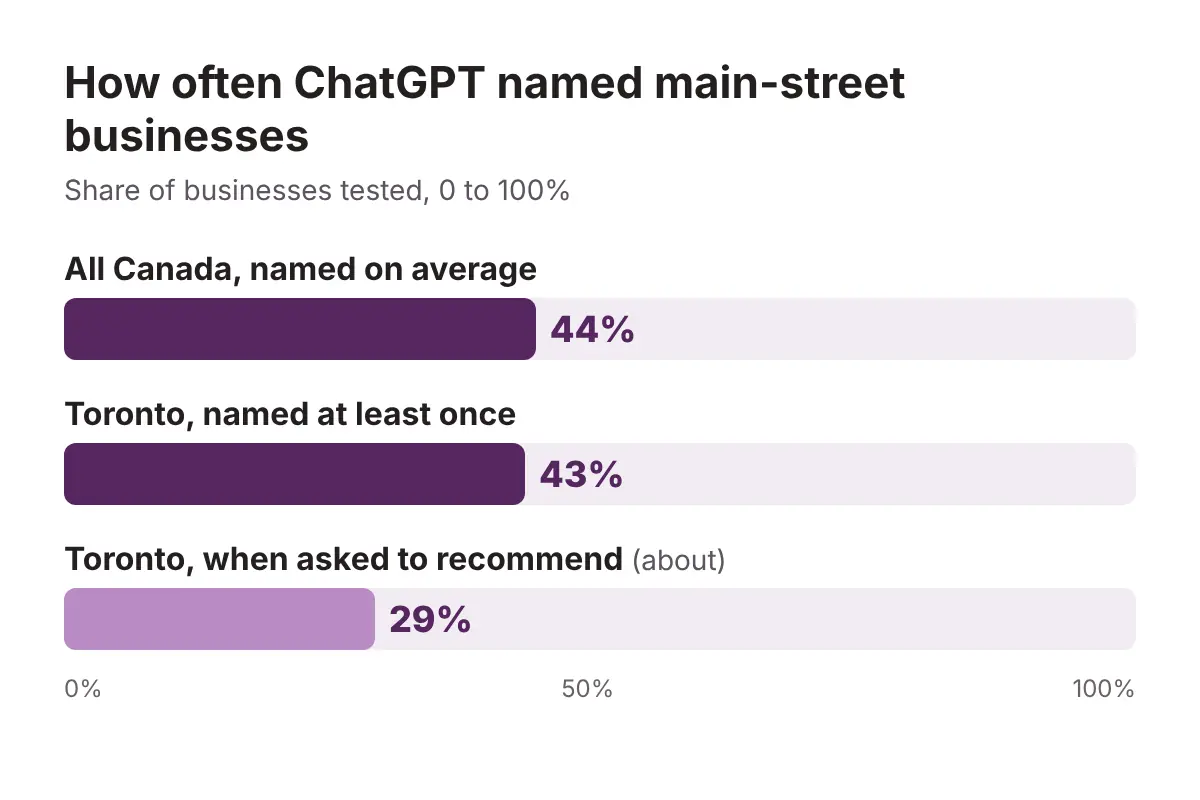
The number to remember: about 29%. Being named is one thing. Being recommended is harder, and that is the one that sends customers.
Bigger names often took the spot. In one example from the report, a best-gym question in Ontario brought up GoodLife Fitness and the YMCA. The earlier Toronto and Ottawa sample set major chains aside, so that comparison tells you about independents only.
Keep the limits in mind. This is commercial research, not a peer-reviewed study, and it does not detail every method. Clixera also says it cannot guarantee inclusion in any AI tool. Treat the figures as a signal, not a score for your business.
One more piece of evidence points the same way. In an analysis of Similarweb data across 10 markets, Aleyda Solis found that local sites often win the clicks AI search sends in ecommerce, finance and travel outside the US. It measured clicks, not citations, and it was not about small shops. But it fits the idea that AI tends to favour whoever has the clearest local answer.
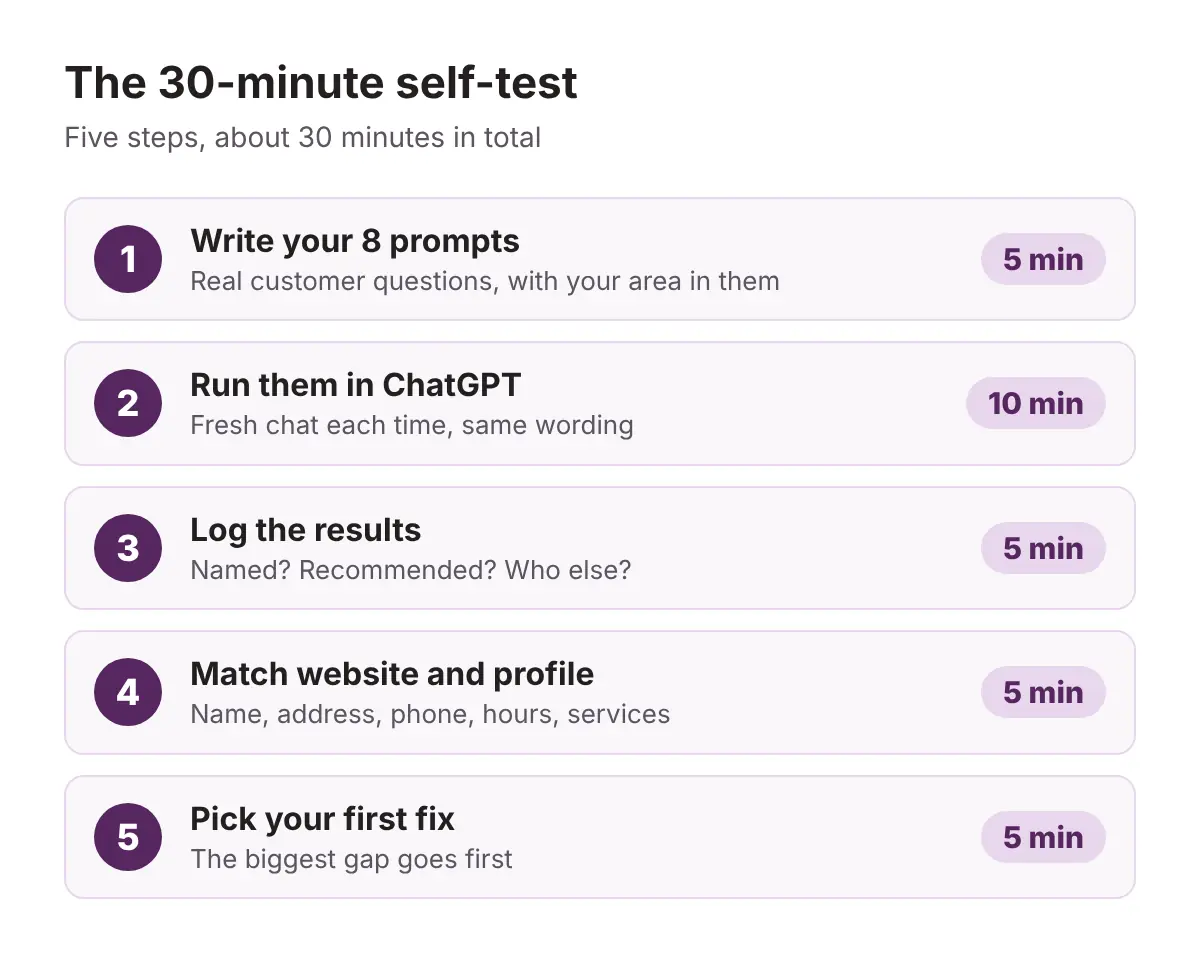
The 30-minute self-test
You do not need a paid tool to start. You need a timer, a notes page and ChatGPT.
- Write eight prompts (5 minutes). Use real customer wording with your area in it. For example: “best physiotherapist near the Beaches” or “who fixes a cracked phone screen in Leslieville”. Mix four “best” questions with four “who should I call” questions.
- Run each prompt in a fresh chat (10 minutes). Use the same wording each time. Answers change from run to run, so ask each prompt twice if you can.
- Log what came back (5 minutes). For each prompt, note whether you were named, whether you were recommended first, and which businesses were named instead. Our free GEO tracker template has a ready-made place for this.
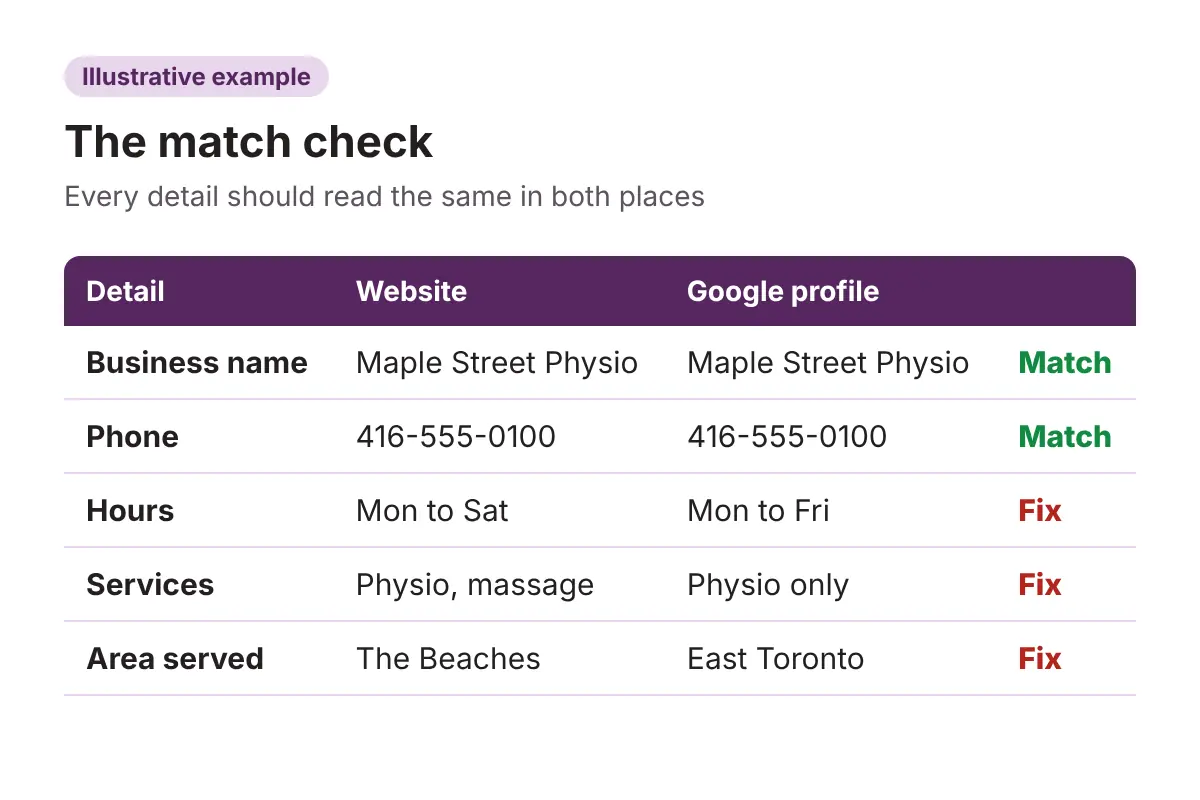
- Match your website to your Google profile (5 minutes). Put them side by side. Check business name, address, phone, hours, services and area served.
- Pick your first fix (5 minutes). Choose the biggest gap and book it into your week.
A note on reading your results. Named but never recommended may mean AI knows you exist but does not trust you for that question. Not named at all may mean it cannot find enough clear information about you. Both are fixable. Our guide to mentions versus citations explains the difference in more depth.
The fix list, in order
Start at the top. Each step makes the next one work harder.
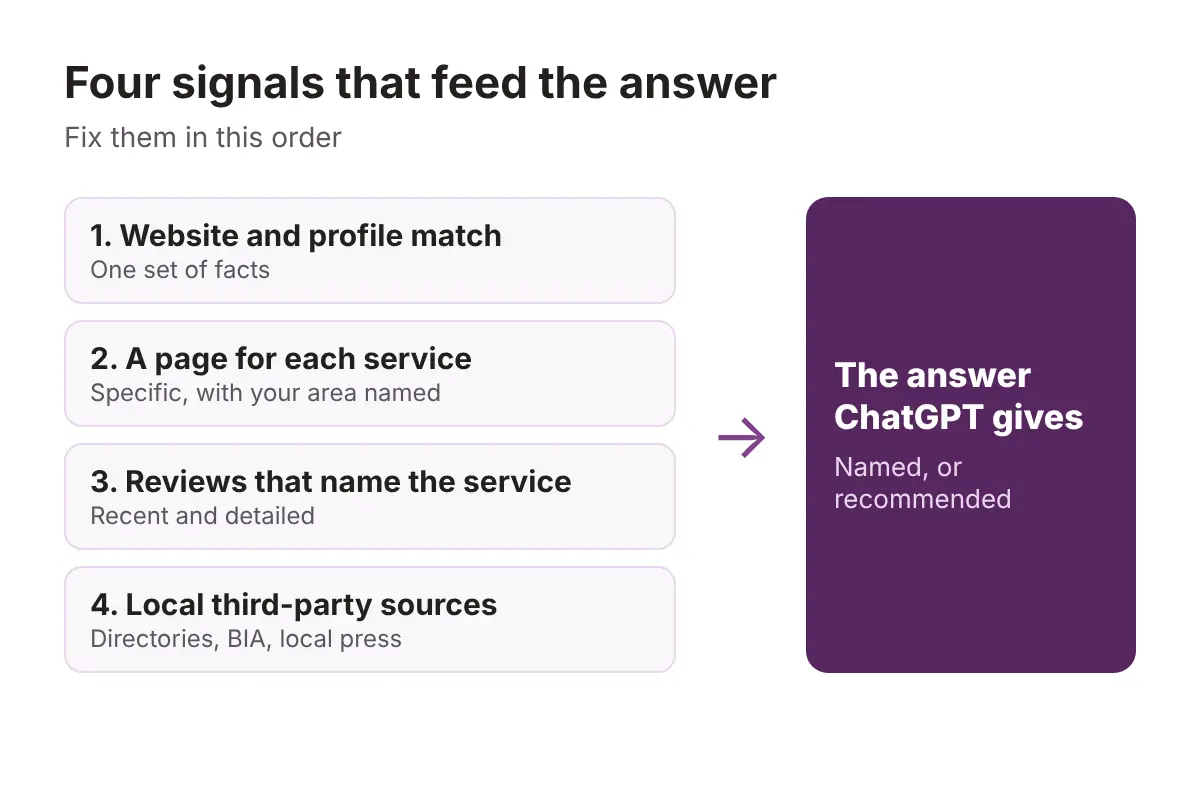
1. Make your website and Google profile say the same thing
AI tools pull facts from several places. When those places disagree, the answer may get vaguer, or you may get left out. Use the exact same business name, address, phone number and hours everywhere. List the same services in the same words on your site and in your Google Business Profile.
2. Give each service its own page
One “Services” page that lists everything is hard for AI to quote. A page for each service is not. Name the service, name the neighbourhoods you serve, and answer the questions customers actually ask: price range, how long it takes, what to expect. Put your location in plain text, not only in an image or a map.
3. Earn reviews that describe what you do
Star ratings help people. Specific words may help AI more. A review that says “fixed my leaking kitchen tap in Riverdale the same day” tells a tool what you do and where. Ask happy customers to mention the service and the area, and reply to reviews with the same clarity. If you want help building that process, see our reviews and reputation work.
4. Get listed on local sources AI can read
Your own site is one voice. Other sources that describe you the same way add weight. Think of your local BIA directory, the chamber of commerce, neighbourhood guides, local press and industry listings. Each one should carry the same name, address and service description from step one.
If you want to see how local profile work plays out in practice, read our Google Maps case study.
Common mistakes
- Testing once and stopping. AI answers change. Repeat the same prompts each month and compare.
- Testing only your business name. Customers rarely type it. Test the questions they ask before they know you.
- Chasing every tool at once. Fix the basics first. Clear facts should help in ChatGPT and in other AI tools.
- Treating one result as the truth. Look for patterns across several prompts and runs.
Be careful: No fix guarantees a mention. Nobody outside OpenAI can promise you a place in ChatGPT’s answers.
If you would rather have a team run this for you, our AI search optimization service helps with steps like these.
Quick recap checklist
- Eight real customer prompts written and run in ChatGPT
- Named, recommended and competitors logged for each one
- Website and Google profile match on every detail
- One page for each service, with your area named
- New reviews that name the service and the neighbourhood
- Same details listed on local directories and guides
- Test repeated next month
Frequently asked questions
Does ChatGPT really ignore small businesses?
Not entirely, but it names fewer than half of them. Clixera’s test found ChatGPT named 44% of main-street businesses on average, and 43% in Toronto.
What is the difference between being named and being recommended?
Being named means your business appears in an answer. Being recommended means ChatGPT points the customer to you when asked where to go. In the Ottawa Business Journal’s report, about 29% appeared when ChatGPT was asked to recommend.
How long does it take to show up in ChatGPT?
Nobody can promise a timeline. Changes to your site and profile can be picked up at different speeds, and answers vary between runs, so track the same prompts monthly.
Do I need a paid tool to test this?
No. You can run the self-test by hand in ChatGPT. Paid tools save time later, once you want to track many prompts.
Do these steps help in Google and other AI tools too?
Often, yes. Clear facts, specific service pages, detailed reviews and consistent local listings help people and search tools alike.
Ask the question your customers ask
The research gives you the odds. Your own test gives you the facts. Run it this week.
If ChatGPT cannot find a clear local answer, it will name someone who has one.
See if ChatGPT would name your business today
The research says fewer than half of main-street businesses get named. You can find out which side you are on in about a minute.
Run a free Radar scan of your business. It shows whether AI recommends you, who it names instead, and three quick wins.
No sign-up. No email. Instant results.
Run my free Radar scan →
About the author
Simar Singh founded Digital 6ix, a Toronto SEO, GEO and content marketing agency. He works with local and growing businesses on being found, cited and described accurately by ChatGPT, Perplexity, Gemini and Google’s AI Overviews. Free audit and planning templates are at digital6ix.ca/templates. Connect with Simar on LinkedIn.
Sources
Instant AI visibility scan
Scan your business with Radar in about 30 seconds. See whether AI names you, who it picks instead, and what to fix first.
Run my free scanBook a free audit call
Not sure where your gaps are? We will go through your local AI visibility together and pick the first fix.
Book my call