
Claude Now Bans Fake Sources Built to Sway AI Answers. Here’s the Line Between Real GEO and Getting Burned
If you read one thing: Anthropic has updated its usage policy to ban using Claude to build fake sources meant to sway search engines and AI answers. The new rules take effect November 12, 2026. Google says its spam policies already cover AI Overviews and AI Mode. If a GEO pitch leans on fake reviews, “independent” sites you own or invented accounts, that is the risk. Real reviews, real press and clear facts on your own site are the safe path.
Some GEO pitches sell a shortcut.
Plant good things about you in many places that look independent. Let AI repeat them.
Two big names in search and AI have now drawn a line against that. This guide shows where the line sits, how to check what your agency does in your name, and where a Toronto business should spend its effort instead.
Two rule changes, one line
Anthropic: the new deceptive campaigns rule
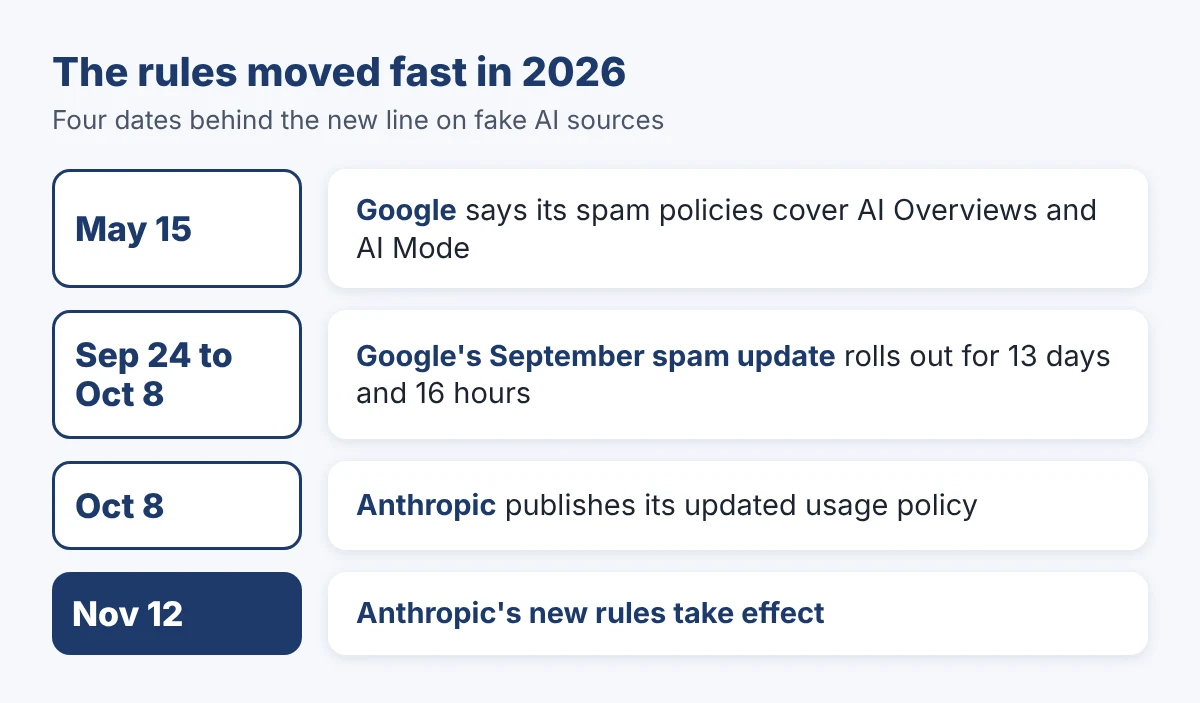
Anthropic published its updated usage policy on October 8, 2026. It takes effect on November 12. The policy adds a section called “Do Not Engage in Deceptive Campaigns or Artificial Activity.” (Anthropic’s announcement, the policy itself)
In plain English, you can’t use Claude to:
- Run fake personas, accounts, media outlets or organizations. That includes fake reviews and astroturfing.
- Spread content through networks of fake or seemingly independent sites that secretly share one source.
- Seed search engines or AI systems with content that misstates where it came from, who wrote it or how independent it is.
- Hide who sponsors content meant to sway public opinion or decision-makers.
- Build or sell tools for any of the above.
The rule covers how Anthropic’s products are used. It is not a law, and it does not police the whole web. It does show how the companies behind AI answers see these tactics. Search Engine Journal covers what it means for anyone trying to influence AI answers.
Google: the same line, already in place
Google says its spam policies now cover generative AI responses in Search, including AI Overviews and AI Mode. Coverage of Google’s changelog dates that clarification to May 15, 2026. It did not add new rules. The existing ones, like those on scaled content abuse and link spam, now apply to AI answers too. (Google’s spam policies)
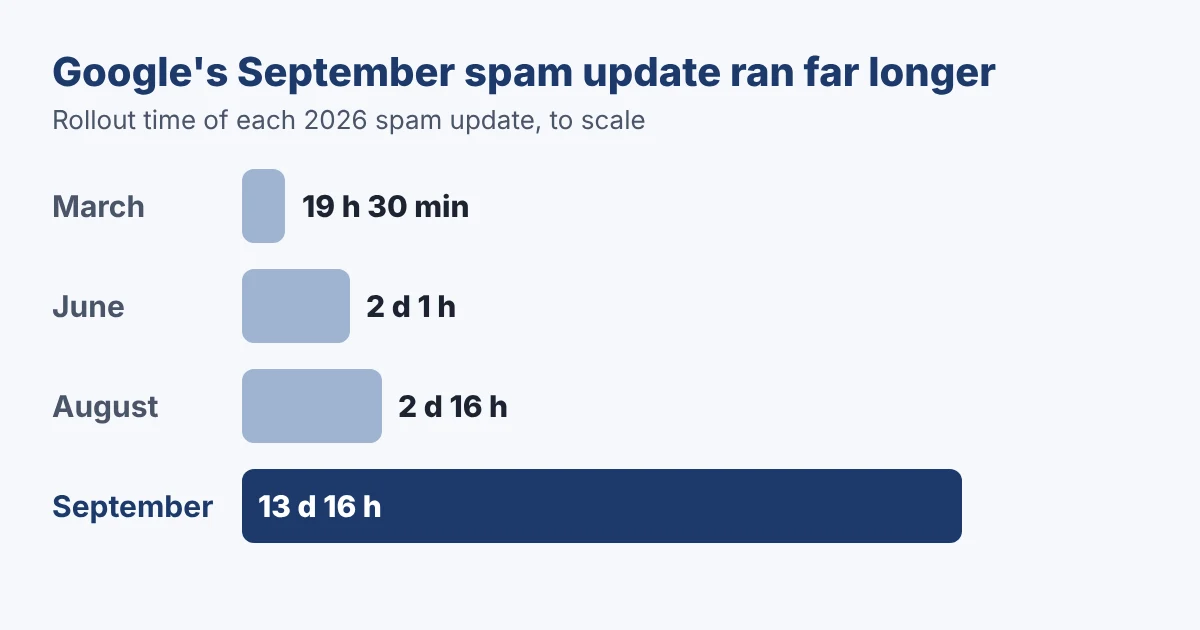
Google’s September 2026 spam update then ran from September 24 to October 8. Google has not said which tactics it targeted. (Search Engine Journal)
Around the same time, Google described SAFE, an AI system built to catch AI-generated spam by imitating a human manual review. Coverage links SAFE to the September update. Google has not confirmed that link. (Search Engine Journal)
The real case behind the rule
Anthropic’s September 2026 threat intelligence report describes one case that shows the pattern.
About 70 fabricated news sites. At least 8,913 articles. Around 20 languages.
The sites were built to look like independent local newsrooms. Articles carried fake journalist bylines, and each site had a matching X account.
Anthropic traced the operation to LKM Company, a France-based digital advertising agency. It said the behaviour fit an “influence-as-a-service” model. The report says the articles were designed to boost the sites’ authority rankings on search engines. Anthropic banned the account and the organization behind it.
Most of that network pushed political messages, not business ads. The method is what matters: many sites that look independent and share one source. Some GEO pitches sell a cheaper version of the same idea.
Four red flags in a GEO pitch
Ask any agency how it plans to get you cited in AI answers. Listen for these four.
1. Fake review sites
Sites that exist to give you five stars, or “best of” pages the agency owns. AI tools read reviews, so the temptation is real.
2. Paid “independent” listicles
Paying to appear in a list is not the issue. Hiding that it was paid is. A listicle that looks neutral but was bought is what the new rule calls out.
3. Persona accounts on Reddit and forums
Invented users who recommend you. Forum threads are easy for AI to read, so some agencies are tempted. It is also the exact thing the policy names: fake personas and astroturfing.
4. Cloned microsites
Ten small sites that repeat one claim and link to each other. They look like ten voices. They are one.
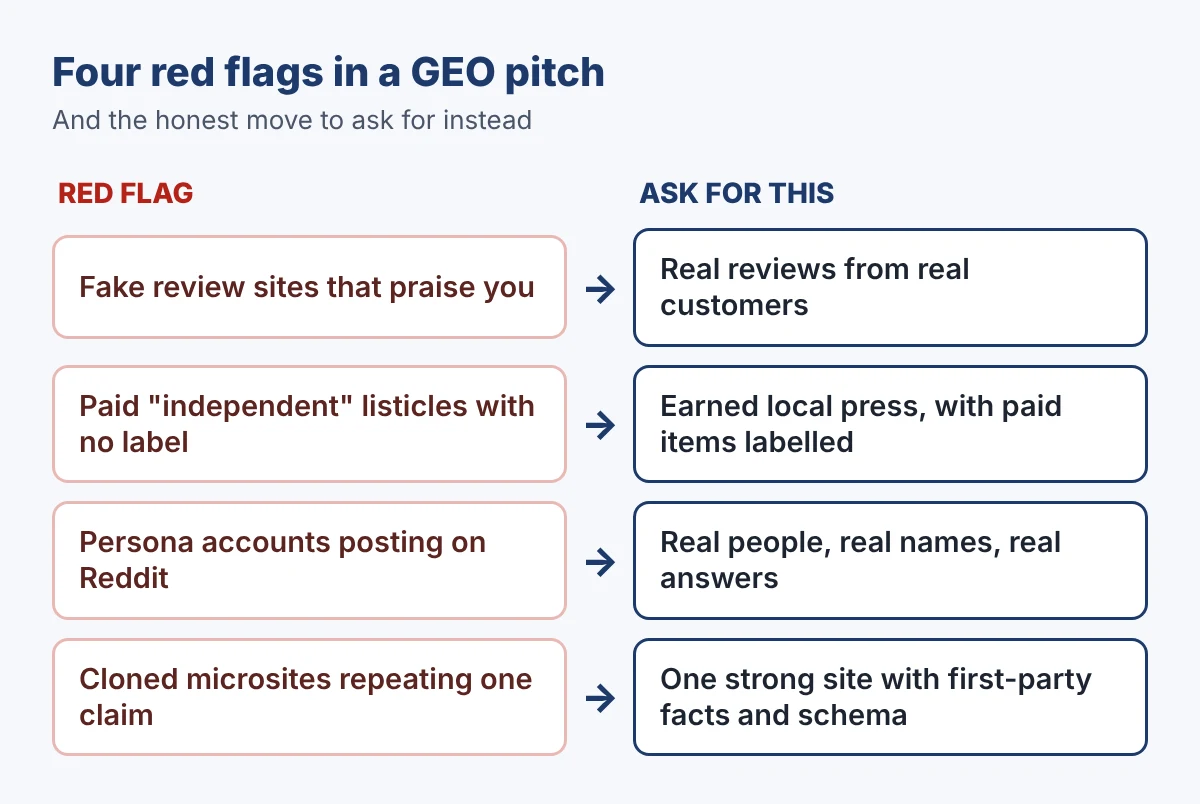
A quiet warning sign: your agency can’t, or won’t, list the sites and accounts that mention you.
Seven questions to ask before November 12
Audit what your agency does in your name. Send these in one email and ask for written answers.
- Which sites will mention us, and who owns them? If the agency or a partner owns them, ask why they look independent.
- Does your team write any of our reviews? Asking happy customers for a review is fine. Writing it for them is not.
- Do you use invented personas or fake accounts? Any yes is a no.
- Is every paid mention labelled as paid? Sponsored content should say so where a reader can see it.
- Do the sites you run share one source? Look for the same text or templates across sites that claim to be separate.
- Can we see every account that posts for us? Real names, real roles.
- Will you put this in the contract? A promise not to use fake sources, plus the right to leave if it is broken.
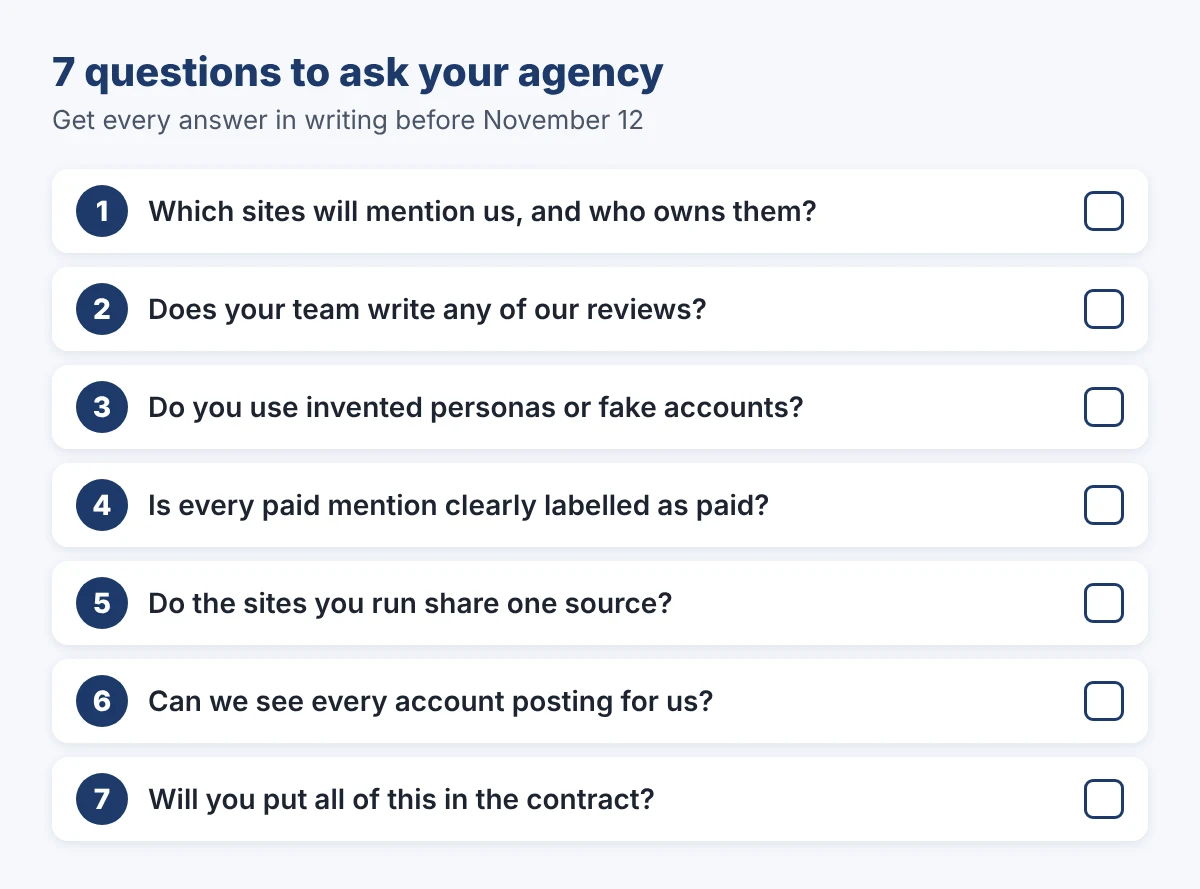
Keep the answers with your audit notes. Our free SEO and GEO audit template is a good place for them.
How to score the answers
Count the answers that came back clean. A clean answer is specific, in writing and easy to check.
- 6 to 7 clean. Low risk. Ask the same questions again each quarter.
- 3 to 5 clean. There are gaps. Get the missing answers before you renew.
- 0 to 2 clean, or no reply. Treat it as high risk. Ask for a full list of sites and accounts, and stop paying for placements you can’t see.
Then check where you stand today. Our free AI visibility check shows whether AI names your business and who it names instead.
What honest GEO looks like
None of this means GEO is dead. It means the work sits where AI can find real evidence.
- Real reviews. Ask real customers, make it easy and reply to every one. Our reviews and reputation management work starts here.
- Consistent citations. The same name, address, phone number and hours on your site, your Google Business Profile and your directories.
- Earned local press. Stories an editor chose to run. Digital PR and link building done honestly is slow, and it lasts.
- First-party facts. Services, prices, hours, service areas and policies in plain text on your own pages.
- Schema. Mark those facts up so machines read them the way people do.
It is the kind of work behind our AI search optimization (GEO) service. Nothing in it needs a fake source.
A simple test: if a customer, an editor or an AI tool could see exactly who is behind a mention and why it exists, it is probably honest. If the answer has to be hidden, don’t do it.
The Toronto playbook: where to spend the effort
Here is where three kinds of GTA business could put their time instead of chasing shortcuts.
| Business | Skip this | Spend effort here |
|---|---|---|
| GTA restaurant | Invented diner accounts and “best of” pages you own. | Real Google reviews, correct hours and menus, and coverage from local food writers. |
| Clinic | Praise written by staff and posted as patient reviews. | Real patient reviews within your regulator’s advertising rules, a clear page for each service and practitioner, and consistent listings. |
| Contractor | Cloned city pages repeating one claim, and reviews bought in bulk. | Photos and details from real jobs, reviews tied to real customers, accurate service areas and local trade or news mentions. |
Illustrative guidance, our recommendations. Not based on any real business.
Pick one item a month and finish it. Slow, real work is easier to defend when the rules tighten.
Frequently asked questions
Does Anthropic’s new rule apply to my business?
Only if someone uses Claude to run these tactics for you. The policy governs use of Anthropic’s products and takes effect on November 12, 2026. The tactics it names may also break other platforms’ rules, including Google’s spam policies.
Is paying for a listicle allowed?
Paying for a placement is not what the new rule targets. Hiding who paid, or making paid content look independent, is. Label sponsored content clearly.
Can Google act against fake sources in AI Overviews?
Google says its spam policies cover AI Overviews and AI Mode. Google’s spam policies say spam may lead to lower rankings or removal from results.
How can I tell if my agency uses these tactics?
Ask the seven questions above and get the answers in writing. Then search your brand name and look for sites or accounts you don’t recognize.
What is GEO?
Generative engine optimization is the work of helping AI systems such as ChatGPT, Gemini, Perplexity and Google’s AI Overviews find, understand and accurately describe your business.
The line, in one sentence
You can help AI find the truth about your business. You can’t invent the evidence.
Earn the mention. Don’t fake it.
See where AI puts your business today
An honest GEO plan starts with a clear picture of what AI says about you now.
Run a free Radar scan of your business in about 30 seconds. See whether AI recommends you, who it names instead, and three quick wins.
No sign-up. No email. Instant results.
Run my free Radar scan →
About the author
Simar Singh runs Digital 6ix, a Toronto agency focused on SEO, GEO and content. He writes about how AI tools choose which businesses to name, and how local companies can earn those mentions the honest way. Find him on LinkedIn.
Sources
- Search Engine Journal: Claude’s New Rules Target Fake Sources Built To Sway AI Answers
- Anthropic: 2026 Usage Policy update
- Anthropic: Usage Policy
- Anthropic: Threat intelligence report, September 2026
- Google Search Central: Spam policies
- Search Engine Journal: Google has deployed a new AI spam detector called SAFE
- Search Engine Journal: Google completes September 2026 spam update
- Search Engine Roundtable: Google September 2026 spam update is done rolling out
Instant AI visibility scan
Radar scans your business in about 30 seconds. See whether AI names you, which rivals it names instead, and three quick wins.
Run my free scanBook a free strategy call
Not sure what your agency is doing for you? Book a call and we will go through it together.
Book my call