
ChatGPT Sends Less Than 1% of Google’s Traffic but Converts 4x Better. Where a Local Business Should Put Its AI Search Effort
Bottom line first: A new 100-site study found that ChatGPT sends about 0.62% as many sessions as Google organic search, yet its visitors converted at 13.8% against 3.02%. For a local business, the takeaway is simple. Google still sends most of the customers, including through its AI features, so protect that first. ChatGPT works more like word of mouth: it shapes shortlists, but rarely shows up as a click.
The headline sounds like a contradiction. ChatGPT sends tiny traffic, but that traffic converts far better. Both things can be true. They just answer different questions.
This post covers what the study found, why click numbers undercount AI, and how a Toronto small business can split its effort and measure the result.
What the 100-site study found
On October 21, 2026, Search Engine Land reported an analysis by Marie Haynes. It used 12 months of GA4 data from 100 websites, covering more than 145 million sessions.
- Traffic: ChatGPT sessions equalled 0.62% of Google organic sessions. Counting other LLMs, the figure was 0.73%.
- Conversion rate: On the 55 sites that track conversions, 13.8% of ChatGPT visitors converted. For Google organic, it was 3.02%.
- Total conversions: Google organic drove 964. All AI chatbots combined drove 36.
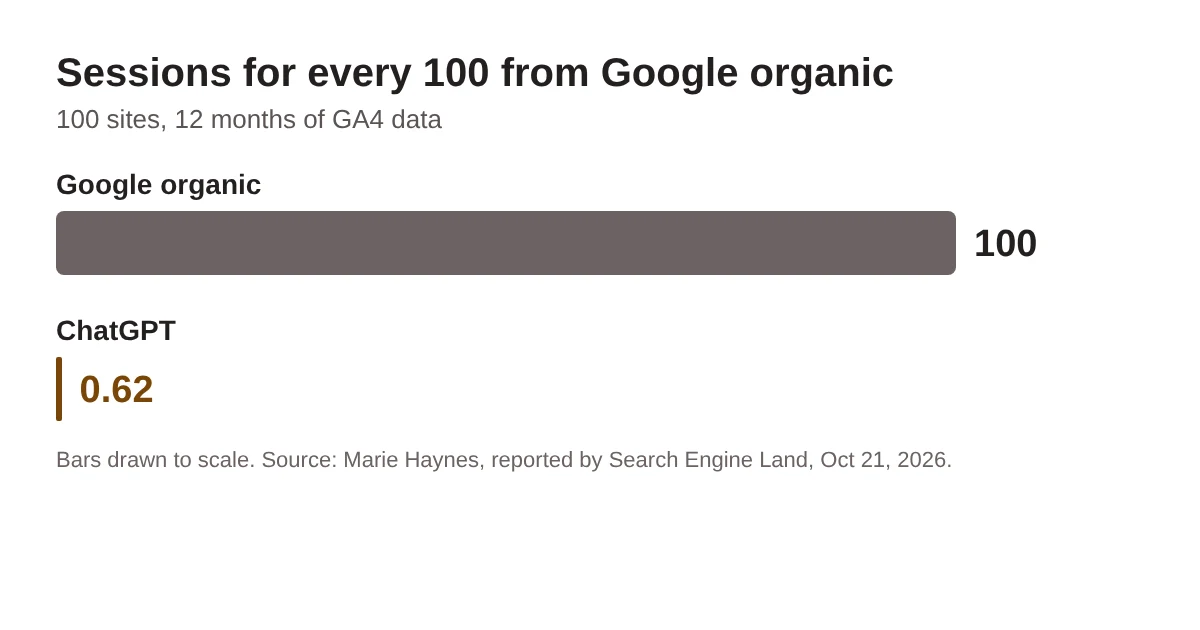
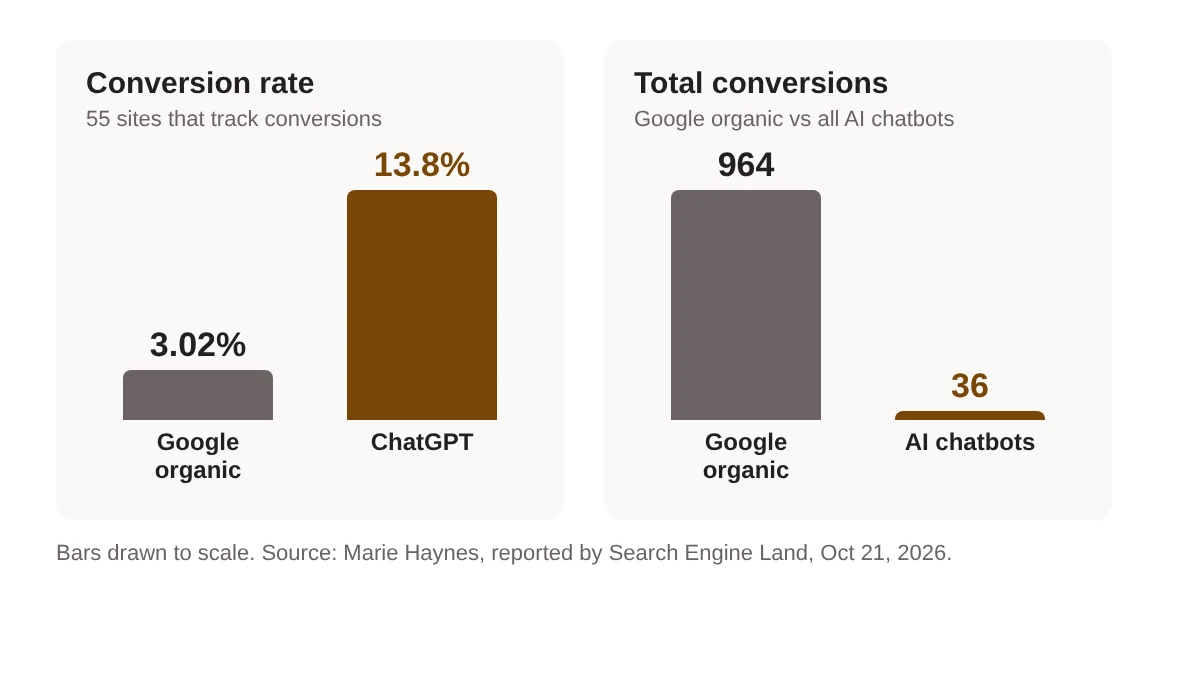
Read the two charts together. The rate is higher for ChatGPT. The total is far higher for Google.
What the study can’t tell you
- It is 100 sites. That is a useful sample, not your market.
- There is no industry mix. A Toronto dental clinic and a SaaS company are not the same buyer.
- Each site defines a conversion its own way. A form fill on one site is a purchase on another.
- Other studies disagree. A 94-site ecommerce analysis found ChatGPT converting at 1.81% against 1.39% for non-branded organic search, a smaller gap. An earlier study of ecommerce sites found ChatGPT converting worse than Google.
So treat the numbers as a direction, not a promise. The direction is clear: small volume today, and Google is still where the customers are.
Why AI clicks undercount what AI does for you
Referral numbers only count people who clicked a link. A lot of AI influence never involves a click.
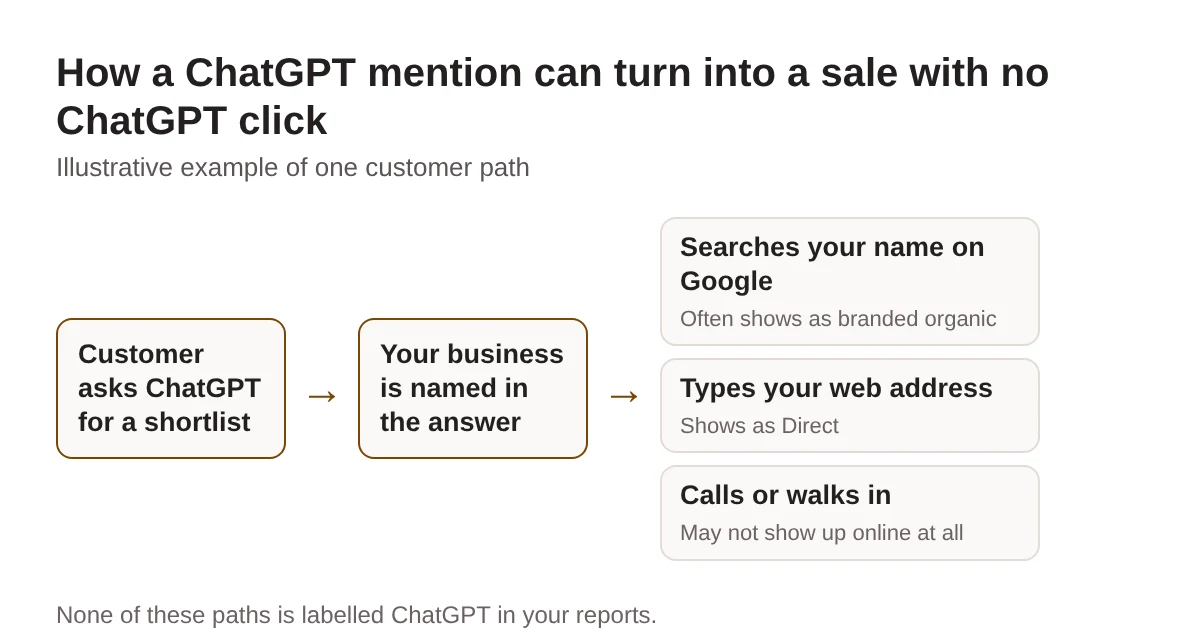
- Zero-click answers. The customer reads your name in the answer and gets what they need.
- Search later. They see you in ChatGPT, then search your business name on Google. GA4 credits branded organic.
- Direct and offline. They type your address, call or walk in. Nothing says “ChatGPT”.
Your October numbers may be off. One analyst reported a ChatGPT tracking bug between October 8 and 15 that removed the signal telling analytics where visits came from. ChatGPT visits fell and Direct traffic rose. OpenAI is reported to have confirmed it on October 14 and fixed it overnight. If your ChatGPT numbers dipped and Direct jumped that week, annotate those dates and don’t read it as a real change.
Even without a bug, referrers get stripped. Google added a native AI Assistant channel to GA4 on May 13, 2026, but it only catches visits that arrive with a recognized referrer. It is not retroactive either. For more on this, read our guide to seeing how many customers AI actually sends your business.
For a local business, the AI that sends customers is mostly Google
Haynes’s own conclusion, as Search Engine Land reported it, is that the AI search sending people to businesses today is not ChatGPT. It is Google.
For a local business, that means three places:
- AI Overviews and AI Mode. Clicks from these show up in your Search Console Performance report under the Web search type. You can’t filter them out on their own.
- Google Maps. This is where “near me” and “best in Toronto” searches land.
- Your Business Profile. Reviews, photos, hours, services and Posts feed what Google shows and says about you. Our guide to Google Posts and a posting plan that also feeds Maps and AI answers is a good place to start.
| Where the customer asks | What you can see | What stays hidden |
|---|---|---|
| Google AI Overviews and AI Mode | Clicks and impressions, mixed into your Web totals in Search Console | Which clicks came from the AI answer |
| Google Maps and Business Profile | Calls, direction requests and website clicks in the Profile’s performance data | What the customer read before they called |
| ChatGPT | Referral visits when someone clicks a link | Mentions that lead to a branded search, a Direct visit or a call |
If you want to see what this work looks like on a real local listing, read our Google Maps case study.
Where ChatGPT still earns its place
Small traffic does not mean small influence.
People use ChatGPT to build shortlists, compare options and decide who to trust. By the time they reach you, they have already half decided. That is why the visitors who do arrive may convert at a higher rate: they come ready to book or buy.
Think of it as word of mouth at scale. You can’t track every recommendation. You can still make sure the answer is good when someone asks.
A simple effort split for a Toronto small business
Here is the order we would use. It is our judgement, not a figure from the study.
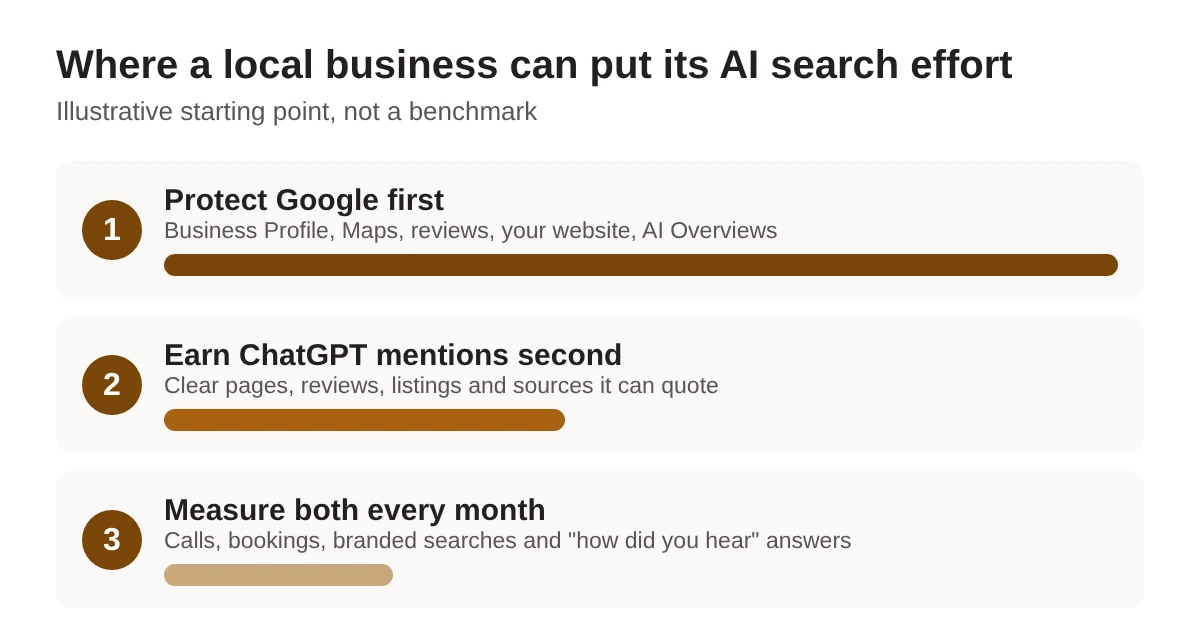
- Protect Google first. Keep your Business Profile complete, collect reviews, keep your website clear and fast, and make sure your key pages answer real questions. Most of your time and budget belongs here.
- Earn ChatGPT mentions second. Make it easy for AI to describe you correctly: clear service pages, consistent listings, reviews, and mentions on sites it already trusts. This is a smaller, steady slice.
- Measure both, every month. Don’t move budget based on one dashboard.
Much of step 2 is the same work as step 1, so the split is less painful than it sounds. If you want help with either side, see our AI search optimization services in Toronto.
How to measure AI value without trusting referral numbers alone
Use several signals. No single one tells the story.
- Annotate October 8 to 15 in GA4. Compare ChatGPT and Direct side by side so the bug doesn’t mislead you.
- Track conversions by source. Look at conversions, not just visits, from the AI Assistant channel and any ChatGPT referrals.
- Watch branded search. In Search Console, track clicks and impressions for your business name. A steady rise may mean people are hearing about you elsewhere.
- Read your Business Profile. Note calls, direction requests and website clicks each month.
- Ask customers. Add “How did you hear about us?” to forms, bookings and phone calls, with an AI assistant option and a free-text box.
- Check the answers monthly. Ask ChatGPT the same ten buyer questions each month and log whether you are named. Our free GEO tracker template is built for this.
Put the six signals in one sheet. If calls, branded searches and “heard it from ChatGPT” answers all rise together, AI is working, even if the referral count stays small.
What to do this week
- Annotate October 8 to 15 in your analytics.
- Add a “how did you hear about us?” question to your main form and phone script.
- Open your Business Profile and fix anything out of date.
- Run ten buyer questions through ChatGPT and write down who gets named.
Frequently asked questions
Does ChatGPT send much traffic to local business websites?
Very little compared with Google. In a 100-site study, ChatGPT sessions equalled 0.62% of Google organic sessions. The visits it does send may convert well, but the volume is small.
Is ChatGPT traffic really worth more than Google traffic?
Per visit, it may be. In the same study, 13.8% of ChatGPT visitors converted on the 55 sites tracking conversions, against 3.02% for Google organic. In total, though, Google organic drove 964 conversions to 36 from all AI chatbots combined.
Why does my ChatGPT traffic look so low in Google Analytics?
Many people read an AI answer and then search your name, type your address or call. Those visits are credited to branded search, Direct or nothing online. A tracking bug in early October also pushed some ChatGPT visits into Direct.
Should a small business stop working on ChatGPT visibility?
No. Keep it as a smaller, steady part of your work. Clear pages, strong reviews and consistent listings help in ChatGPT and in Google, so most of the work overlaps.
How do I know if AI is sending me customers?
Combine several signals: conversions from AI referrals in GA4, branded search trends, Business Profile calls and direction requests, and a “how did you hear about us?” question on forms and calls.
Google sends the customers. ChatGPT shapes the shortlist. Measure both.
See whether AI names your business today
Your referral numbers only show the clicks. They don’t show whether ChatGPT and Google’s AI name you when a customer asks.
Run a free Radar scan in 30 seconds. See who AI recommends in your category and three quick wins to fix the gaps.
No sign-up. No email. Instant results.
Run my free Radar scan →
About the author
Simar Singh founded Digital 6ix, a Toronto agency for SEO, GEO and content marketing. He works with local and growing businesses on getting found in Google, Maps and AI answers, and on measuring what that brings in. Free audit and planning templates are at digital6ix.ca/templates. Connect with Simar on LinkedIn.
Sources
- Search Engine Land: ChatGPT sends less than 1% of Google’s traffic: Data
- Search Engine Land: ChatGPT vs non-branded organic search conversions (94-site analysis)
- Search Engine Land: ChatGPT and LLM referrals convert worse than Google Search (earlier study)
- Search Engine Journal: ChatGPT traffic drop appears to be a tracking problem
- TechWyse: ChatGPT tracking bug hid AI referrals in Direct traffic
- TechWyse: Google Analytics adds native AI Assistant channel to GA4
- Search Engine Land: Search Console AI Mode performance can’t be broken out
Instant AI visibility scan
Radar checks in 30 seconds whether AI names your business, who it recommends instead, and what to fix first.
Run my free scanBook a free audit call
Want help reading your numbers? Book a call and we will go through your traffic, calls and AI visibility together.
Book my call