
ChatGPT Citations Keep Shifting. Here’s How to Measure AI Visibility Anyway
The short answer: ChatGPT and other AI tools change which sources they cite, sometimes within days of a model update. In August 2026, two separate trackers saw ChatGPT’s citations of Reddit fall by more than 70% in a matter of days. A single AI visibility check can’t tell you much in that environment. Track how often you show up across a fixed set of prompts, keep the method the same every month, and judge the trend rather than any one answer.
If you check your brand in ChatGPT this morning and again this afternoon, you may get two different answers.
Different brands. Different order. Different sources cited underneath.
That isn’t a bug in your tracking. It’s how these systems work right now, and it changes how AI visibility should be measured and reported.
This guide covers what shifted in ChatGPT’s citations this summer, why one-off checks mislead, and a measurement routine that still holds up when the ground moves.
What changed in ChatGPT in August 2026
On August 6, 2026, OpenAI’s release notes said GPT-5.6 Luna was rolling out as the default for people on the Free and Go plans that week, while Plus and Pro subscribers got a refreshed version of GPT-5.6 Sol.
Within days, AI visibility trackers started reporting a sharp change in what ChatGPT cited.
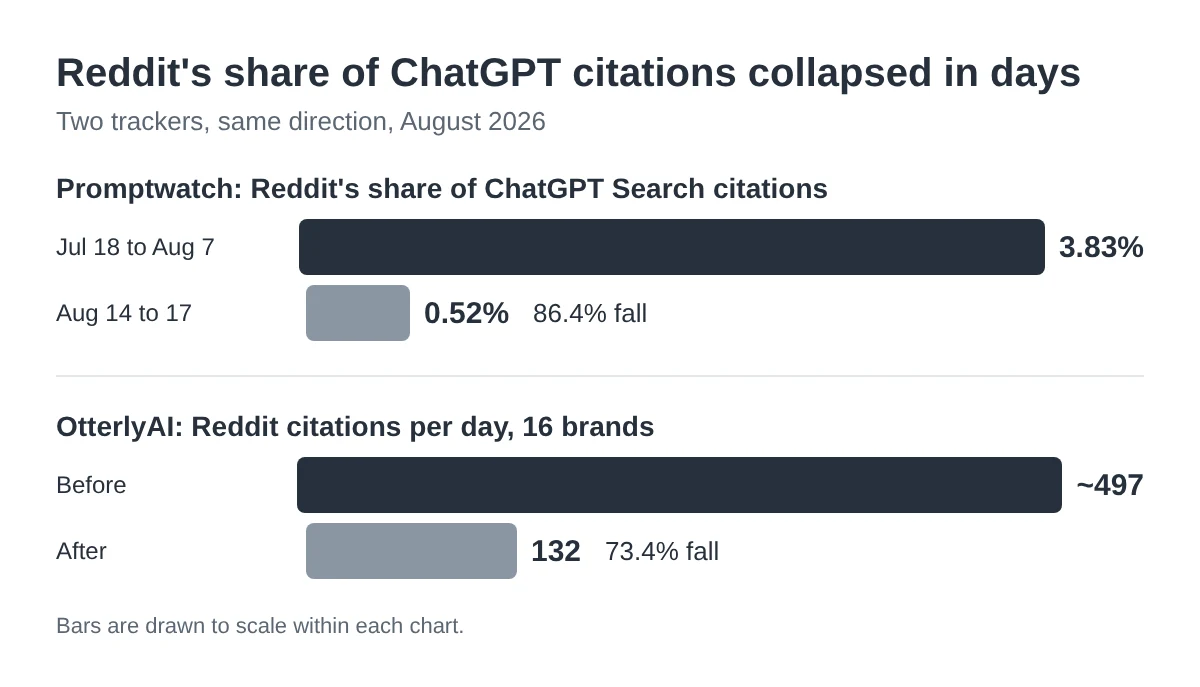
- Promptwatch measured Reddit’s slice of all ChatGPT Search citations shrinking from 3.83% (July 18 to August 7) to 0.52% (August 14 to 17). That’s an 86.4% fall.
- OtterlyAI reviewed reports for 16 brands in unrelated industries. ChatGPT’s Reddit citations dropped 73.4%, from about 497 a day to 132. Every one of the 16 brands lost Reddit citations, and three lost all of them.
OtterlyAI also looked at what took Reddit’s place. Brands’ own official pages, and their competitors’ pages, picked up citations in 10 of the 15 reports where those pages appeared. Reference and encyclopedia sites were up in 4 of the 5 reports that included them.
What these numbers don’t prove: neither tracker can say for certain why the shift happened. Promptwatch said its numbers show “when the shift occurred, not why,” and that it couldn’t fully exclude a problem in its own data. OpenAI hasn’t published anything about citation changes. Treat the timing as a strong signal, not a confirmed cause.
For a brand that relied on Reddit threads to get mentioned, this would have looked like a visibility collapse overnight. Nothing on their own site had to change for it to happen.
Why one AI answer tells you almost nothing
Model updates aren’t the only source of movement. Answers also vary from one run to the next, even when nothing has been updated.
In January 2026, SparkToro’s Rand Fishkin and Gumshoe’s Patrick O’Donnell had 600 volunteers put the same 12 prompts into ChatGPT, Claude and Google’s AI, close to 3,000 times in total. Their findings:
- An identical list of recommendations came back twice less than 1% of the time.
- An identical list in an identical order was rarer still, roughly one time in a thousand.
- Yet some names kept coming back. For hospitals, agencies and consumer brands, certain brands showed up in 60% to 90% of the answers to the same kind of question.
That last point is the useful one.
Your “position” in an AI answer is close to random. How often you appear is not.
Semrush says the same in its own documentation. Because AI answers shift quickly and vary from person to person, it says no tool can produce exact visibility figures.
So the goal isn’t a perfect number. It’s a consistent one.
Consistent beats exact
Think of AI visibility like checking your weight. One reading after a big lunch tells you nothing. The same scale, at the same time of day, every week, shows you the real direction.
The same applies here. You can’t get a true, fixed AI visibility score, but you can measure the same way every time. When the method stays fixed, a change in the result means something changed out in the world, not in how you measured it.
That’s also what makes AI visibility reportable to a client or a leadership team. You stop defending a single screenshot and start showing a trend with context.
How to measure AI visibility when answers keep changing
This is the routine we’d recommend to any business tracking its presence in AI answers.
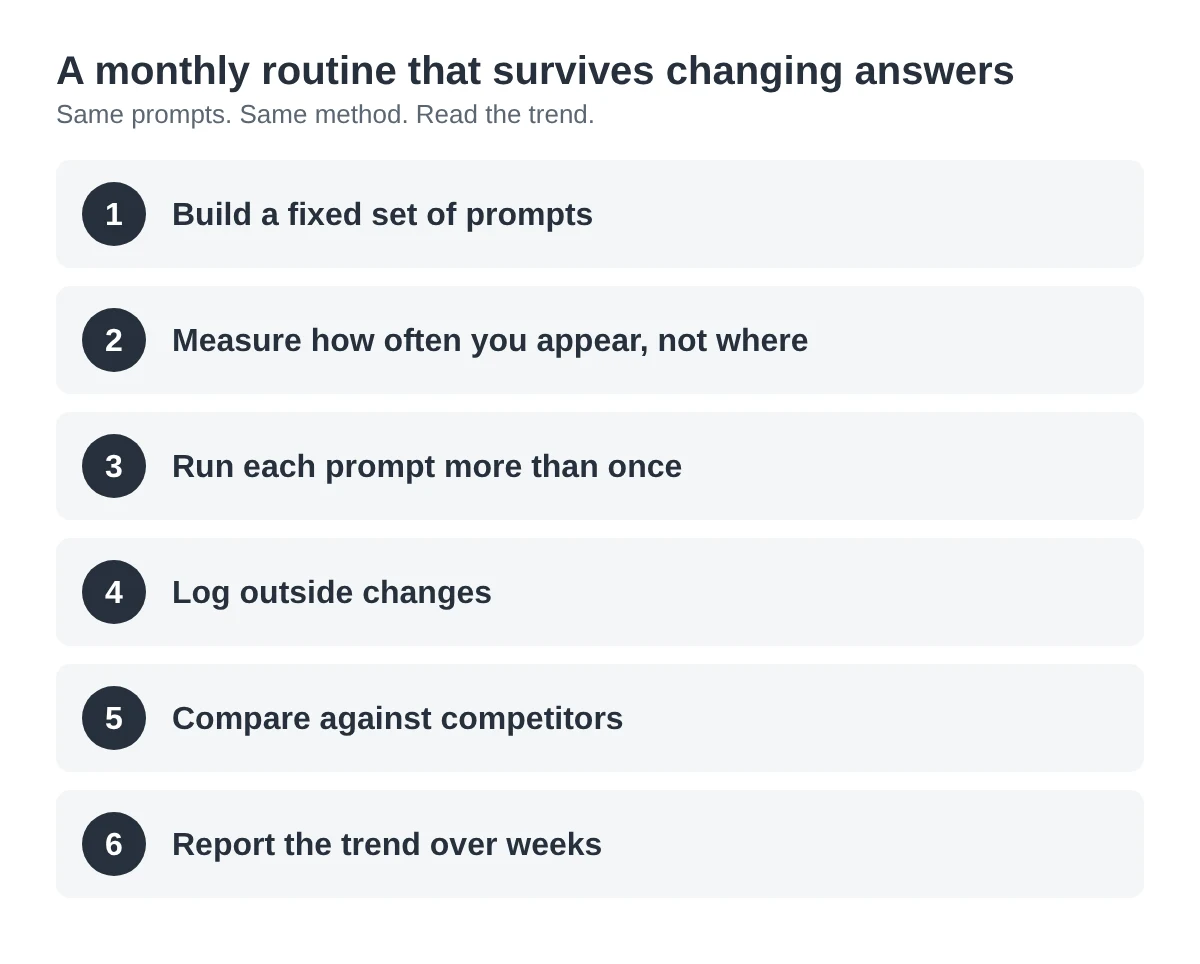
1. Build a fixed set of prompts
Write down the questions your buyers actually ask an AI tool before they’d contact you. Mix broad category questions with specific ones, like comparisons and “best for” questions.
Then lock the list. If you rewrite your prompts every month, you lose the ability to compare one month with the next.
2. Measure how often you appear, not where
For each prompt, record two things: whether your brand is named in the answer, and whether one of your pages is cited as a source.
Your headline number is the share of prompts where you appear. Ignore whether you were listed first or fourth. As the SparkToro research shows, order changes too often to mean much.
3. Run each prompt more than once
One run is a sample of one. Run the same prompt a few times, and in more than one tool, before you record a result.
If you show up in two out of three runs, that’s a different story from showing up once by luck.
4. Keep a log of outside changes
Next to your results, note anything that could explain a jump: model announcements in release notes, Google updates, a site redesign, new reviews or press coverage.
When your numbers move in the same week as a model update, you’ll know where to look first.
5. Compare against competitors, on the same prompts
Your visibility on its own can mislead. If everyone in your category dropped in the same week, the model changed. If only you dropped, something specific to you changed.
Track two or three direct competitors on the same prompt set so you can tell the difference.
6. Report trends over several weeks
Review results monthly and look at the direction over two or three months. Day-to-day swings are mostly noise.
When you report, explain what moved, what likely caused it and what you’re doing next. That’s a far more useful conversation than “we were mentioned 14 times.”
What to do when your AI citations drop
Before you change anything, work through these questions in order:
- Did the model change? Check the AI platform’s release notes for the week your numbers moved.
- Did a whole type of source lose ground? If you relied on one channel, like Reddit threads or third-party listicles, and that channel lost citations across the board, the drop isn’t about your content.
- Did competitors drop too? A category-wide drop points to the model. A drop that only hit you points to your pages or your mentions.
- Are your own pages clear and current? After the August shift, OtterlyAI saw official brand pages gain citations in most reports. Your service pages, pricing, About page and FAQs should state the facts plainly and match each other.
That last point connects to site structure. If your own pages are the clearest source of truth about your business, you’re less exposed when AI tools stop leaning on third-party sites. We cover how to set that up in our guide to site structure and AI visibility.
Spread your risk: don’t depend on one kind of source to get mentioned. A brand that shows up through its own pages, reviews, directories and press coverage is harder to wipe out with one model update.
Tracking it with Semrush
You can run this routine by hand in a spreadsheet. A tool makes the daily runs, competitor comparisons and history much easier to keep up with.
Semrush One includes the AI Visibility Toolkit alongside the SEO Toolkit. According to Semrush’s documentation:
- Prompt Tracking runs your chosen prompts every day across ChatGPT Search, Gemini, and Google’s AI Overviews and AI Mode. This is where your fixed prompt set from step 1 lives.
- Visibility Overview and Competitor Research update daily on a rolling basis, so you can compare your presence with competitors over time.
- Brand Performance refreshes weekly and adds your share of voice plus the tone AI takes when it talks about you.
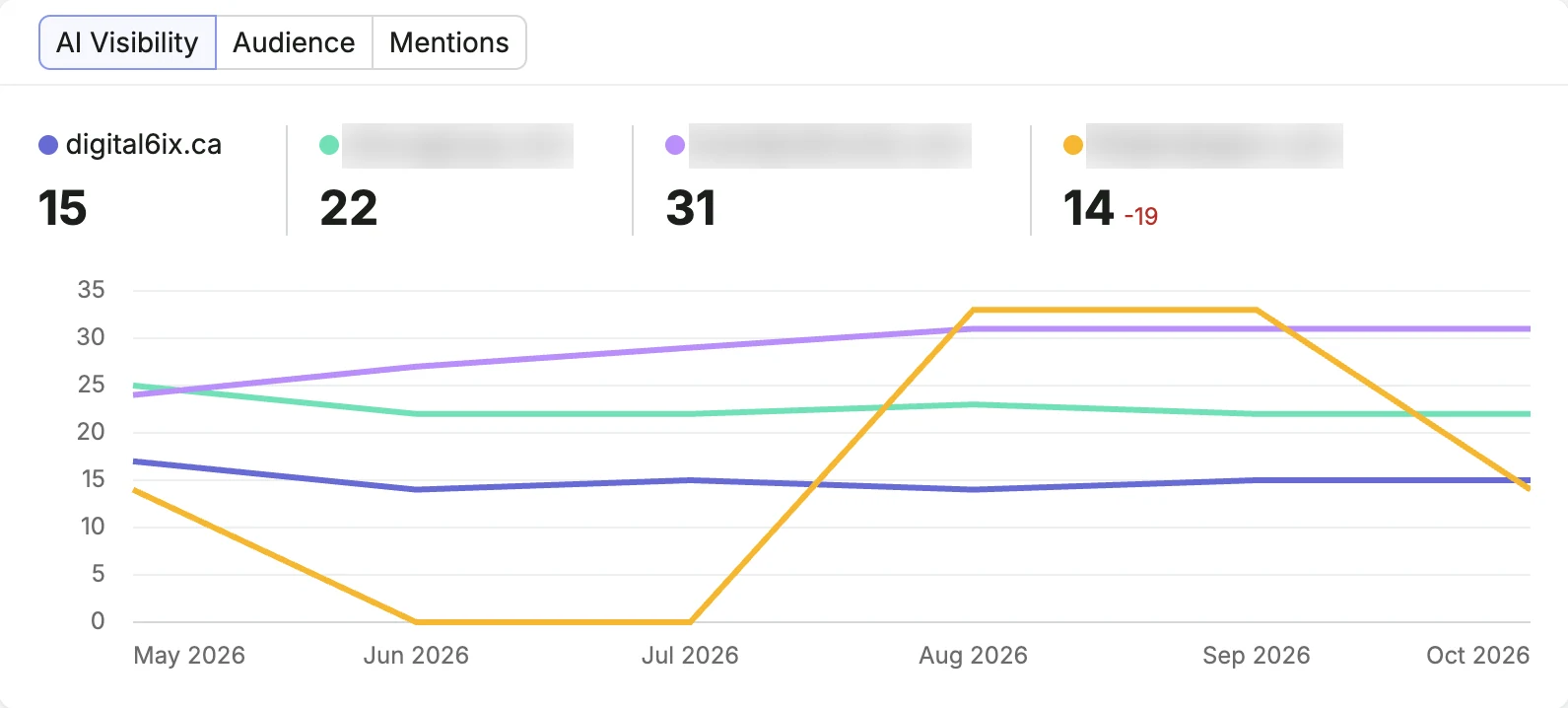
Daily data doesn’t mean you should react daily. Use it to build the monthly trend, and annotate it with the outside changes from step 4.
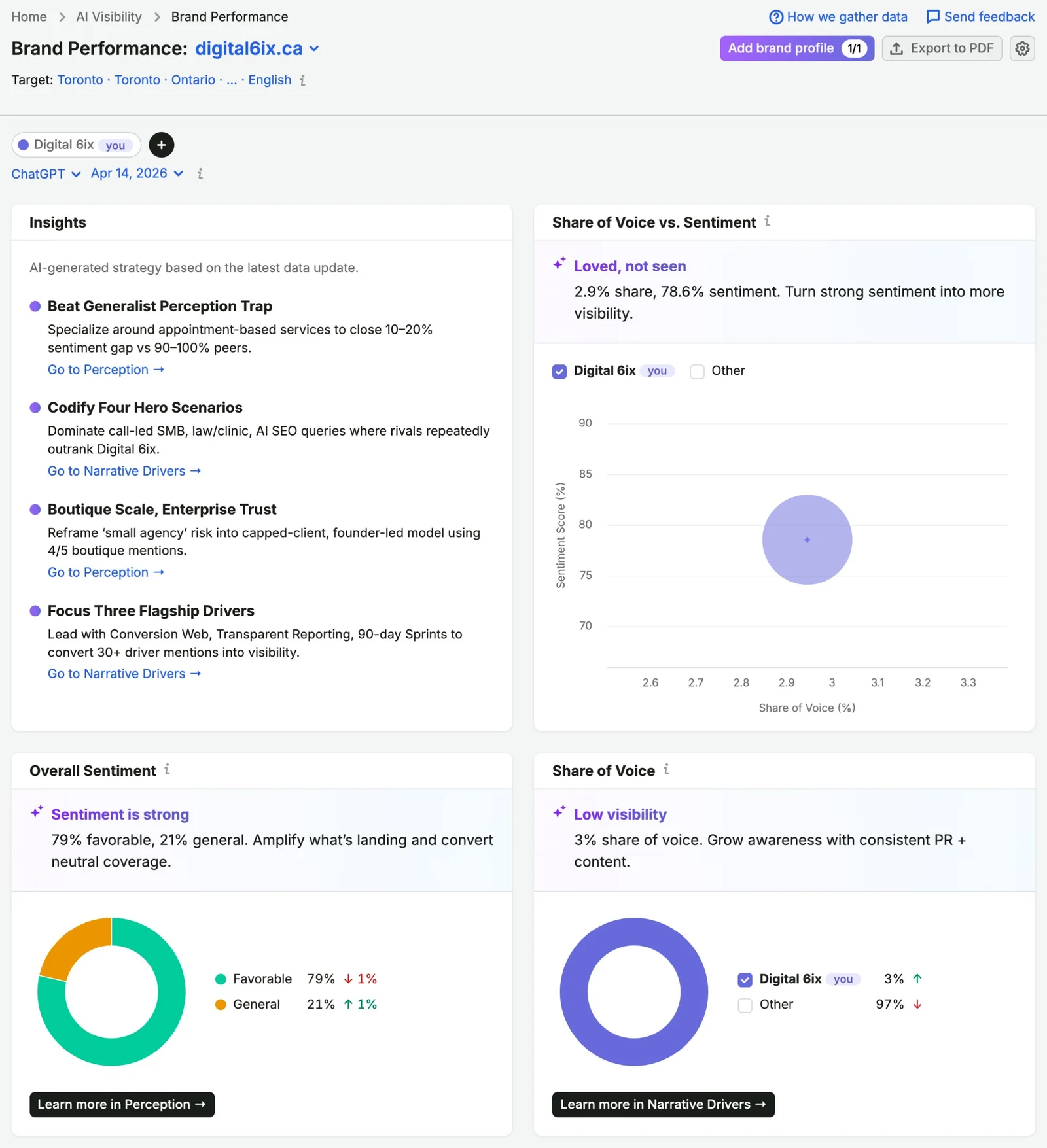
Try it free: new Semrush One accounts get 7 days free. That’s enough time to load your prompt list and capture a first baseline.
Start your free Semrush One trialThis is an affiliate link. If you sign up, Digital 6ix may be paid a commission.
Prefer to start free? Our GEO / AI Visibility Tracker template gives you a simple way to log the same prompts each month, and our Radar scan gives you a quick first read on whether AI recommends you.
Frequently asked questions
Why does ChatGPT give different answers to the same question?
AI tools generate each answer fresh, and the sources they search and cite can change between runs and after model updates. Research from SparkToro and Gumshoe found the chance of getting the same list of recommendations twice was under 1 in 100.
Why did my ChatGPT citations drop in August 2026?
Several AI visibility trackers saw ChatGPT’s citations shift sharply in mid-August 2026, shortly after OpenAI changed its default models. Reddit was hit hardest, while official brand pages gained citations in many reports. The cause hasn’t been confirmed, so check whether your competitors dropped too before changing your content.
What is the best way to measure AI visibility?
Track how often your brand is mentioned or cited across a fixed set of prompts, run each prompt more than once, and compare the results month to month against a few competitors. Your position in a single answer changes too often to be useful.
How often should I check my AI visibility?
Collect data as often as your tools allow, but review it monthly and judge it over two or three months. Day-to-day changes are mostly noise.
Can any tool give exact AI visibility numbers?
No. Semrush’s own documentation says AI answers change too quickly and vary too much between users for any platform to report exact figures. What a tool can give you is a consistent method, and that’s what makes the trend meaningful.
Measure the trend, not the moment
AI answers will keep changing. Models will keep updating, and sources will rise and fall.
You can’t control that. You can control how you measure it.
Same prompts. Same method. Read the trend.
Get your first AI visibility baseline
Every trend starts with a first data point. Run a free Radar scan: in about half a minute you’ll know if AI tools recommend your business, which competitors they mention instead, and three things to fix first.
No sign-up required. Results in seconds.
Get my free baseline →
About the author
Simar Singh leads Digital 6ix, a Toronto SEO, GEO and content agency. His focus is a simple question: what do ChatGPT, Gemini, Perplexity and Google’s AI answers say about a business, and how can that be improved? Free templates from the Digital 6ix team are at digital6ix.ca/templates, and Simar shares more on LinkedIn.
Sources
- OpenAI: ChatGPT release notes (August 6, 2026)
- Search Engine Land: Reddit’s ChatGPT Search citations fell 86% in four days (Promptwatch data)
- OtterlyAI: ChatGPT cut Reddit citations by at least 73% in August 2026
- Search Engine Land: AI recommendation lists repeat less than 1% of the time (SparkToro and Gumshoe study)
- Semrush help center: Where the AI Visibility Toolkit gets its data
- Semrush help center: What is Semrush One?
Free 30-second AI check
Want a quick baseline before you set up tracking? Radar takes about 30 seconds and shows whether AI recommends you and who it names instead.
Scan my businessTalk to us about tracking
Need help building a prompt set or reporting AI visibility to leadership? Book a call and we will walk through it with you.
Book a call