
Same Brand, Different Story: Why How AI Describes Your Brand Shapes Your Pipeline
The short answer: AI brand mentions only help when the description is right. When ChatGPT, Perplexity, Gemini or Google’s AI Overviews mention you, they also tell the buyer what you do, who you’re for and who you compete with. If that story is wrong, more mentions can send the wrong buyers your way and keep the right ones from shortlisting you.
This guide explains why how AI describes your brand matters more than how often it mentions you, how to check what AI says about your brand, and how to change it.
Why AI mention counts only tell half the story
Most teams that track AI search watch the same numbers:
- How often AI mentions the brand
- How often it cites the brand’s pages
- Share of voice against competitors
These numbers are useful. They tell you whether you show up at all.
But they skip the question that decides whether a mention helps you: what did AI actually say about you? A brand can be mentioned in hundreds of answers and still be described as something it isn’t. When that happens, the count goes up while the story works against you.
What every AI mention tells a buyer about your brand
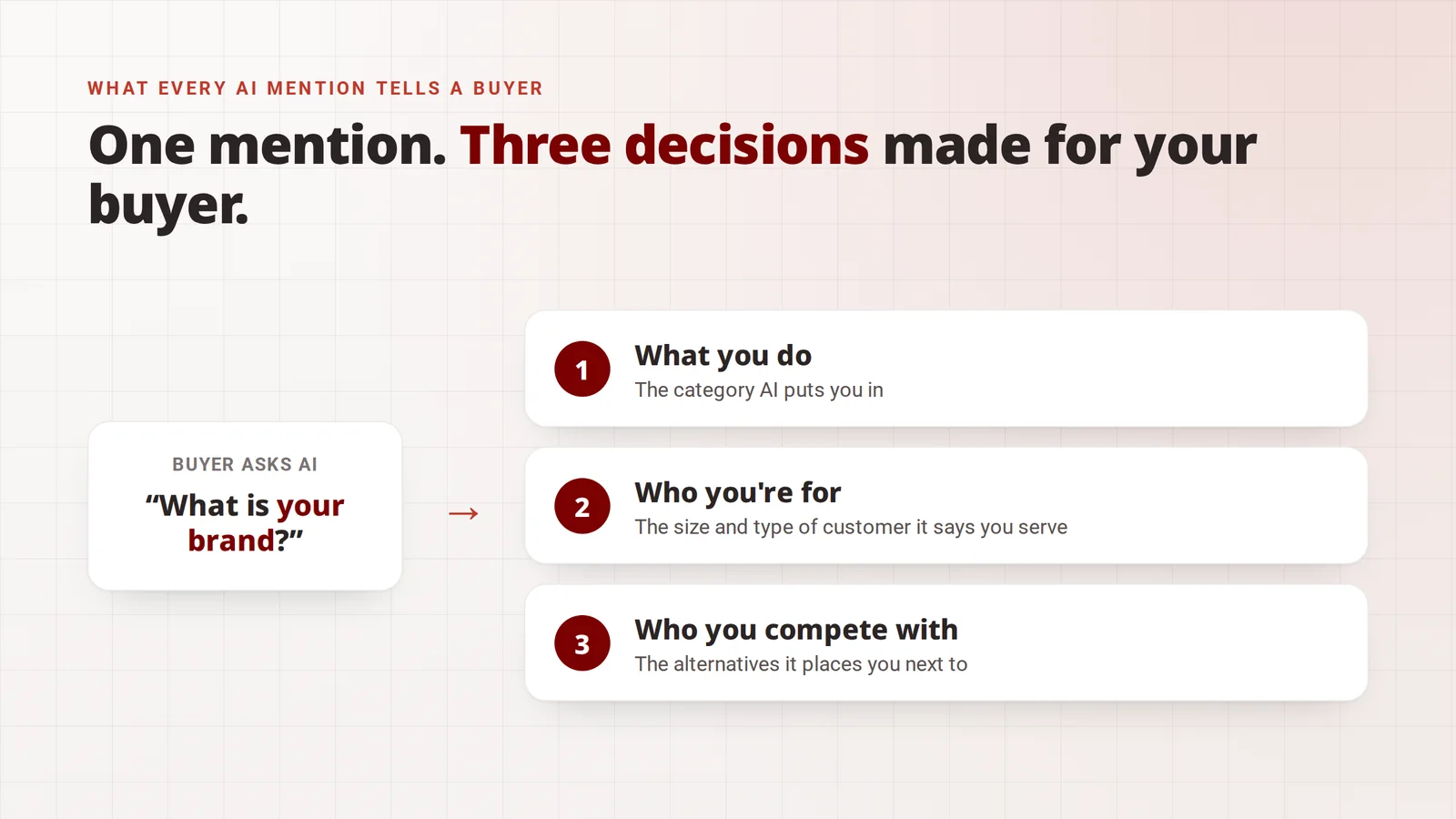
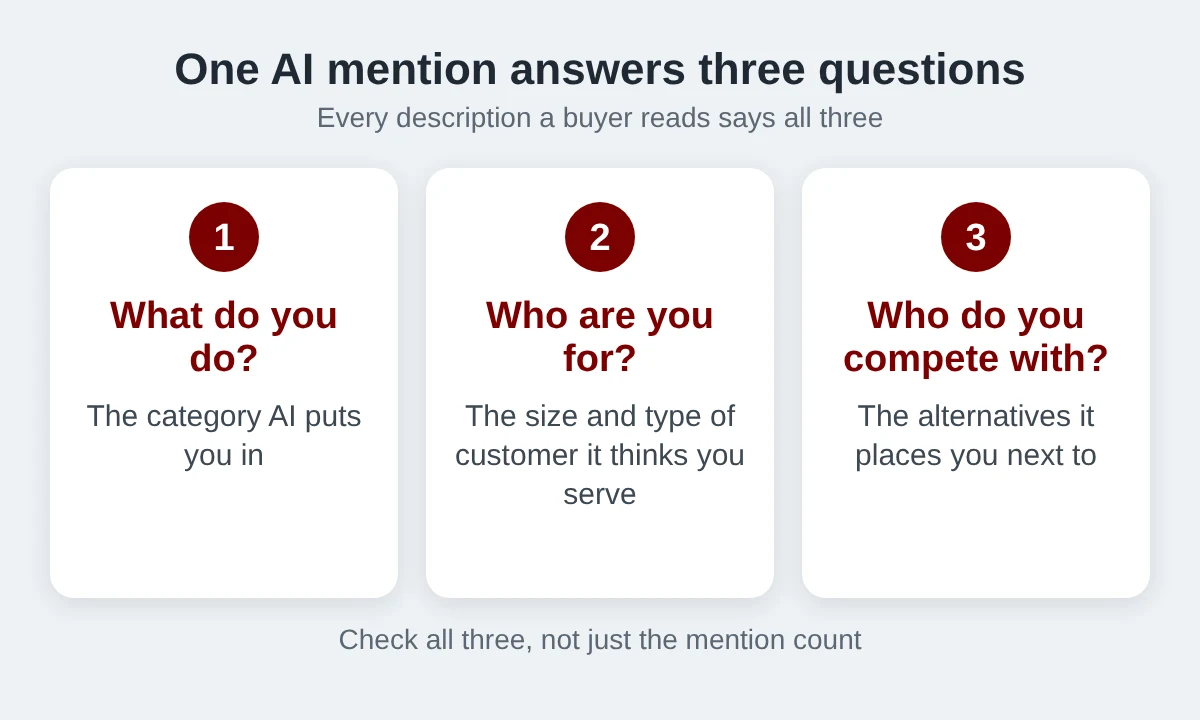
When a buyer asks ChatGPT, Perplexity, Gemini or Google’s AI Overviews about your company, the answer rarely stops at your name. It adds a short description, and that description quietly answers three questions for the buyer:
- What do you do? The category AI puts you in.
- Who are you for? The size and type of customer AI thinks you serve.
- Who do you compete with? The alternatives AI places you next to.
You don’t write that description. AI pieces it together from what it can find and understand about you: your own website, reviews, directories, articles, comparison pages and forum threads.
If those sources tell a clear, consistent story, AI is more likely to repeat it. If they are vague, outdated or contradictory, AI may fill the gaps with the simplest version it can find. That version is often the wrong one.
Examples: the same brand, two AI descriptions
The mismatch is easiest to see with brands everyone knows. The examples below are illustrative, written to show the pattern. They are not copied from real AI answers. Each “right story” is based on how the company describes itself.
| Brand | ✕ The wrong story | ✓ The right story |
|---|---|---|
| Salesforce | A contact database where sales reps log calls and update deal stages. Seen as admin work for the sales team, compared with spreadsheets and basic contact managers. | An AI CRM platform that connects sales, service, marketing, commerce and data in one system, with Agentforce AI agents built in. Serves companies of all sizes, up to large global enterprises. |
| Shopify | A website builder that helps small sellers and side hustles set up a first online store. Compared with Wix and Squarespace. | A commerce platform used by new sellers and by high-growth and enterprise brands such as Gymshark, Glossier and ALDO. Runs online storefronts, in-store POS and B2B selling from one system. |
| Semrush | A keyword research tool for SEO freelancers and bloggers who want to check rankings and backlinks. Compared with free keyword tools. | A brand visibility platform, now part of Adobe, covering AI search, SEO, PPC, content, local and social, for freelancers and agencies up to enterprise marketing teams. |
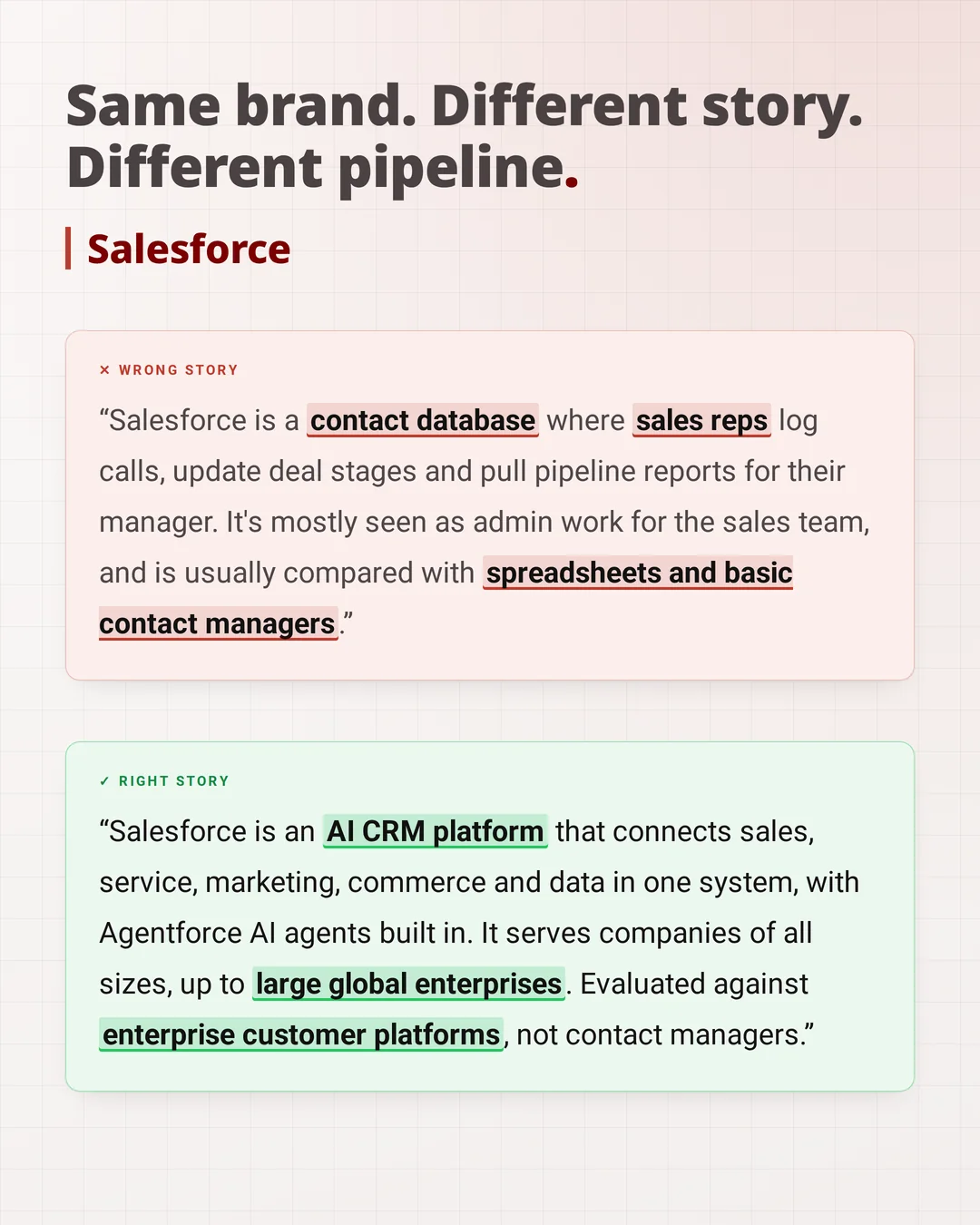
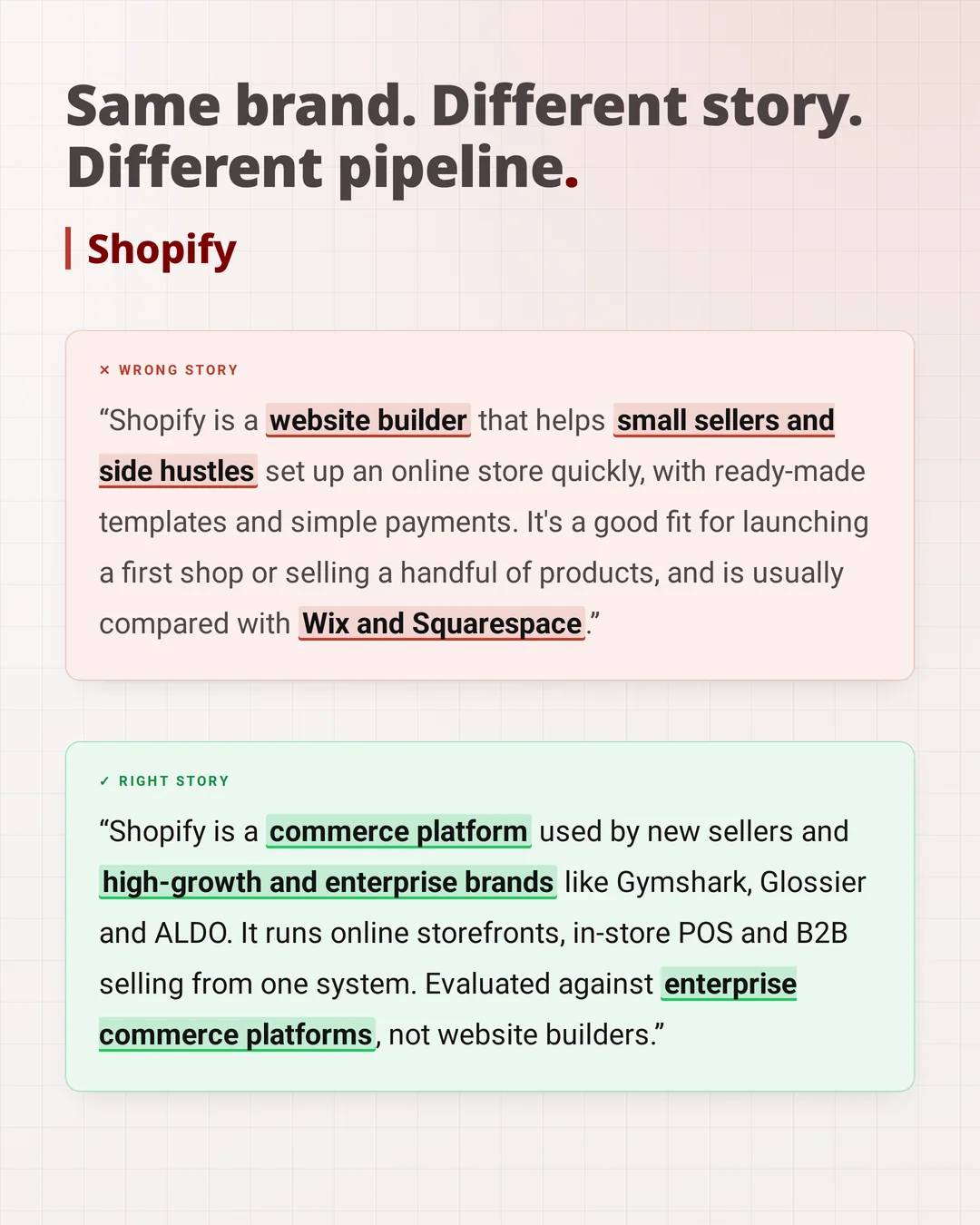
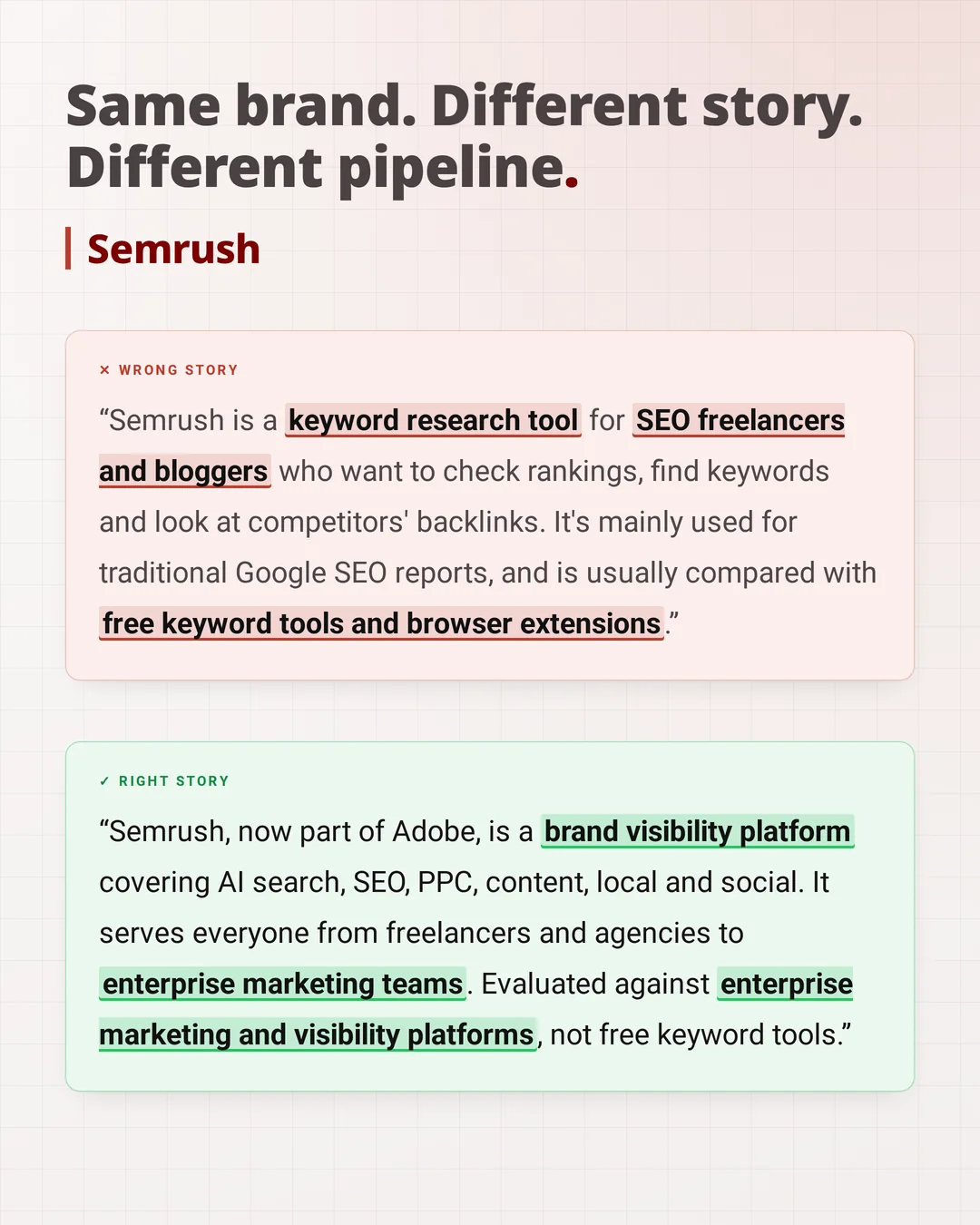
Illustrative examples, not captured AI output. Tap an image to view it full size.
In every case the brand is still mentioned. The wrong story puts it in a smaller category, in front of a smaller buyer, next to cheaper alternatives. A buyer reading it would have little reason to shortlist the company for a serious evaluation.
Why the wrong AI description costs you pipeline
A wrong description does its damage before anyone reaches your website.
When a buyer uses an AI answer to build a first shortlist, they often don’t click through to double-check a short description. They take it at face value and move on to the options that sound like a better fit for their size, budget and problem.
That creates three quiet costs:
- You miss the right buyers. An enterprise team reading “tool for freelancers” may never add you to the list.
- You attract the wrong ones. Smaller buyers show up expecting a cheaper, simpler product, and the deal stalls on price or fit.
- You get compared on the wrong terms. Next to low-cost alternatives, your price looks high and your depth looks unnecessary.
None of this shows up as a lost deal in your CRM. There is no email, no feedback form and no rejection to learn from. You may never know it happened.
This is also why chasing more mentions can backfire. If the story is wrong, more mentions just repeat the wrong story to more buyers.
How to check what AI says about your brand
You can run this check yourself in under an hour. Use the tools your buyers are likely to use: ChatGPT, Perplexity, Gemini, Claude and a Google search that triggers an AI Overview.
- Ask the direct question. “What is [your brand]?” and “Who is [your brand] for?”
- Ask the comparison question. “What are the alternatives to [your brand]?” and “[Your brand] vs [your main competitor].”
- Ask the buyer’s question. Describe your ideal customer’s problem without naming yourself, for example “best [category] for a mid-market SaaS team”, and see whether you appear and how.
- Read the sentences, not just the mentions. For each answer, write down three things:
- The category AI puts you in
- The customer size and type it says you serve
- The brands it compares you with
- Compare against your own positioning. Anywhere the answer’s category, buyer or comparison set differs from yours is a gap worth fixing.
Answers vary between tools and between runs, so repeat the prompts a few times and look for the pattern rather than a single response.
To log the results over time, use our free GEO / AI Visibility Tracker template. It has no email wall and tracks whether ChatGPT, Perplexity and Google name your business.
What story is AI telling about your brand?
Run four prompts, then rate what came back. Takes about ten minutes. Nothing you enter leaves this page.
- What is [your brand] and who is it for?
- What are the best alternatives to [your brand]?
- Best [your category] for a growing company
- Is [your brand] a good fit for a mid-size team?
How to change how AI describes your brand
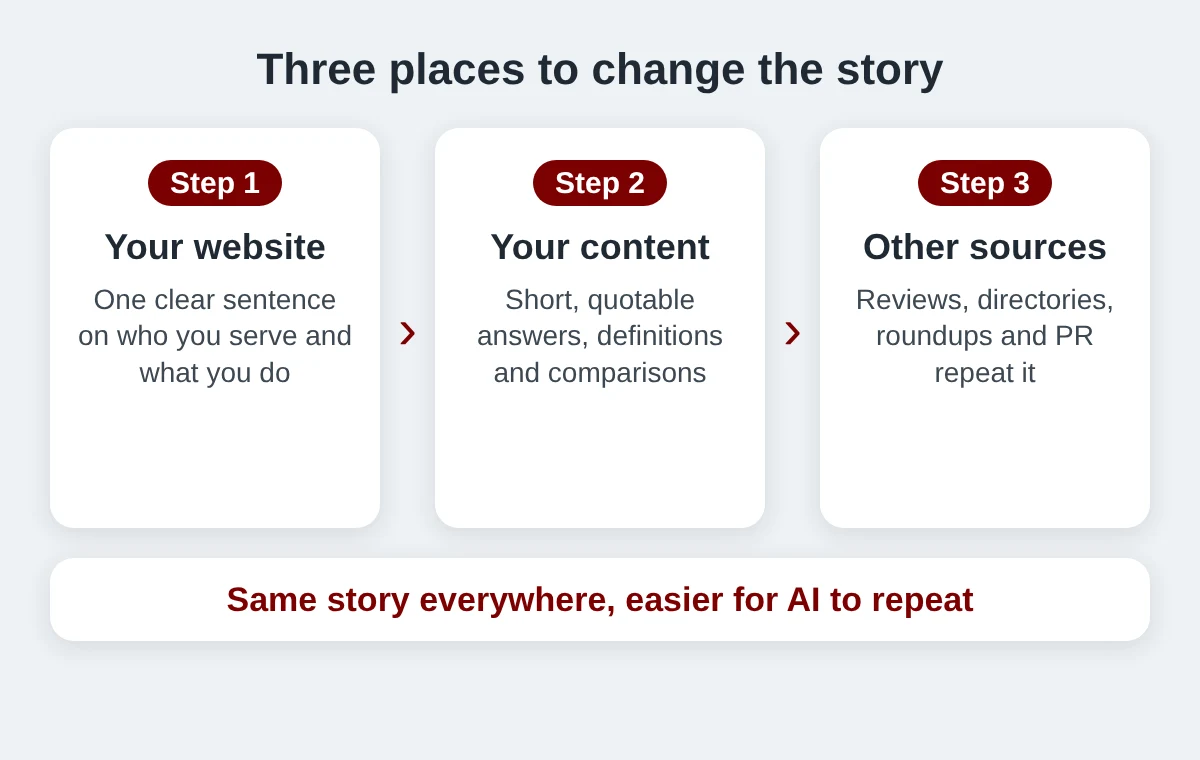
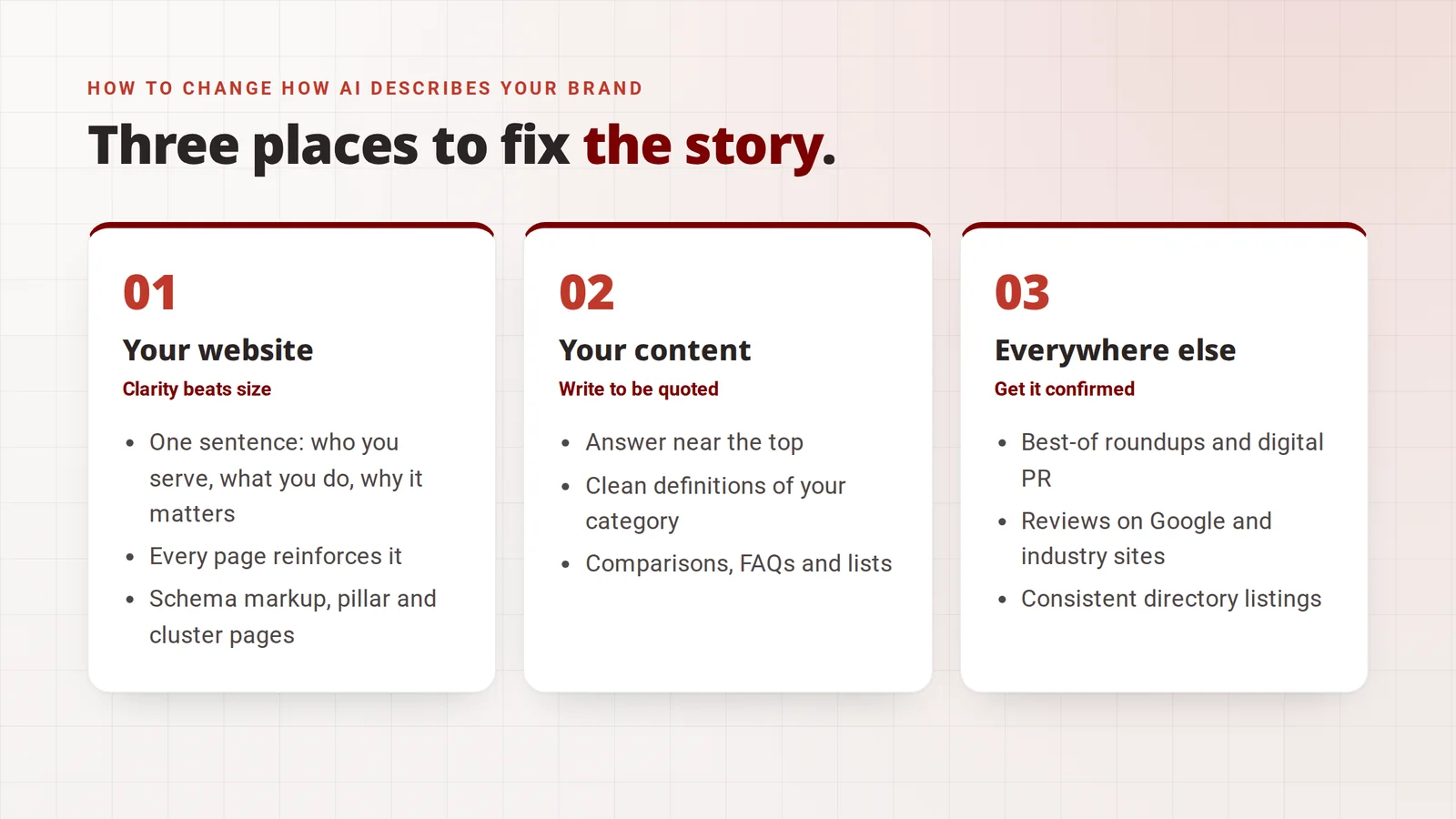
You can’t edit an AI answer directly. You can change the sources it learns from, so the right story becomes the easiest one to find and repeat. This is the core of generative engine optimization (GEO), and the work happens in three places.
1. Make your website say one thing, clearly
Write one sentence that defines who you serve, what you do and why it matters. Put it on your homepage, and make every other page reinforce it rather than drift from it. Add schema markup so machines can read the key facts about your company, and organise content into clear pillar and cluster pages. A clear story beats a big website.
2. Write content that is easy to quote
AI systems lift short, self-contained passages. Put the summary or answer near the top of each page. Answer questions directly. Write clean definitions of your category and product, and publish comparisons, FAQs and lists that state who you are for and who you compete with. Don’t bury the point.
3. Get the same story confirmed off your site
AI trusts a story more when other sources repeat it. Aim for inclusion in relevant best-of roundups, contribute expert commentary through digital PR, collect reviews on Google and industry platforms, and keep your listings consistent across directories. Every outside source that describes you the same way makes the right story harder to ignore.
Want to see how these steps fit together in a real engagement? Read how our GEO process works.
Frequently asked questions
Do more AI mentions mean more pipeline?
Not on their own. A mention helps only when AI describes your brand in the right category, for the right buyer, next to the right competitors. If the description is wrong, more mentions repeat the wrong story to more buyers.
Can you control what ChatGPT says about your brand?
Not directly. You can influence it by making your website clear and consistent, publishing content that is easy to quote, and getting the same description confirmed by reviews, directories, roundups and media coverage.
What is generative engine optimization (GEO)?
Generative engine optimization is the work of helping AI systems such as ChatGPT, Perplexity, Gemini and Google’s AI Overviews find, understand and accurately describe your business, so you are cited and recommended in their answers.
How often should you check how AI describes your brand?
Monthly is a practical starting point. AI answers change as models update and new content is published, so a regular check with the same prompts shows whether your story is improving or drifting.
Which AI tools should you check?
Start with the tools your buyers are most likely to use: ChatGPT, Perplexity, Gemini, Claude and Google searches that show an AI Overview. Run the same prompts in each and compare the category, buyer and competitors each one names.
Count your mentions. Then read them.
Being mentioned by AI is the start, not the finish. The mentions that help are the ones that describe you in the right category, for the right buyer, next to the right competitors.
Same brand. Different story. Different pipeline.
Find out what AI is telling your buyers right now
Your buyers may already be asking AI about your category. Right now, you don’t know if you’re in the answer, or what it says you are.
Stop guessing. Run a free Radar scan of your business in 30 seconds. See whether AI recommends you, who it names instead, and three quick wins to fix it.
No sign-up. No email. Instant results.
Run my free Radar scan →
About the author
Simar Singh is the founder of Digital 6ix, a Toronto-based SEO, GEO and content marketing agency. He helps businesses get found, cited and described accurately in AI answers from ChatGPT, Perplexity, Gemini and Google’s AI Overviews. Digital 6ix publishes its working audit and content-planning templates for free at digital6ix.ca/templates. Connect with Simar on LinkedIn.
Instant AI visibility scan
Run a 30-second test scan of your business with Radar. See if AI recommends you, who it names instead, and three quick wins to fix it.
Run my free scanBook a free audit call
Want a deeper review? We will walk through your AI visibility, what competitors are doing, and where to start.
Book my call