
Claude Searches Up 378%, ChatGPT Down 35%: What AI Search Demand Really Tells You
The short answer: Between September 2025 and September 2026, US searches for “Claude” grew almost five times over, while searches for “ChatGPT” fell 35%, according to Ahrefs data. That doesn’t mean people stopped using ChatGPT. OpenAI reported its weekly users kept growing. Search volume shows how many people look a tool up, not how many use it. For brands, the lesson is twofold: don’t read branded search as usage, and make sure your AI visibility tracking includes Claude.
We pulled a year of US search data for the biggest AI assistants.
One number jumped out. A second one made us look again.
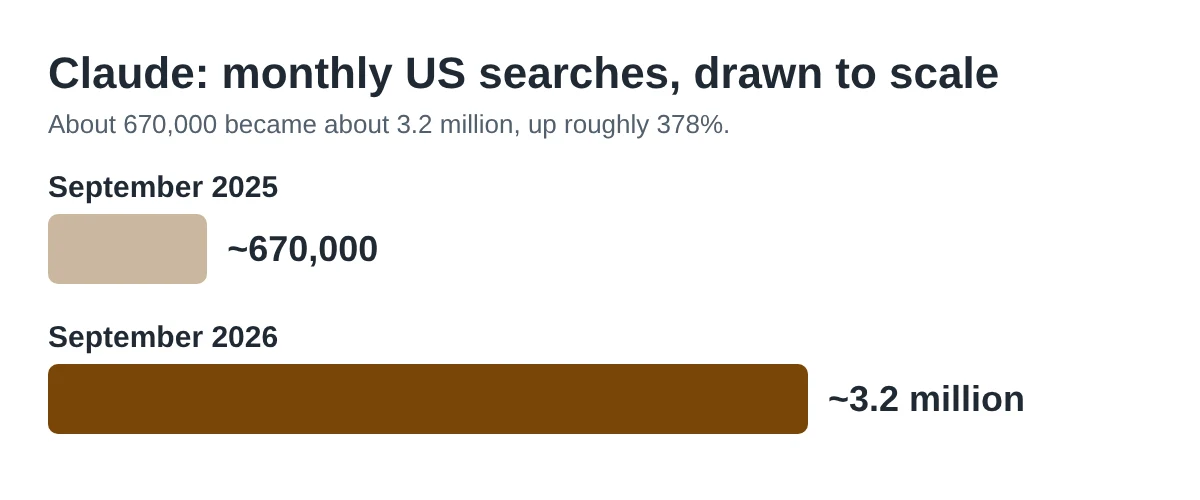
Searches for Claude grew almost five times over.
Searches for ChatGPT fell by more than a third.
It’s tempting to read that as “people are leaving ChatGPT.” The usage figures say otherwise.
This post covers what the numbers show, why search demand and usage moved in opposite directions, and what it means for where you track your brand in AI answers.
AI assistant search demand, September 2025 vs September 2026
Here’s how US monthly search volume for each assistant’s name changed over 12 months.
| AI assistant | Sept 2025 | Sept 2026 | Change |
|---|---|---|---|
| Claude | 670K | 3.2M | +378% |
| Grok | 1.2M | 2.3M | +92% |
| Gemini | 10.9M | 12.1M | +11% |
| Copilot | 2.4M | 2.2M | -8% |
| ChatGPT | 39.7M | 25.8M | -35% |
| Character.ai | 2.1M | 752K | -64% |
Source: Ahrefs Keywords Explorer, US monthly search volume for each brand term, September 2025 vs September 2026. Percentages are calculated from the rounded volumes shown.
A few details sit under the headline numbers:
- “Google Gemini” rose 5% and “Gemini AI” rose 6%, with a bump in September.
- “Microsoft Copilot” on its own rose 9%, even though total Copilot searches fell.
- Character.ai stepped down in February 2026 and never recovered.
- Meta AI fell 13%.
- Perplexity and DeepSeek are left out. Ahrefs returned flat placeholder values for both terms for most of 2026, so the numbers can’t be trusted.
Claude went from under a million searches a month to more than three million. No other assistant changed scale like that.
Why ChatGPT searches fell while usage kept growing
If search volume tracked usage, ChatGPT would be shrinking.
It isn’t.
OpenAI said ChatGPT had 800 million weekly users in October 2025. By February 2026, it reported 900 million.
So why are fewer people searching for it?
Most people who type a tool’s name into Google aren’t researching it. They’re using Google as a shortcut to get there.
Once a tool becomes a habit, that shortcut isn’t needed. People:
- open the app on their phone
- type the address straight into the browser
- click a bookmark or a pinned tab
- reach it from inside another product they already use
None of those visits show up as a search.
Key point: Branded search measures curiosity and navigation. It doesn’t measure usage. A tool people use every day can lose search volume while its user base grows.
Gemini’s modest growth may reflect the same thing. Many people meet Gemini inside Google products they already have open, so they never need to search for it by name.
This is our read of the data. Search numbers alone can’t prove why people stopped searching. But they clearly can’t prove people stopped using ChatGPT either.
Claude’s jump is a different story
Claude’s rise isn’t a shortcut effect. It looks like new people looking it up for the first time.
That lines up with what happened in early 2026:
- Anthropic ran Super Bowl ads in February. TechCrunch reported they helped push the Claude app into the top 10.
- Anthropic was in the headlines for weeks over a public dispute with the US Department of Defense. Card-transaction data analysed for TechCrunch by Indagari showed new users climbing fastest during that stretch.
- An Anthropic spokesperson told TechCrunch that Claude’s paid subscriptions had more than doubled since January. TechCrunch also pointed to Claude Code as a driver.
Some of that new demand will settle into habit too. When it does, Claude searches may flatten the way ChatGPT’s did. That won’t mean people stopped using it.
For brands, the takeaway is simple.
A growing group of people now ask Claude for answers. Some of them may be your buyers.
The tracking gap: is anyone watching Claude?
A lot of AI visibility tracking was set up when ChatGPT was the assistant that mattered most, with Google’s AI features close behind.
Many setups still look like that.
Take Semrush, one of the most widely used SEO platforms. Its own documentation lists the engines its AI Visibility Toolkit covers:
- Prompt Tracking: Google AI Mode, AI Overviews, Gemini and ChatGPT Search
- Brand Performance: Google AI Mode, ChatGPT, Perplexity and Gemini
Claude isn’t on either list.
That isn’t a knock on one tool. Coverage varies a lot across AI visibility platforms and plans, and it changes often. Some include Claude. Some only on higher tiers. Some not at all.
The point is to check.
If your dashboard says your AI visibility is strong, ask: strong where?
Watch out: if Claude isn’t in your tracking, you can’t see whether it recommends you, ignores you or describes you wrong. That blind spot gets bigger as Claude’s audience grows.
How an assistant describes you matters as much as whether it mentions you. We covered that in Same Brand, Different Story.
When we test Digital 6ix’s own visibility, we check ChatGPT, Claude, Perplexity and Gemini side by side. The answers don’t always match.
What to do with this data
You don’t need to rebuild your tracking. You need to point it at the right places.
1. Stop treating branded search as a usage number
When you report on AI platforms, or on your own brand, don’t read a drop in searches as a drop in interest. Check usage figures, referral traffic or direct visits before you draw a conclusion.
2. Find out which assistants your buyers use
Look at referral traffic in GA4 from chatgpt.com, claude.ai, perplexity.ai and gemini.google.com. Add AI assistants as options in your “How did you hear about us?” question. Ask new clients on sales calls.
3. Add Claude to your checks
If your tool doesn’t cover Claude, run your key prompts in it by hand once a month. Log the results next to your tool’s data.
4. Report each assistant on its own
A single blended “AI visibility” score can hide a gap. Strong in ChatGPT and missing in Claude is a different problem from average everywhere.
5. Review the mix every quarter
This data shows how fast the picture moves. An assistant that was small a year ago can grow its search demand almost fivefold in twelve months. Recheck which tools you track at least once a quarter.
For the monthly routine itself, including fixed prompts, repeat runs and competitor comparisons, see our guide to measuring AI visibility when answers keep shifting.
What this data can and can’t tell you
Search data is useful. It’s also easy to over-read. Keep these limits in mind:
- It’s US only. Other markets may look very different.
- It compares one month with one month. A single September can include one-off spikes, like the bump in “Gemini AI”.
- Volumes are estimates. Tools like Ahrefs model search volume. They don’t count every search.
- It only covers brand names. People who use a tool without searching its name don’t appear here.
- Two big names are missing. Perplexity and DeepSeek returned unreliable data, so we left them out rather than guess.
Read it as a signal of attention, not a scoreboard of users.
Frequently asked questions
Are fewer people using ChatGPT in 2026?
There’s no sign of that. OpenAI reported 900 million weekly users in February 2026, up from 800 million in October 2025. US searches for “ChatGPT” fell 35% over the year, which more likely reflects people going straight to the app or website instead of searching for it.
How much did searches for Claude grow?
US monthly searches for “Claude” rose from about 670,000 in September 2025 to about 3.2 million in September 2026, according to Ahrefs data. That’s an increase of roughly 378%, and Claude was the only assistant in this comparison to move from under a million searches a month to several million.
Does branded search volume show how popular an AI tool is?
Only partly. It shows how many people look a tool up by name. People who open the app, type the address or use a bookmark don’t show up, so a well-established tool can lose search volume while its user base grows.
Should I track my brand’s visibility in Claude?
If your buyers might use it, yes. Claude’s audience grew quickly in 2026, and not every AI visibility tool or plan covers it. If yours doesn’t, run your key prompts in Claude by hand each month.
Which AI assistants should a business monitor?
Start with ChatGPT, Google’s AI Overviews and AI Mode, Gemini, Claude and Perplexity. Then adjust based on where your own referral traffic and customers come from, and review the list every quarter.
Follow the users, not the searches
Search volume tells you who’s curious. It doesn’t tell you who’s using what.
ChatGPT’s searches fell while its users grew. Claude’s searches soared as a new audience found it.
Both are worth reading carefully. Neither is a reason to guess.
Find out where your buyers actually ask. Then make sure you’re watching there.
Searches show curiosity. Usage shows habit. Track where your buyers ask.
See what AI tells your buyers today
Different assistants can give very different answers about the same business. Most companies only ever check one.
Start with a free Radar scan. In about 30 seconds you’ll see whether AI recommends you, which competitors it suggests instead, and three fixes worth making first.
No sign-up and no email needed.
Scan my business free →
About the author
Simar Singh founded Digital 6ix, a Toronto agency for SEO, GEO and content. The question he works on with clients: when buyers ask ChatGPT, Claude, Gemini or Google’s AI for a recommendation, does the business show up, and is it described correctly? The team’s free planning and audit templates live at digital6ix.ca/templates. Follow Simar on LinkedIn.
Sources
- Ahrefs Keywords Explorer (US search volume, September 2025 vs September 2026)
- TechCrunch: ChatGPT reaches 900M weekly active users (February 27, 2026)
- OpenAI: Scaling AI for everyone
- TechCrunch: Anthropic’s Super Bowl ads helped push Claude’s app into the top 10 (February 13, 2026)
- TechCrunch: Anthropic’s Claude popularity with paying consumers is skyrocketing (March 28, 2026)
- Semrush help center: Where the AI Visibility Toolkit gets its data
Free AI visibility scan
In about 30 seconds, Radar shows whether AI tools recommend your business, who they suggest instead, and three fixes to start with.
Start my free scanNot sure which AI tools to watch?
Book a free call. We’ll look at where your buyers come from and which assistants are worth tracking for your business.
Book a free call