
Your Real Search Market: The 10 Questions Buyers Ask Before They Choose You
The short answer: Your real search market is every question a buyer asks on the way to a decision, not just the people typing your name. Before buyers search for you, they ask about comparisons, alternatives, pricing, reviews, use cases and more. If your content only answers questions about your brand, you’re invisible for most of the journey, in Google and in AI answers.
Most businesses think their search market is the people typing their name. That’s the smallest slice of it.
This guide breaks down the 10 question types hiding in every buying journey, what content answers each one, and how to find the gaps in yours.
Your real search market is every question, not your name
Behind a single buyer, you’ll find questions like:
- “Best accounting software for small business.”
- “QuickBooks vs Xero.”
- “What’s cheaper than QuickBooks?”
- “Is Xero actually any good?”
- “Accounting software for freelancers.”
And that’s just five. Map them all out and you get something like this:

Every one of those is a moment where a buyer is deciding. You’re either part of that decision, or you’re invisible.
Why most brands only show up for their own name
Search your own brand name and you’ll probably rank first. It feels like SEO is working.
But a buyer who types your name has usually done most of their research already. They found you somewhere else first: a comparison, a review, a “best for” list, an AI answer.
Branded search mostly captures demand you’ve already earned. It rarely creates new demand.

Most brands only ever show up for one question: their own name. The rest is the market they can’t see. And it’s the market their competitors are quietly winning.
If your content strategy doesn’t map to these question types, you’re not doing SEO. You’re doing brand protection.
The 10 question types buyers ask before they decide
Here are the 10 core question types, using accounting software as the example. QuickBooks and Xero are only there to show the pattern. Swap in your own category and it holds.
1. Comparisons
Buyer asks“QuickBooks vs Xero”
The buyer has a shortlist and wants a tie-breaker. They want the differences, not another feature list.
What to publish: Honest “[you] vs [competitor]” pages. Compare price, fit and trade-offs side by side, including where the other option wins.
2. Alternatives
Buyer asks“What’s cheaper than QuickBooks?”
The buyer knows the big name and isn’t sold on it. Price, complexity or fit is pushing them to look around.
What to publish: “[competitor] alternatives” pages that include you and a few others, with who each one suits best.
3. Pricing
Buyer asks“How much does QuickBooks cost?”
The buyer is checking whether you’re even in budget. If they can’t find a number, some will simply move on.
What to publish: A clear pricing page, or a pricing explainer if your work is quoted: what it costs, what changes the price and what is included.
4. Reviews
Buyer asks“Is Xero actually any good?”
The buyer wants proof from someone who isn’t you.
What to publish: Case studies and a reviews page on your site, and keep reviews coming in on Google and the platforms your industry trusts.
5. Use cases
Buyer asks“Accounting software for freelancers”
The buyer wants to know if this works for someone like them.
What to publish: One use case or industry page for each segment you actually serve, with examples from that segment.
6. Best for X
Buyer asks“Best accounting software for small business”
The buyer is building a shortlist from scratch. This is often where listicles and AI answers do the choosing.
What to publish: Your own “best [category] for [segment]” guides, and work on getting included in the third-party roundups that already rank.
7. Problems and solutions
Buyer asks“How do I track business expenses?”
The buyer has a problem and may not know your category exists yet.
What to publish: Guides that solve the problem first, then show where a product or service like yours fits.
8. Mistakes to avoid
Buyer asks“Bookkeeping mistakes small businesses make”
The buyer is nervous about getting it wrong. They want to learn from other people’s mistakes.
What to publish: Mistakes and red-flag lists drawn from what you see with real customers.
9. How-to
Buyer asks“How to do your own bookkeeping”
The buyer wants to understand the work before they pay for help with it.
What to publish: Step-by-step tutorials. Teach the process, and you become the name attached to it.
10. Who should use this
Buyer asks“Is QuickBooks right for a one-person business?”
The buyer is checking fit before they commit. They want a reason to say yes, or a reason to walk away.
What to publish: A “who it’s for, and who it’s not for” page. Being honest about bad fits makes the good-fit claim easier to believe.
None of this is writing for algorithms. Google’s own guidance says to create helpful, people-first content rather than content made to manipulate rankings. Answering the questions your buyers really ask is exactly that.
You don’t need ten new pages tomorrow. You need to know which of the ten you’re missing.
Where each question shows up in the buying journey
The question types aren’t random. They follow the buyer from problem to decision.

- Exploring the problem: problems and solutions, how-to, mistakes to avoid.
- Exploring options: best for X, use cases, who should use this.
- Choosing: comparisons, alternatives, reviews, pricing.
Your brand name usually comes at the very end, once the shortlist is made. Show up only there, and you miss every moment where the shortlist was being built.
Brand protection vs SEO: what’s the difference?
Here’s what each approach looks like in practice.
| What changes | ✕ Brand protection | ✓ Full search market |
|---|---|---|
| Searches you target | Your brand name, and maybe your product names. | All 10 question types, plus your brand name. |
| When buyers find you | After they’ve already shortlisted you. | While they’re still building the shortlist. |
| Who frames the comparison | Whoever wrote the comparison page. Often not you. | You, with an honest page you control. |
| What AI learns about you | Your name and your homepage. | Your category, who you’re for and who you compete with. |
| Where growth comes from | Demand you already created. | New buyers who didn’t know your name yet. |
Brand protection still matters. You should own your own name. It just can’t be the whole strategy.
How to map your content to the 10 question types
You can do a first pass in an afternoon.
- List the questions your buyers ask. Pull them from sales calls, support emails, reviews, Google’s People Also Ask boxes and the queries in your Google Search Console.
- Sort each question into one of the 10 types. Some will fit two. Pick the one closest to what the buyer is trying to decide.
- Match each question to a page you already have. Mark it as no page, a thin page, or a strong page that answers it directly.
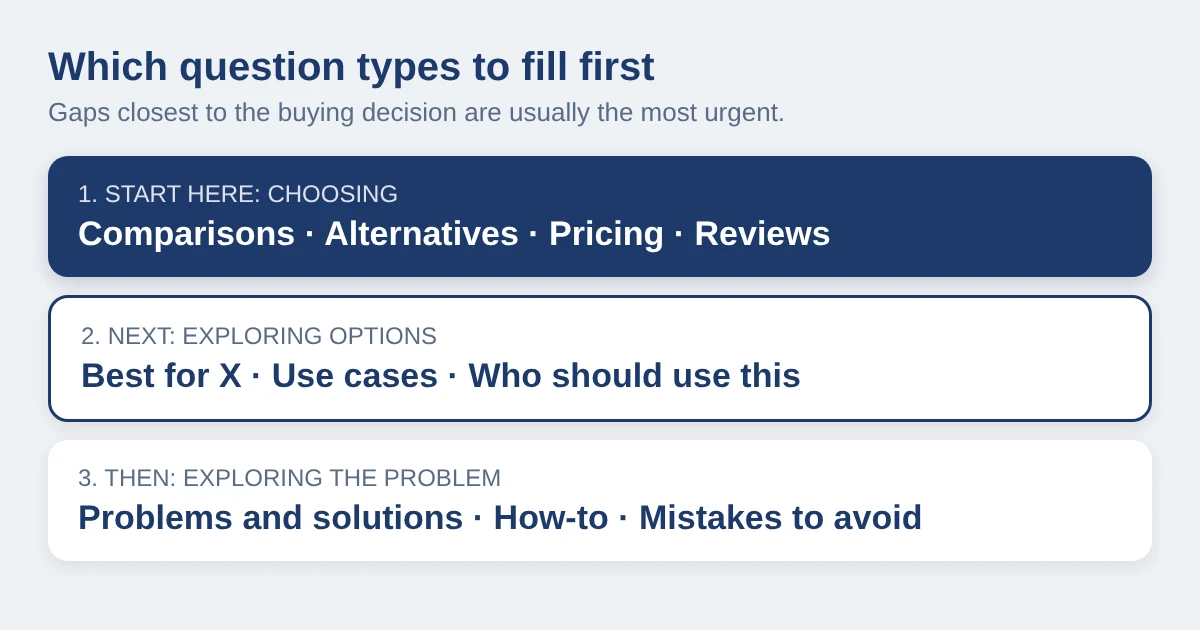
- Fill the gaps closest to the decision first. Comparisons, alternatives, pricing and reviews sit right before the buying decision, so gaps there are usually the most urgent.
- Check who shows up instead. Search each question on Google and ask ChatGPT, Perplexity and Gemini. Note whether you appear, and which brands appear in your place.
- Repeat every quarter. New competitors, new products and new questions keep showing up. Your map should keep up with them.
Want a quick read on where you stand? Rate your site below.
Which question types are you missing?
Rate how well your site answers each question type today. Takes about two minutes. Nothing you click leaves this page.
To log step 5 over time, use our free GEO / AI Visibility Tracker template. No email wall, and it tracks whether ChatGPT, Perplexity and Google name your business.
Why this matters even more in AI search
Buyers now ask these same questions in ChatGPT, Perplexity, Gemini and Google’s AI Overviews. Often as a full sentence: “what accounting software should a small business use?”
The AI answer is built from content that answers that question. If your site only talks about you, AI has very little to work with when the buyer hasn’t named you yet.
Every question type you cover gives AI another reason to bring you up, and another chance to describe you correctly. We covered why that description matters in how AI describes your brand.
One more thing: put the answer near the top of each page. AI and buyers both skim. We explained why in lead with the point.
Frequently asked questions
What is a search market?
Your search market is every question a buyer asks on the way to a decision in your category. It includes searches for your brand name, but most of it is questions about comparisons, alternatives, pricing, reviews, use cases and problems.
What are the 10 question types buyers search?
Comparisons, alternatives, pricing, reviews, use cases, best for X, problems and solutions, mistakes to avoid, how-to, and who should use this.
Is ranking for your own brand name enough?
No. Buyers who search your name have usually decided to look at you already. Most of the decision happens earlier, in questions that don’t include your name at all.
Which question type should you create content for first?
Start with the gaps closest to the buying decision: comparisons, alternatives, pricing and reviews. Then work back toward use cases, best-for lists and problem-led guides.
Do these question types matter for AI search too?
Yes. Buyers ask ChatGPT, Perplexity, Gemini and Google’s AI Overviews the same questions. Those answers draw on content that addresses the question, so the same gaps can keep you out of AI answers.
What’s the one question you’re missing?
Every one of these questions is a moment where a buyer is deciding.
Map your content to all of them, and you show up while the shortlist is still being written.
So: what’s the one question type your buyers ask that you still don’t have content for?
You’re either part of the decision, or you’re invisible.
See which buyer questions AI answers without you
Your buyers are asking AI these questions right now. You probably don’t know which answers include you, or who gets named instead.
Run a free Radar scan of your business. In 30 seconds you’ll see whether AI recommends you, which competitors it names, and three quick wins to close the gap.
No sign-up. No email. Instant results.
Run my free Radar scan →
About the author
Simar Singh runs Digital 6ix, a Toronto SEO, GEO and content marketing agency. He maps the questions buyers ask on the way to a decision, so businesses show up in Google and get named in AI answers from ChatGPT, Perplexity, Gemini and Google’s AI Overviews. Digital 6ix shares its content-planning templates for free at digital6ix.ca/templates. Find Simar on LinkedIn.
Sources
- Google Search Central: Creating helpful, reliable, people-first content
- QuickBooks and Xero (named only in illustrative example searches)
Who does AI name instead?
Radar checks in 30 seconds whether AI recommends your business, which competitors it names in your place, and three quick wins to fix it.
Run my free scanMap your gaps with us
Book a free 30-minute audit call. We will look at which buyer questions you cover, which you miss, and where to start.
Book my call