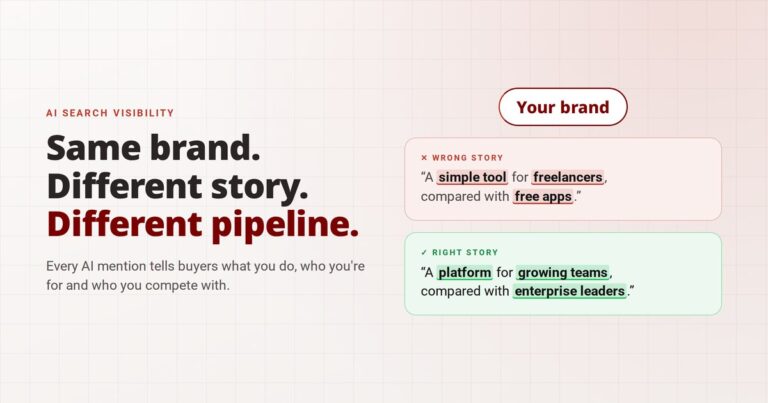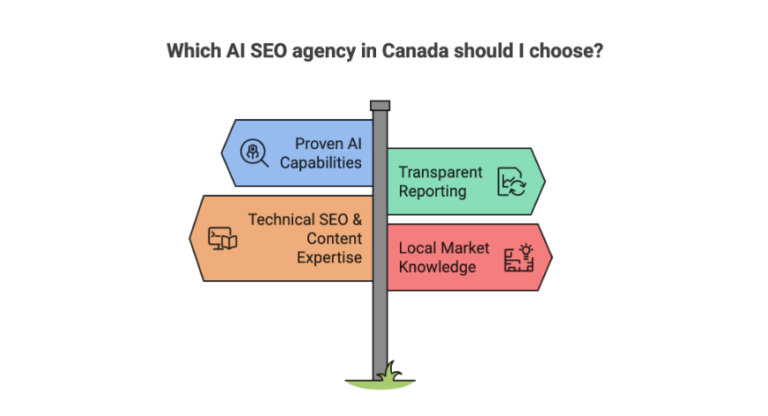

Clarity Beats Size: Why Site Structure Now Shapes Your AI Visibility
The short answer: Adding more keyword pages won’t automatically get your site into search results or AI answers. How your site is organized matters just as much as how much you publish. When the structure is clear, search engines and AI systems can work out who you are, what you offer and which topics you know best.
Start by looking at your site the way a machine reads it. It checks:
- What each page covers
- Which pages link to which
- Which page is the go-to resource for each topic
- Whether every page describes your business the same way
If you’re about to brief another 20 blog posts, look at the structure you already have first.
Fix the structure first. Then publish.
Why publishing more pages stopped working
For years, the SEO routine went like this:
Pick a keyword → write a page → hit publish → do it again.
Run that loop for a few years and you end up with hundreds of articles.
Here’s the catch: a lot of them answer nearly the same question.
A visitor sees a busy blog.
A search engine or AI system sees overlap, and has to guess which page actually matters.
It usually shows up as:
- Three or four posts on the same topic, with none of them clearly the main one
- Internal links pointing wherever the writer happened to remember
- Pages that each describe the business a little differently
- Several posts chasing the same search intent
Google’s own guidance shows where this ends up. When identical content lives at several URLs, Google picks one canonical URL and shows that one. (Google’s SEO Starter Guide)
Near-duplicate posts cause a milder version of the same thing. Your effort gets split across pages that compete with each other instead of adding up.
Why AI search raises the stakes
Google says AI Overviews and AI Mode can use query fan-out: the system splits one question into several related searches across subtopics, then pulls the results together into a single answer. (Google’s AI features documentation)
When your knowledge is scattered across thin, overlapping pages, no single page clearly answers each piece of that question.
Google is also clear that there’s no special trick for its AI features. The usual SEO fundamentals still apply, including solid internal linking and structured data that matches what’s on the page.
So the fix isn’t a new hack.
It’s a clearer website.
What does entity architecture mean?
“Entity” sounds technical. It isn’t.
An entity is anything a search engine or AI system can identify as its own distinct thing, such as:
- Your business
- Each service you offer
- The people on your team
- The cities or regions you serve
Our entity SEO guide goes deeper on this.
Entity architecture is how your website shows the connections between those things.
On a well-structured site, four questions have obvious answers.
1. Which page is the main page for each topic?
Each important topic should have one main page, not several pages fighting for that role.
That’s your pillar page.
2. Which pages support that main page?
Supporting pages go narrower and answer specific questions inside the topic.
Each one should earn its place, not repeat something the pillar or another post already says.
3. How are the pages connected?
The pillar links out to its supporting pages.
The supporting pages link back to the pillar where it makes sense.
Related topics link to each other.
Users and search engines both get a clear path through the site.
4. Are your facts consistent?
Your business name, services and description should read the same on every page and in your structured data.
If your homepage says one thing and your service pages say another, machines have to pick a version. They may pick the wrong one.
Keyword volume vs. entity-focused structure
Side by side, the two approaches look like this:
| ✕ Keyword-focused approach | ✓ Entity-focused approach |
|---|---|
| Create a page for every keyword variation | Create one strong page for the main topic |
| Many pages may cover similar questions | Each page has a clear purpose |
| Internal links develop naturally or randomly | Internal links are planned |
| Content can become repetitive | Supporting content adds new information |
| Focus is mainly on individual keywords | Focus is on topics, relationships and expertise |
This isn’t about publishing less.
It’s about making sure every new page has a reason to exist.
What the data says about topical depth and AI answers
Recent data backs up the idea of going deep on your core topics rather than spreading thin.
In August 2026, Semrush published a study of 1,094 US categories that it tracked in ChatGPT between January and June 2026. The study used five prompts for each category and looked at two things:
- Citations: the pages ChatGPT linked to as sources
- Mentions: when the brand itself was named in the answer
Two findings stand out for anyone thinking about site structure.
Depth seems to matter more close to your area of expertise
In categories closely related to a brand’s core expertise, the brand was cited as a source and mentioned in the answer in 34% of appearances.
For categories farther away from the brand’s core expertise, that number dropped to 9%.
Being present once may not be enough
Brands that appeared in only one of the five prompts for a category tended to have a smaller share of mentions.
According to the study, that effect continued until the brand appeared in at least three of the five prompts.
Semrush is also careful about how these findings should be interpreted.
The study links topical authority with stronger visibility, but it describes topical authority as one factor among several. This is correlation, not a guarantee.
Other things still matter, including reviews, press coverage, roundups and other off-site signals.
What does this mean for your website?
The practical takeaway:
Going deep on a few closely related topics may be more useful than creating a thin presence across dozens of unrelated topics.
Start with the subjects your business is already known for.
Build those areas properly.
Then expand into related topics once your core is strong.
How to restructure your website in six steps
You don’t need to rebuild your entire website from scratch.
In many cases, most of the work can be done using the pages you already have.
1. Write a one-line definition of your business
Start with one simple sentence.
It should explain:
- Who you serve
- What you do
- What result you provide
For example:
We help local healthcare businesses attract more patients through SEO and digital marketing.
Use this basic idea across your homepage, About page, service pages and author bios.
Then look at your other pages.
Ask yourself:
Does this page support what we say our business does, or does it take us somewhere completely different?
If it doesn’t fit, it may need to be updated, merged or removed.
2. Choose the topics you can actually own
You don’t need to write about everything related to your industry.
Instead, make a list of topics where you have:
- Real expertise
- Real customers
- Real business value
Start with the topics closest to your core service.
Once those are strong, move into closely related topics.
This is usually better than trying to become an expert on every possible subject at the same time.
3. Give every page a topic and a purpose
Next, crawl your website and look at every URL.
For each page, ask:
What topic does this page belong to?
Then ask:
What role does this page play?
You can broadly classify pages as:
- Pillar pages
- Supporting pages
- Pages that don’t really fit anywhere
If several pages answer essentially the same question, consider combining them into the strongest page.
The other URLs can then be redirected using 301 redirects.
Pages that don’t fit into any useful topic may need to be updated, merged or retired.
4. Rebuild your internal links deliberately
Don’t leave internal linking to chance.
A simple structure might look like this:
Pillar page → Supporting pages
And:
Supporting pages → Pillar page
You can also link between closely related supporting pages.
Use descriptive anchor text. Google says anchor text helps both people and Google understand what the linked page is about. (Google’s SEO Starter Guide)
Also look for orphan pages: pages that have no internal links pointing to them.
If a page is important enough to keep, it should usually have a clear place within your site’s structure.
5. Make important information easy for machines to understand
Your website should be clear to people, but it should also provide useful information in a format search engines can understand.
For example, adding Organization structured data to your homepage can help Google understand information about your organization. (Google’s Organization structured data guide)
Just make sure your structured data matches what is actually visible on the page.
Also keep important information consistent across:
- Your website
- Google Business Profile
- Online directories
- Other business profiles
Your name, description and services shouldn’t constantly change from one place to another.
6. Measure what changes
Before you start restructuring the site, take a baseline.
Record things such as:
- Rankings for your main topic keywords
- Internal linking and crawl health
- Number of orphan pages
- AI visibility for a fixed list of prompts
Then check again after the changes.
Ideally, use the same prompts every month.
Don’t judge your results based on one AI answer. AI responses can change from one run to another, so trends over time are much more useful. (Digital 6ix: How to measure AI visibility when ChatGPT keeps changing)
Before you move any URLs: don’t change URLs casually.
Changing slugs or folders on a live website can affect your rankings if the old URLs aren’t redirected properly.
Before making changes:
- Make a list of your existing URLs.
- Decide where each URL is going.
- Map old URLs to new URLs.
- Set up 301 redirects.
- Then make the changes live.
The goal is to make the website clearer without accidentally breaking the paths that already bring visitors to it.
How to measure the impact with Semrush
You really need to look at two sides of the picture:
Can search engines understand and crawl your new structure?
And:
Are AI systems picking up the changes?
Semrush One combines the SEO Toolkit and AI Visibility Toolkit, so you can look at both in one place.
Structure: Site Audit
The Internal Linking report in Site Audit can show things like:
- Crawl depth: how many clicks a page is from your homepage
- Orphaned pages
- Which pages are receiving the most internal link value
Run the audit before making your changes.
Then run it again afterward.
That gives you something concrete to compare.
Rankings: Position Tracking
Use Position Tracking to monitor the keywords associated with your main topics.
The idea is to see whether your pillar pages improve as you consolidate supporting content and internal links around them.
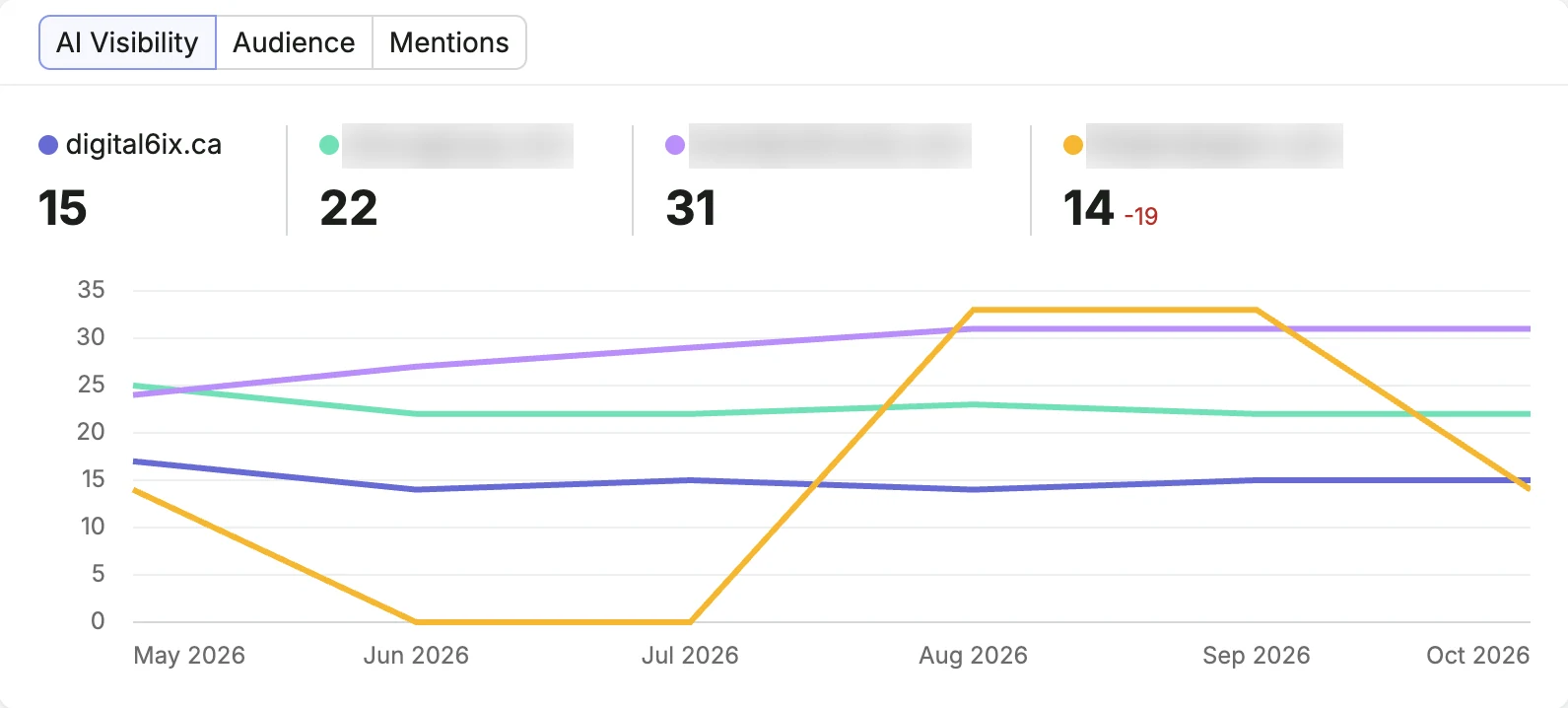
AI answers: AI Visibility Toolkit
You can add the questions your customers actually ask to Prompt Tracking.
Then use tools such as Visibility Overview and Competitor Research to see how often your brand appears in AI answers.
Brand Performance can also show your share of voice and the tone AI systems use when describing your brand.
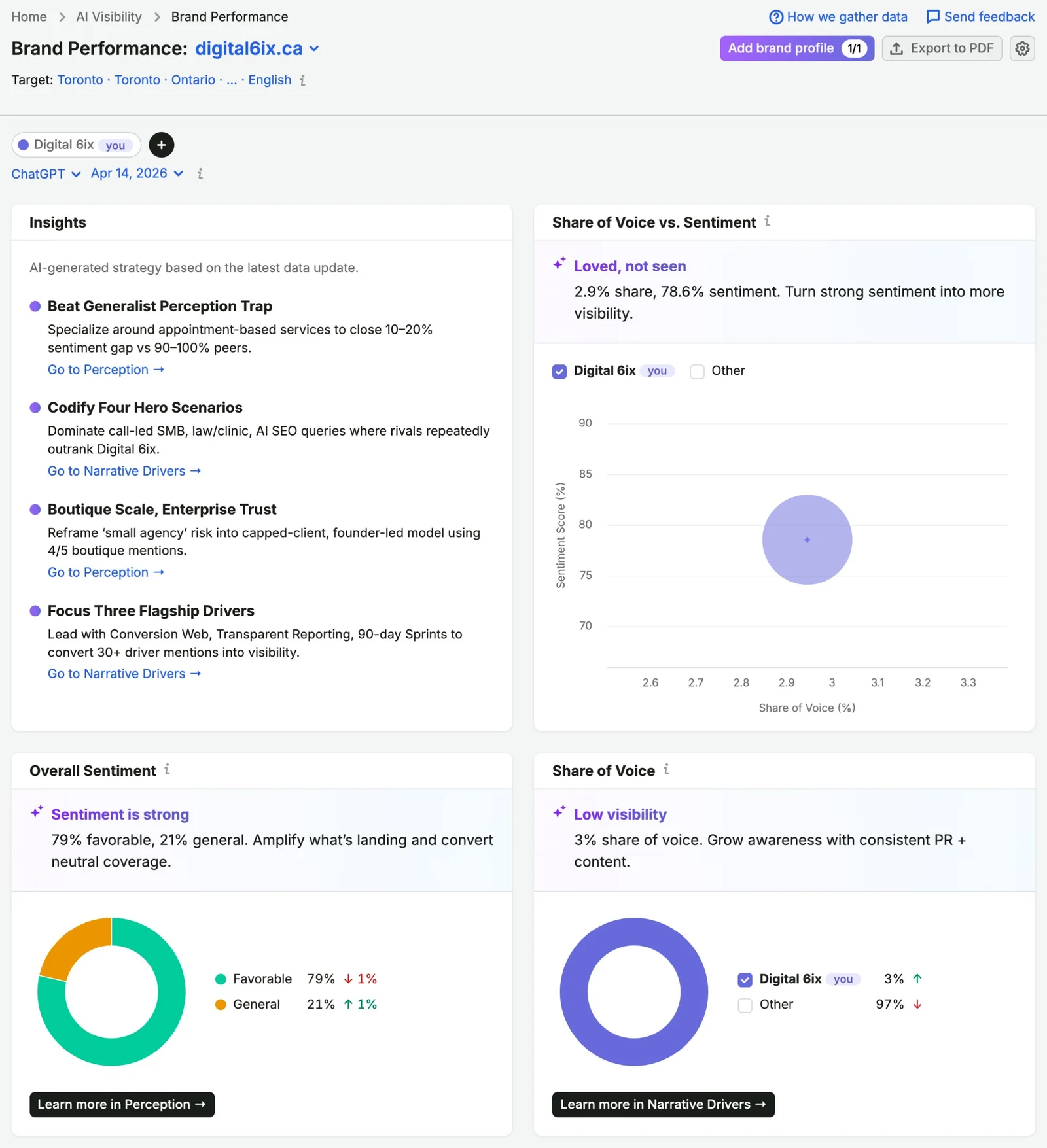
The toolkit covers ChatGPT, Gemini, Perplexity, and Google’s AI Overviews and AI Mode, although not every report includes every platform.
Try it free: Semrush One offers a 7-day free trial for new accounts, which gives you time to establish a baseline before making major changes.
Start your free Semrush One trialAffiliate link: Digital 6ix may earn a commission if you sign up.
Not ready to pay for a tool?
You can also use our free Radar scan to get a quick look at whether AI systems recommend your business.
Or use our free GEO / AI Visibility Tracker template to track the same prompts over time.
Common website restructuring mistakes
There are a few mistakes we see again and again.
Deleting pages that still bring traffic
Don’t automatically delete an old page just because you want to clean up your site.
If it still gets traffic or has valuable links, consider merging it into a stronger page and redirecting the old URL.
Changing URLs without redirects
If an old URL has a new home, make sure visitors and search engines are sent there with a 301 redirect.
Adding structured data that doesn’t match the page
Your schema should describe what people can actually see on the page.
Don’t add information simply because you want search engines to associate your business with it.
Trying to cover every topic at once
You don’t have to write about every topic next to your industry.
Get your core topics right first.
Then expand.
Judging success from one AI answer
AI answers can change between runs and between different tools.
Instead of asking, “Did ChatGPT mention us today?”, track the same set of prompts over time.
The trend tells you far more than any single answer.
Frequently asked questions
What is entity architecture in SEO?
Entity architecture is simply the way your website is organized around the things you want to be known for.
That could include your business, services, people and locations.
A strong structure usually has one main page for each important topic, supporting pages around it, clear internal links and consistent information throughout the site.
The goal is to make it easier for search engines and AI systems to understand what your business does and where your expertise lies.
Do I need to stop publishing new content?
No.
But it may be worth restructuring what you already have before publishing dozens of new pages.
Once your existing content is organized, create new pages when they fill a real gap.
Don’t create another article just because you found another variation of a keyword you’ve already covered.
Does site structure affect whether ChatGPT mentions my brand?
It can.
Semrush’s study of 1,094 ChatGPT categories found that brands were cited and mentioned more often in categories closely related to their core expertise.
But site structure isn’t the only factor.
Reviews, press coverage, roundups and other signals can also influence how a brand appears in AI answers.
Do Google’s AI Overviews need special optimization?
No.
Google says that you don’t need special optimization or additional steps to appear in AI Overviews or AI Mode.
The same SEO fundamentals still matter, including good internal linking and structured data that accurately represents the visible content on your page.
What should I measure after restructuring?
Start with a baseline before you make changes.
Then track three main areas:
1. Website structure: crawl depth, orphaned pages and internal linking health.
2. Search performance: rankings for your main topic keywords.
3. AI visibility: how often AI systems mention or cite your brand for a fixed set of prompts.
Check these regularly and focus on the trend rather than one individual result.
Clarity beats size
You don’t need hundreds of pages for AI systems to understand your business.
You need a website that makes sense.
Before you commission another blog post, take a step back and look at the pages you already have.
Do they tell one clear story?
Can someone quickly understand:
- Who you are?
- What you do?
- Who you help?
- What you know about?
If the answer is yes, you’re building a strong foundation.
If the answer is no, more content probably won’t solve the problem.
Make the structure clear first. Then scale.
See where your site stands in AI answers
Before you restructure anything, get a baseline. A free Radar scan shows in about 30 seconds whether AI recommends your business, which competitors it names instead, and three quick wins.
Free and instant. No sign-up needed.
Run my free Radar scan →
About the author
Simar Singh founded Digital 6ix, a Toronto agency focused on SEO, GEO and content. His work centres on helping businesses be understood and accurately described by AI answer engines such as ChatGPT, Perplexity, Gemini and Google’s AI Overviews. The agency’s audit and content-planning templates are free at digital6ix.ca/templates, and you can find Simar on LinkedIn.
Sources
- Semrush: How topical authority spreads (and where it doesn’t) in ChatGPT, August 2026
- Google Search Central: AI features and your website
- Google Search Central: SEO Starter Guide
- Google Search Central: Organization structured data
- Semrush Knowledge Base: Site Audit thematic reports
- Semrush Knowledge Base: What is Semrush One?
- Semrush Knowledge Base: AI Visibility Toolkit
Instant AI visibility scan
Curious whether AI recommends you today? Radar checks in about 30 seconds and shows who gets named instead, plus three quick fixes.
Run my free scanBook a free audit call
Planning a restructure? We can review your site structure and AI visibility with you and map out where to start.
Book my call