
AI Recommends Different Businesses Depending on the Language Your Customer Asks In. Is Yours Visible in Punjabi, Mandarin or Tamil?
If you read one thing: AI may name different businesses when the same question is asked in a different language. A Search Engine Journal test found Claude’s brand picks shifted across five languages. In Toronto, where Mandarin, Cantonese, Tagalog, Spanish and Tamil lead the non-English home languages in the city, an English-only check can miss a lot. Test your name in your customers’ languages. Then fix the pages, profile and reviews that AI reads in those languages.
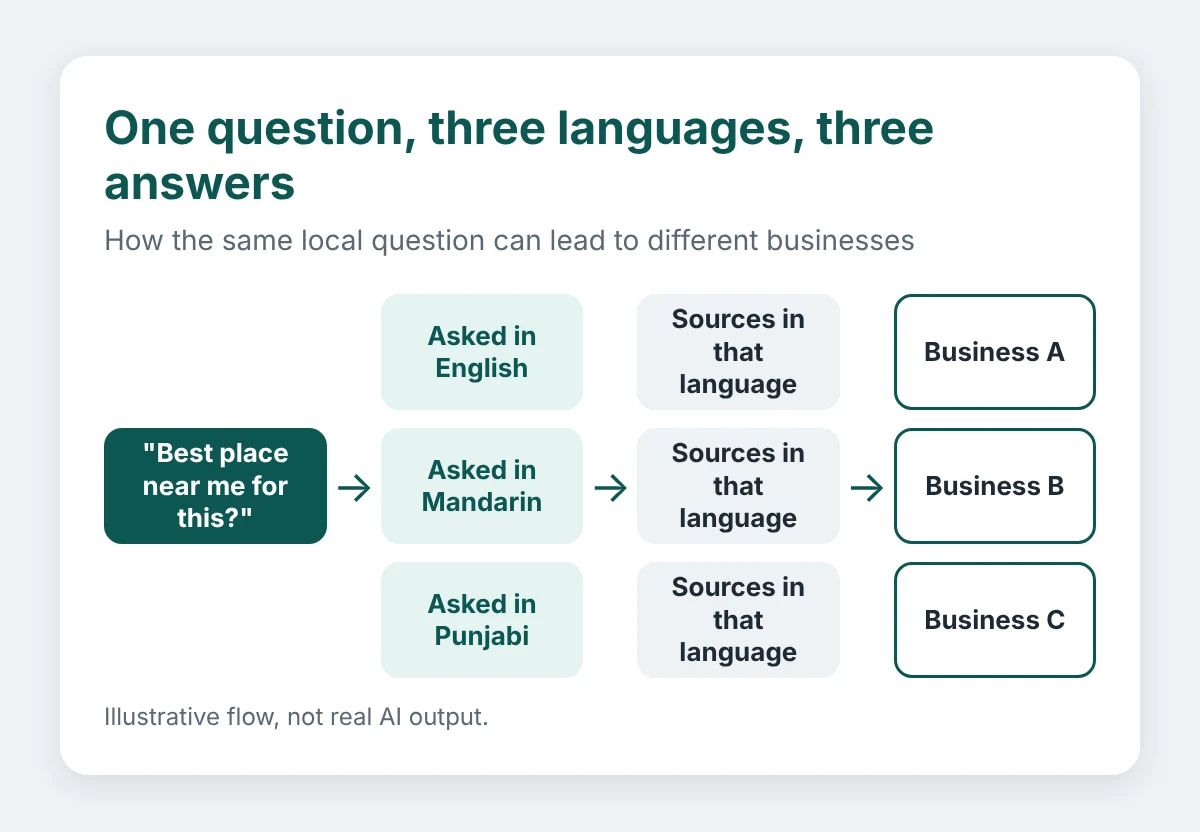
Open ChatGPT. Ask for the best place near you to buy what you sell. Now ask again in Punjabi, or Mandarin, or Tamil.
Do you get the same names? Often, you won’t. This guide shows you how to check, and what to fix.
What the research found: same question, different brand
Reza Moaiandin, a co-founder at SALT.agency, tested this in a piece for Search Engine Journal. He used Claude Sonnet 5 with web search turned off. He asked it the same buying questions in five languages: English, Arabic, Russian, Simplified Chinese and Persian.
Each time, the model named three brand options, then said which one it would recommend. The test gathered 1,650 responses across six scenarios.
One scenario was a flight from London to Tenerife. In Persian, Claude picked British Airways 52.5% of the time and easyJet 12.5%.
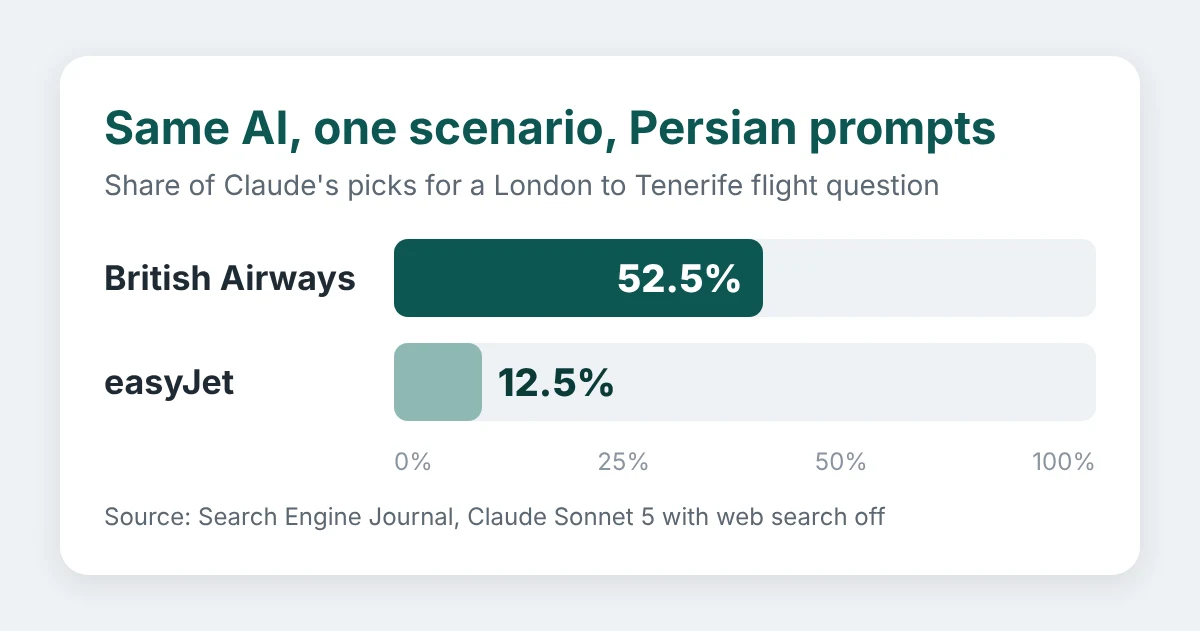
Same model. Same kind of question. The language you ask in can change the brand that comes back.
It isn’t only one study. Profound looked at 3.25 billion AI citations from March 2026, across 7 models and 14 countries. It reports that the language of the query is a stronger driver of the sources AI cites than the country a person is in. The effect varies by model.
Why a language change can change the answer
AI doesn’t keep one list of the best businesses. It builds each answer from what it can find and read.
Ask in Mandarin, and the pages it leans on can be different from the pages it uses for English. That points to a likely cause: different sources, different reviews, different words for the same service.
So a business can look strong in English and thin in another language. Not because it is worse. Because the language-specific evidence isn’t there.
The Toronto numbers behind the problem
Toronto’s customers don’t search in one language. Statistics Canada’s 2021 census, as reported by the City of Toronto, counts the people who speak a language most often at home. Besides English, Mandarin leads with 86,150 people. Cantonese follows with 74,845. Tagalog, Spanish and Tamil come next. Urdu ranks ninth, with 22,650.
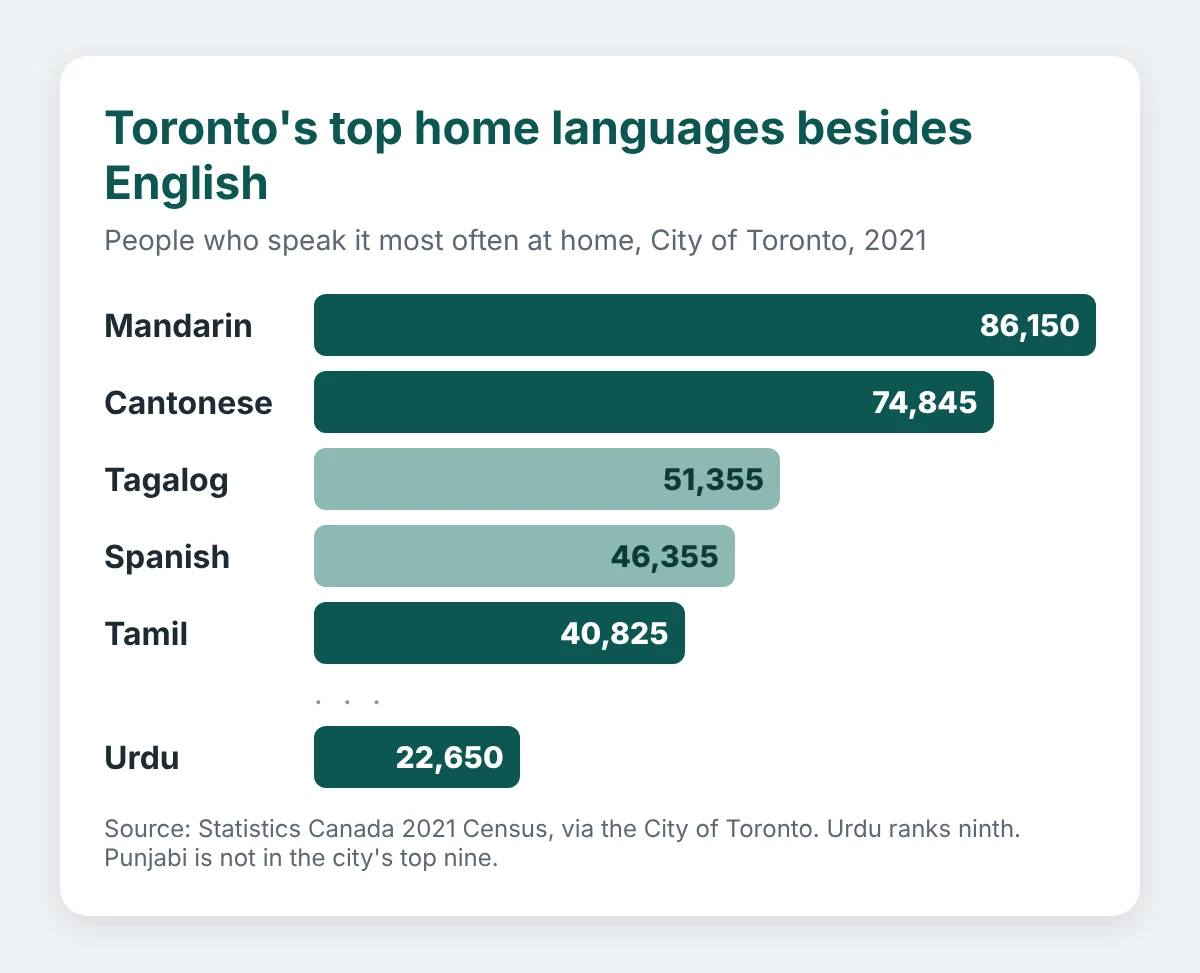
Punjabi doesn’t appear in the City of Toronto’s top nine. Across Canada it is a different story: Mandarin and Punjabi lead the languages spoken most often at home other than English and French, according to Statistics Canada. Your customers may live well outside the city limits, so check the census profile for your own service area.
Many of these customers also ask AI for local picks. If you only test in English, you are checking one slice of your market.
A 15 minute test you can run today
You don’t need a paid tool. You need a timer and a notes page.
- Pick your languages (2 minutes). Choose the three languages your customers use most. Start with the ones you already hear at the counter or on the phone.
- Write one local question per language (3 minutes). Use real customer wording with your area in it, like “best dentist near Scarborough Town Centre”. Ask a native speaker to check each version. A rough machine translation can change the answer on its own.
- Run it in three tools (7 minutes). Ask ChatGPT, Gemini and Google AI Mode the same question in each language. Use a fresh chat each time.
- Log who gets named (3 minutes). For every language and tool, note whether you were named and which businesses came up instead.
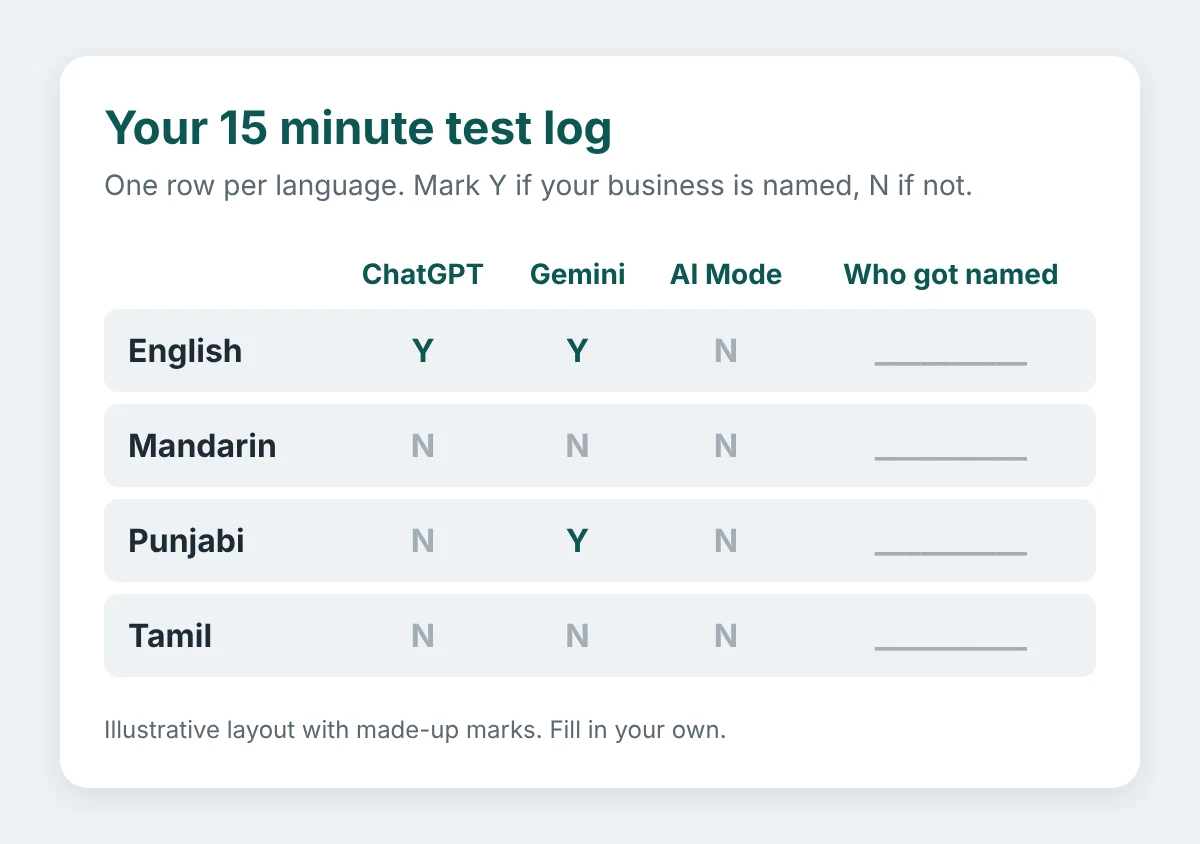
Answers change from run to run. Ask each question twice if you can, and look for the pattern. Our free GEO tracker template has a place to log it. For the English side of the test, see how to get into ChatGPT’s answers for Toronto main-street businesses.
Fixes that work
You can’t edit an AI answer. You can give it better evidence in each language.
Translate the pages that bring in customers
Start with your main service pages, your location and your contact details. Have a real speaker write or review each page. A raw machine translation can read oddly, and that doesn’t build trust with people or with AI.
Tell Google which page is for which language
Use hreflang tags to connect each language version of a page. Each version should point to the others and to itself. Give each language its own address, not a pop-up that swaps the text.
Use the names your customers use
List service and menu names in the other language where it reads naturally. Customers search with their own words, so put those words on the page.
Fill in your Google Business Profile
Keep your name, address and hours identical to your site. Add services and a clear description. Then ask happy customers to leave reviews in their own language. Our reviews and reputation work covers how to ask without pushing.
If you want help turning this into a plan, that’s what our AI search optimization services are for.
Getting named in sources AI reads in your customers’ languages
AI also leans on what others say about you. So look past your own site.
- Community language media. Newspapers, radio sites and blogs written in your customers’ language. Offer a useful tip or a local story, not an ad.
- Directories. Local and community business directories in that language. Keep your name, address and phone number the same everywhere.
- Forums and community groups. Join the conversation where your customers already ask for advice. Answer honestly and say who you are.
Earn these mentions. Don’t fake them. Made-up sources are the kind of thing AI tools are starting to push back on.
What the numbers don’t tell you
- It was one model. The Search Engine Journal test used Claude Sonnet 5 with web search off. ChatGPT, Gemini and AI Mode, which search the web, may behave differently.
- Profound sells AI tracking. Treat its figures as a strong signal, not a final word.
- Home language isn’t shopping language. The census counts what people speak at home. It doesn’t say which language they use to ask AI for a business.
- The city isn’t the whole region. The Toronto figures cover the City of Toronto, not the suburbs around it.
So test your own market. That is the only number that matters for your business.
How to track it over time
Repeat the same test every month. Same questions, same languages, same three tools.
- Keep one log. One row per language and tool, with a column for who got named.
- Note what you changed. A new translated page, a new batch of reviews, a new directory listing. Then you can see what moved things.
- Watch the pattern. One odd answer is noise. Three months of the same gap is a signal.
To get an English baseline first, run a free AI visibility check.
Frequently asked questions
Does AI really recommend different businesses in different languages?
It can. A Search Engine Journal test asked Claude the same buying questions in five languages and found its brand picks shifted with the language. Profound’s study of 3.25 billion AI citations also found that query language is a stronger driver of which sources get cited than the country a person is in.
Which languages should a Toronto business test first?
Start with the languages your customers already use with you. In the City of Toronto, Statistics Canada’s 2021 census shows Mandarin, Cantonese, Tagalog, Spanish and Tamil as the top non-English languages spoken most often at home. Check your own service area too, because suburbs can look different.
Do I need a fully translated website?
Not for everything. Start with the pages that bring in customers: your main services, your location and your contact details. Translate those properly, then add more once you see results.
What is hreflang?
Hreflang is a tag that tells Google which language and region each version of a page is for, and how the versions connect. It helps the right version reach the right searcher.
How often should I test multilingual AI visibility?
Monthly is a practical start. Answers change between runs and as models update, so use the same questions each time and look for the pattern, not a single answer.
Your customers ask in their own language. Make sure AI can find you there.
Start with the version of the test you can run now
Before you test in other languages, know where you stand in English. It takes half a minute.
Run a free Radar scan to see whether AI recommends your business and who it names instead.
No sign-up. No email. Instant results.
Run my free Radar scan →
About the author
Simar Singh founded Digital 6ix, a Toronto agency for SEO, GEO and content. He tests how ChatGPT, Gemini and Google’s AI answers name local businesses, and shows owners what to change. Connect with Simar on LinkedIn.
Sources
Instant AI visibility scan
Start with an English baseline. Radar scans your business in 30 seconds and shows who AI names instead.
Run my free scanBook a free audit call
Not sure which languages to test first? Talk it through with us on a free call.
Book my call