
9–14 minutes

The Battle Between Local SEO and Traditional SEO: What Toronto Businesses Should Actually Do

In the race to win online visibility, local intent is a major signal. In fact, 46% of Google searches are looking for local information (HubSpot,2024). That’s a big number, but it doesn’t automatically mean every business should go “all-in” on Local SEO.

So what’s the right move:
Local SEO in Toronto or Traditional SEO?

If you’re researching local SEO in Toronto, this guide breaks down the difference when each strategy wins, and how to choose the most profitable path for your business, especially if you serve customers in the GTA.

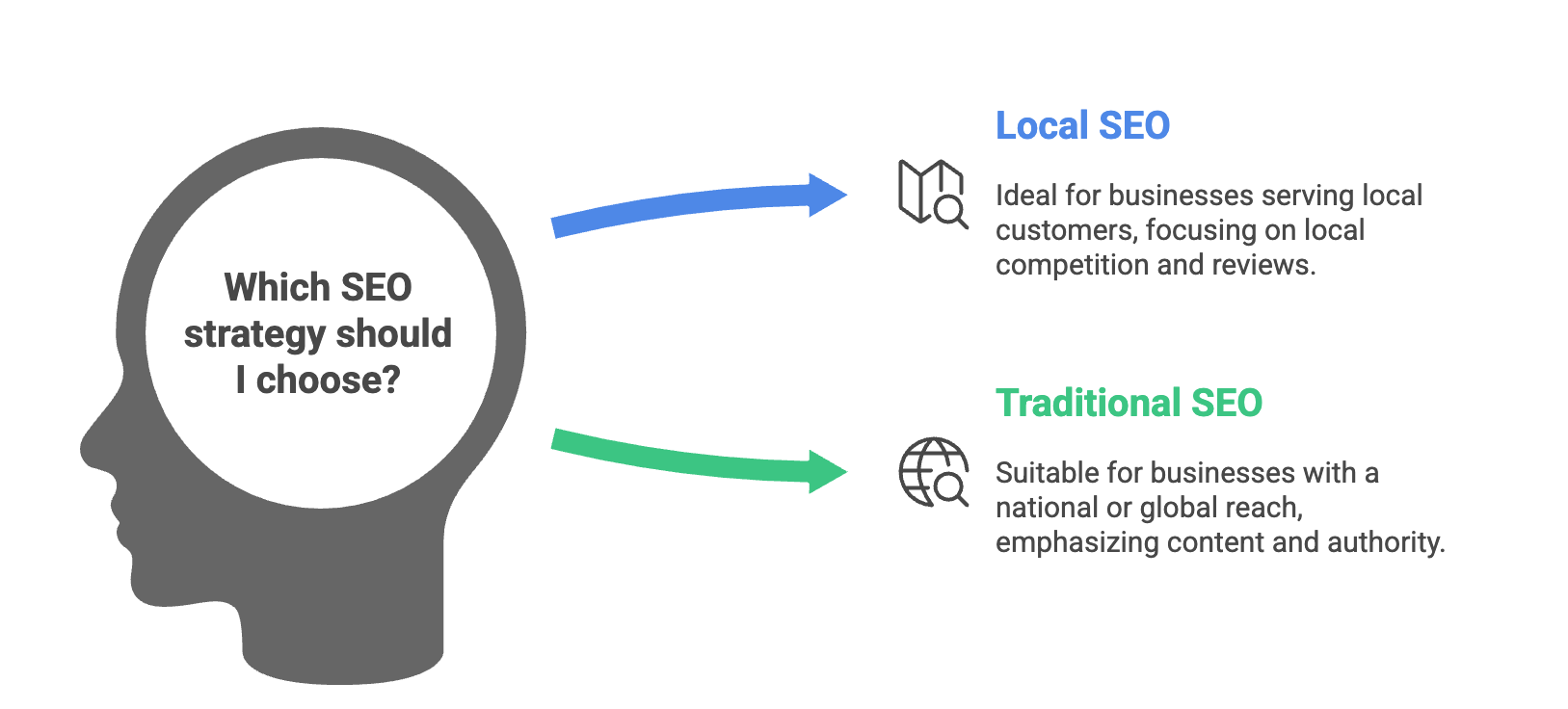
Infographic comparing Local SEO - best for local businesses, with focus on competition and reviews to Traditional SEO - best for national or global businesses, emphasizing content and authority. Text is inside and around a human head silhouette.

Local SEO vs Traditional SEO: Quick Comparison

Summary: The table below compares local SEO and traditional SEO across goals, audience, keywords, ranking signals, and timelines. In short, local SEO is designed to improve visibility in Google Maps and local results using Google Business Profile, reviews, and citations, while traditional SEO focuses on national or global organic rankings driven by content depth, backlinks, and technical SEO. Use this table to choose the approach that best matches your business reach and customer intent.

Category Local SEO Traditional SEO
Primary Goal Increase visibility in local search results and Google Maps Increase visibility in national or global organic search results
Target Audience Users searching within a specific geographic area (e.g., Toronto) Users searching without location-based intent
Typical Keywords Location-based queries like “local SEO in Toronto” or “SEO agency near me” Broad keywords like “SEO services” or “digital marketing strategy”
Google Maps Presence Yes, Google Business Profile is a core ranking factor No, rankings focus on standard organic results
Key Ranking Signals Proximity, relevance, reviews, citations, Google Business Profile Content quality, backlinks, technical SEO, topical authority
Content Focus Service pages, location pages, local FAQs, community-based content In-depth guides, educational content, industry insights
Conversion Intent High, users often ready to call, book, or visit Medium to low, often research or comparison stage
Time to See Results 2-4 months on average (depending on competition) 4-6+ months for competitive keywords
Best For Service-based and location-dependent businesses in Toronto E-commerce, SaaS, publishers, and national brands

What Is Local SEO?

Infographic titled Enhancing Local Visibility with five steps: Google Business Profile Optimization, Local Keyword Targeting, Citations and Directory Consistency, Reviews and Reputation Signals, and Local Content, connected in a circular layout.


Local SEO is the practice of improving your visibility when people search for services “near me” or in a specific city/area (like Toronto, North York, Scarborough, Etobicoke, Mississauga, etc.).

The goal is to show up in:

Google’s local pack
Google Maps
Localized organic results (standard listings with city intent)

Local SEO is ideal for businesses that rely on customers in a defined service area – think restaurants, dentists, clinics, law firms, contractors, salons, gyms, and home services.

Key components of Local SEO (Toronto-focused)

Google Business Profile (GBP) Optimization
This includes accurate categories, services, business hours, photos, products, and consistent business info.

Local keyword targeting
Keywords that include a city/area modifier, such as:
“local SEO agency Toronto”
“plumber in Scarborough”
“dentist near Yonge and Eglinton”

Citations and directory consistency
Ensuring your NAP (Name, Address, Phone) is consistent across online directories, listings, and platforms.

Reviews and reputation signals
Review quantity, quality, recency, and responses matter, especially for map rankings.

Local content
Content that speaks to your community: service-area pages, neighbourhood guides, and locally relevant FAQs.

What Is Traditional SEO?

A five-layer pyramid diagram illustrating traditional SEO in Toronto: keyword research, on-page optimization, content strategy, authority building, and technical SEO, each with icons and brief descriptions.

Traditional SEO (sometimes called “national SEO” or “organic SEO”) focuses on ranking in search results regardless of location. The goal is to grow visibility across a wider region.

This approach is best for businesses that can sell or deliver without geographic limits, such as:
eCommerce
SaaS
Online services
National brands
Publishers / content businesses

Key components of Traditional SEO:

1. Keyword research (volume + intent)
Finding high-intent keywords that aren’t tied to a location.

2. On-page optimization
Titles, headings, internal links, content structure, topical depth, and entity coverage.

3. Content strategy at scale
Guides, comparisons, how-tos, and educational content built to earn rankings and links.

4. Authority building (link acquisition)
Earning backlinks from high-quality, relevant websites.

5. Technical SEO
Site speed, mobile UX, crawl/index control, Core Web Vitals, structured data, and clean architecture.

Local SEO vs Traditional SEO: The Real Differences

The Battle Between Local and Traditional SEO: What You Need to Know and differences on the basis of Target Audience, Ranking, Keyword Strategy, Off- Page Signals and content strategy

1. Target audience
Traditional SEO: Broad reach across multiple regions
Local SEO: People searching inside (or about) a specific area, like Toronto

2. Ranking
Traditional SEO: You compete in standard organic results
Local SEO: You compete for Map Pack + organic, which can double your visibility on page one

3. Keyword strategy
Traditional SEO: Higher-volume, broader keywords (more competition)
Local SEO: Location-based long-tail keywords (often faster wins)
Examples of local-intent terms:
“local SEO company Toronto”
“local SEO audit Toronto”
“Toronto SEO services for small business”
“SEO agency near me”

4. Off-page signals
Traditional SEO: Backlinks and topical authority dominate
Local SEO: Reviews + citations + proximity + GBP signals carry more weight (especially for Maps)

5. Content strategy
Traditional SEO: Topic clusters that build national authority
Local SEO: Service-area pages + neighbourhood pages + local proof (case studies, testimonials, photos, community relevance)

A circular infographic with four colored sections outlines benefits of local SEO in Toronto: stronger trust signals, increased visibility, cost-effective national competition, and higher conversion rates, each with a brief description and relevant icon.


Toronto is competitive and that’s exactly why Local SEO can be a strong growth lever. You’re not just trying to get traffic. You’re trying to get ready-to-buy leads.

1. Increased visibility where purchase intent is highest
Local searchers are typically closer to taking action: calling, requesting a quote, booking, or walking in.

2. Higher conversion rates
Someone searching local SEO agency Toronto” or “emergency plumber Toronto” isn’t browsing, they’re actively looking for a provider.

3. Stronger trust signals (especially in service industries)
Toronto buyers often compare providers quickly. Reviews, map presence, photos, and consistent information build confidence faster than generic “about us” copy.

4. Often more cost-effective than competing nationally
Traditional SEO can take longer due to heavy competition. Local SEO can deliver faster wins by targeting a smaller, higher-intent market.

When Traditional SEO Is the Better Choice

Local SEO is not always the main priority.
Traditional SEO may be better if:
You sell online across Canada or internationally.
Your services aren’t location-dependent.
Your growth plan relies on content-driven acquisition (top-of-funnel).
You need to scale visibility across multiple provinces/cities.

Many high-growth companies ultimately run both:
Local SEO to drive immediate leads in priority areas.
Traditional SEO to build long-term authority and reduce paid media dependency.

When Traditional SEO Is the Better Choice 1

Practical Steps: How to Implement Local SEO in Toronto (Correctly)

A six-level pyramid diagram titled Local SEO Execution Pyramid, listing steps from bottom to top: Optimize for local visibility, Analyze strengths and weaknesses, Build location-aware website, ensure consistent online listings, Publish relevant, engaging material, and Amplify local signals and engagement.


If you want results, not just “SEO tasks” – this is the execution path that tends to move rankings and leads.

1. Fully optimize your Google Business Profile
Pick the correct primary category
Add secondary services
Add real photos (team, location, work, before/after)
Use posts and updates
Ensure hours and service areas are accurate
Build a review system and respond consistently

2. Run a Local SEO audit
GBP completeness + category alignment
NAP consistency across directories
Website on-page location signals
Map rankings vs organic rankings
Competitor gap analysis (reviews, citations, content)

3. Build location-aware site structure
At minimum:
Strong homepage + service pages
Clear contact page (with embedded map where relevant)
Service-area pages (only if you can support them with real differentiation and content)
Internal links that reinforce location + service relevance

4. Clean up and build citations
Focus on reputable directories and industry-relevant listings. Consistency matters more than quantity.

5. Publish local content that proves relevance
High-performing local content usually includes:
“Service in [Neighbourhood]” pages done properly
Local case studies with measurable outcomes
FAQs that match local search phrasing
Content tied to Toronto-specific needs and timelines (seasonality helps)

6. Use social media to amplify local signals
Social doesn’t directly “rank” you, but it supports discoverability, brand searches, engagement, and review velocity.

Local SEO or Traditional SEO: Success Stories

Traditional SEO Case Study:
Toronto Car Cleaning Business Grew to 59.8K Monthly Organic Visitors in 6 Months (No Ads)

Primary Goal: Drive organic leads without paid advertising

Key Results:
2,300+ ranking keywords, including multiple top-10 positions
Zero spend on paid ads
Noticeable improvement in inbound lead quality fulfil services remotely


Local SEO Case Study:
3 times the number of phone calls through Google Business profile within 90 days

Primary Goal: Grow qualified leads through organic channels alone

Key Results:
3x the phone calls
2.5x more website visits
Google Maps Visibility Page 1 → Top 3 pack

Key Takeaways: Which Should You Choose?

A Venn diagram titled “Maximizing Business Growth with SEO Synergy,” showing overlap between Local SEO, Hybrid SEO (in the centre), and Traditional SEO with relevant icons in each section.


Choose Local SEO if:
You serve customers in Toronto/GTA
Calls, bookings, and walk-ins matter
You’re competing against nearby providers
Reviews and Google Maps are important to your category

Choose Traditional SEO if:
You sell nationally or globally
You can fulfil services remotely
You need to build authority through content
Your product/service is not location-dependent

Best-case scenario:
Many businesses benefit most from a hybrid strategy:
Local SEO to win Toronto leads now
Traditional SEO to build compounding traffic over time

How We Can Help

A Venn diagram showing Strategic SEO Growth in the center, with Local SEO (targeted local customer acquisition) on the left and Traditional SEO (broad online visibility) on the right. Title: Maximizing Toronto Business Growth Through SEO.


Toronto is competitive, but the businesses that win aren’t “doing SEO”, they’re executing the right SEO strategy for how customers actually search.

As of January 2026, If you’re a Toronto-based business, and you want more qualified leads (not just traffic), Local SEO can be one of the most direct growth channels available, especially when your Google Business Profile, reviews, and on-site location signals are aligned.

If you want support from a team that understands both Local and Traditional SEO, you can work with a Trusted SEO agency in Toronto to build a strategy that drives visibility, leads, and long-term growth.

Digital 6ix is a premier Toronto-based web design and digital strategy agency dedicated to helping GTA businesses outshine their competition. With a portfolio of over 100 successful website launches, from high-end boutiques in Yorkville to service providers in Etobicoke, our team specializes in merging high-performance SEO with conversion-centric design. We don’t just build websites; we build digital sales engines designed for the unique pace of the Toronto market.

Frequently Asked Questions

Get a free Virtual Consultation now!

Leave a Comment

Your email address will not be published. Required fields are marked *

1 thought on “The Battle Between Local and Traditional SEO: What You Need to Know”