

Entity SEO: How Search Engines Think in 2026
Google no longer matches the words you type – it interprets what those words actually mean. This shift from keyword matching to entity recognition is the most significant change in search since PageRank.
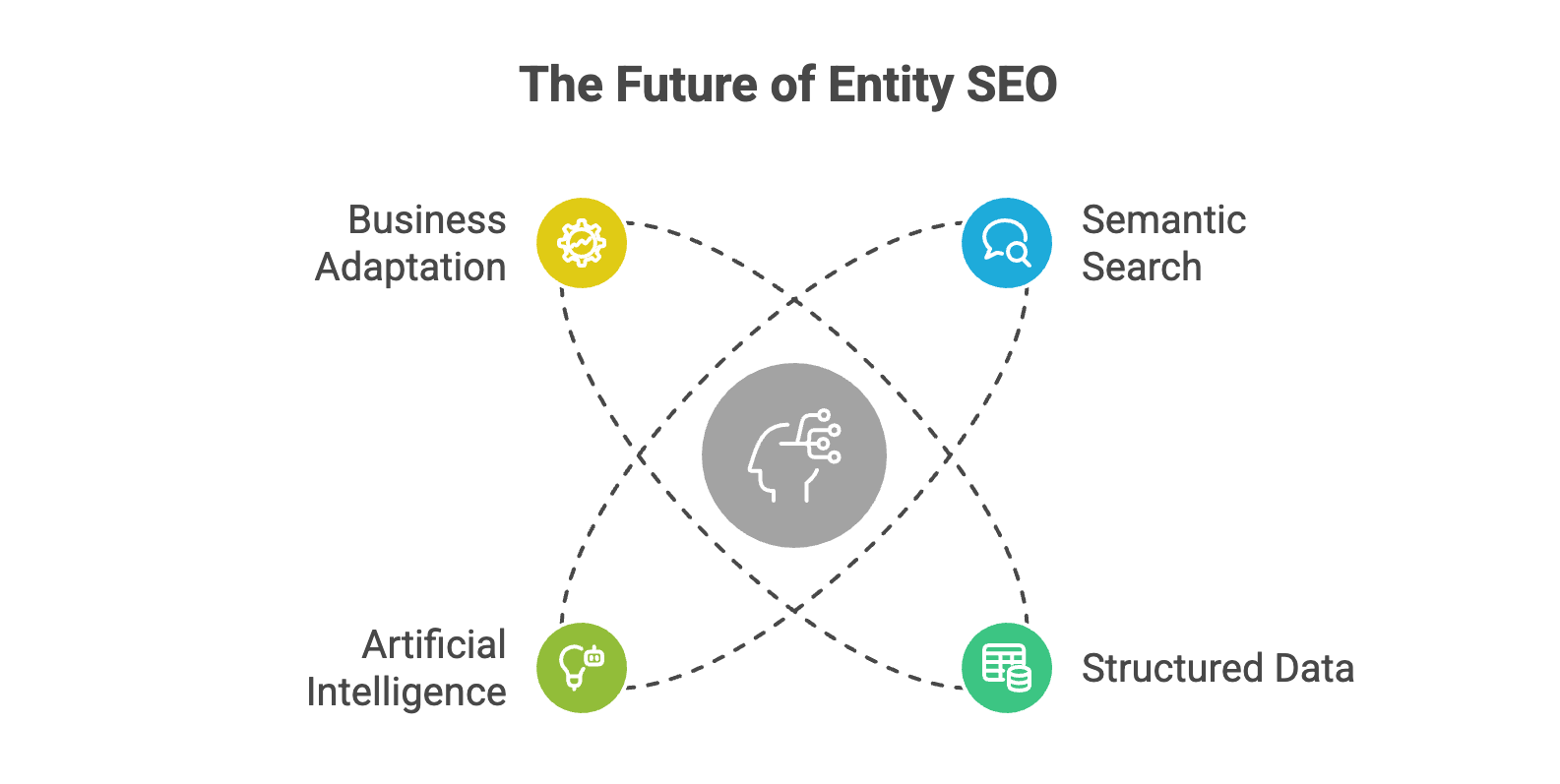
What Is Entity SEO
Entity SEO is the practice of optimizing your website around real-world things – people, places, brands, concepts – rather than just keyword phrases. An entity is anything singular and distinguishable that Google can identify and store in its database.
Instead of matching the words someone types, Google now tries to understand what those words actually refer to. When you search “Apple,” Google figures out whether you mean the tech company or the fruit based on context. That’s entity recognition at work.
Google maintains a massive database called the Knowledge Graph – storing over 500 billion facts about five billion entities and how they connect to each other.
For your business, relevant entities might include:
- Your brand nameThe company itself as a distinct, recognizable thing
- PeopleFounders, team members, or key personnel
- LocationsYour city, neighbourhood, or office address
- ServicesThe specific offerings you provide
- Industry conceptsTopics and terms related to your field
How Keywords and Entities Differ
Keywords are the exact words people type into search bars. Entities are the underlying concepts those words point to. “Best marketing agency Toronto,” “Toronto digital marketing company,” and “marketing firms near me” are three different keyword strings that all refer to the same type of entity.
| Aspect | Keyword SEO | Entity SEO |
|---|---|---|
| Focus | Exact word matching | Meaning and context |
| Search behaviour | String-based queries | Conversational queries |
| Optimization goal | Rank for specific terms | Establish topical authority |
| Relationship handling | Isolated keywords | Connected concepts |
A page optimized only for keywords might rank for one specific phrase. A page optimized for entities can rank for dozens of related queries that share the same underlying meaning – even if those queries use completely different words.
How Search Engines Use Entities
Google identifies, categorizes, and connects entities to serve more relevant results. Once you see how this process works, the optimization steps make a lot more sense.
The Knowledge Graph and Entity Recognition
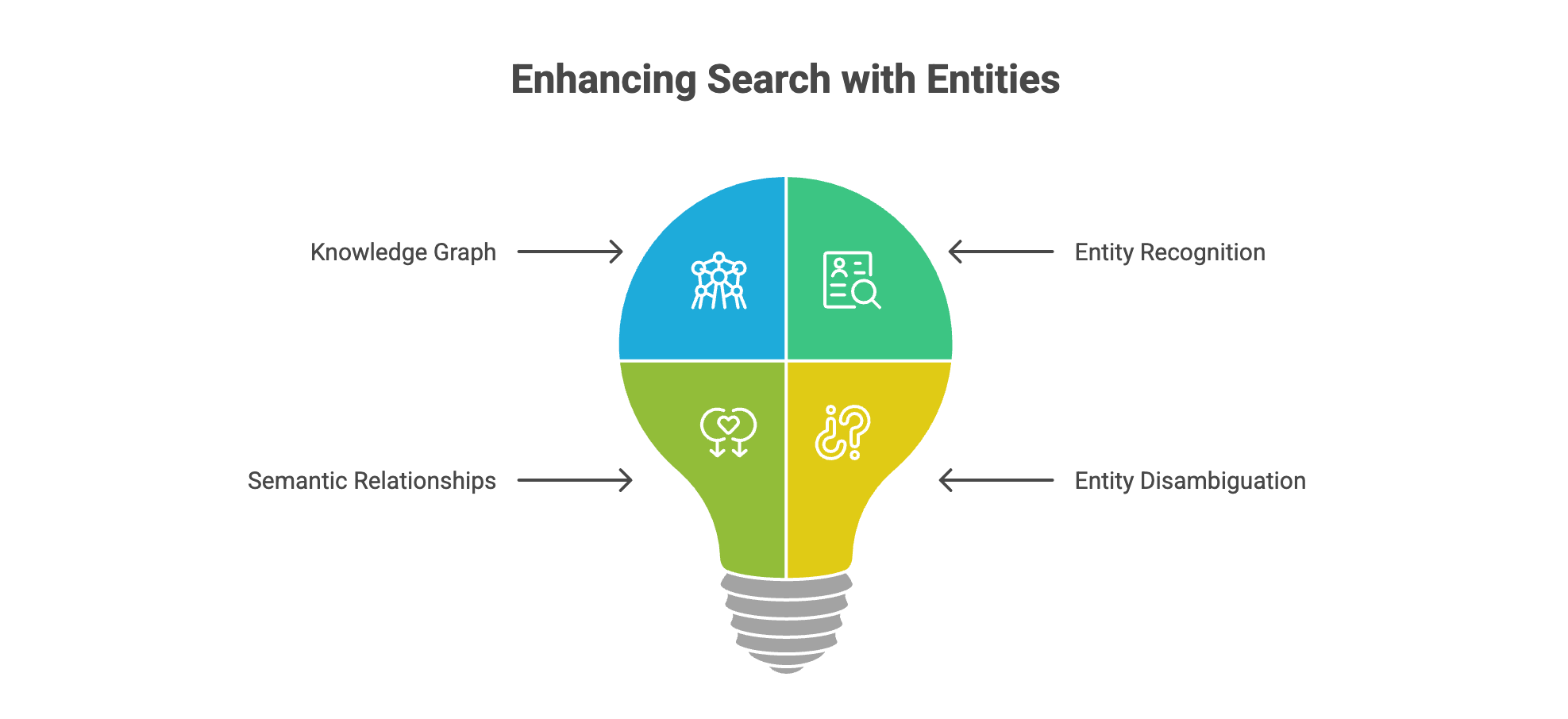
The Knowledge Graph is Google’s database of entities and their attributes. When you search for a well-known brand or person, the information panel on the right side of your screen pulls directly from this database. Getting your business recognized in the Knowledge Graph means Google understands who you are as a distinct thing – not just a collection of keywords on a page.
Semantic Relationships Between Entities
Google maps connections between different entities to understand context. A real estate agent entity connects to related entities like “home buying,” “Toronto neighbourhoods,” and “mortgage rates.” When your content clearly establishes these relationships through internal links and topical coverage, Google can surface your pages for a wider range of relevant queries.
Entity Disambiguation in Search Results
Google distinguishes between entities that share the same name by analyzing surrounding context. Search “Mercury” and you might get the planet, the element, or the car brand – depending on what else appears in your query. Structured data and contextual signals help Google understand which entity your content references.
Why Google Shifted from Keywords to Entities
Google’s move toward entity-based search happened through several major algorithm updates. Each one built on the last.
- 2012Knowledge Graph
Introduced entity-based understanding – Google could now recognize real-world things rather than just matching text strings.
- 2013Hummingbird
Enabled semantic search, interpreting the full meaning of a query rather than analyzing individual words in isolation.
- 2015RankBrain
Added machine learning to interpret unfamiliar or ambiguous queries by relating them to known entity patterns.
- 2019BERT
Improved Google’s understanding of natural language and conversational queries – making context far more important than keyword density.
- 2021MUM
Introduced multimodal understanding across languages and formats, deepening entity relationships and enabling cross-topic connections.
Why Entity SEO Matters for Your Business
Entity optimization connects directly to visibility and lead generation across modern search surfaces.
- AI-generated answersTools like ChatGPT and Google AI Overviews pull from well-recognized entities. If Google doesn’t understand your brand as an entity, you’re unlikely to appear in AI results.
- Brand authority signalsBecoming a recognized entity builds trust with both search engines and users. Google treats known entities differently than unknown ones.
- Local search performanceClear entity signals improve visibility in “near me” searches and Google Maps results, where Google relies heavily on entity data.
- Long-term compoundingEntity recognition builds over time. The work you do now continues to pay off as Google’s understanding of your brand deepens.
How to Optimize Your Website for Entities
Each step below helps Google recognize and categorize your brand as a distinct entity.
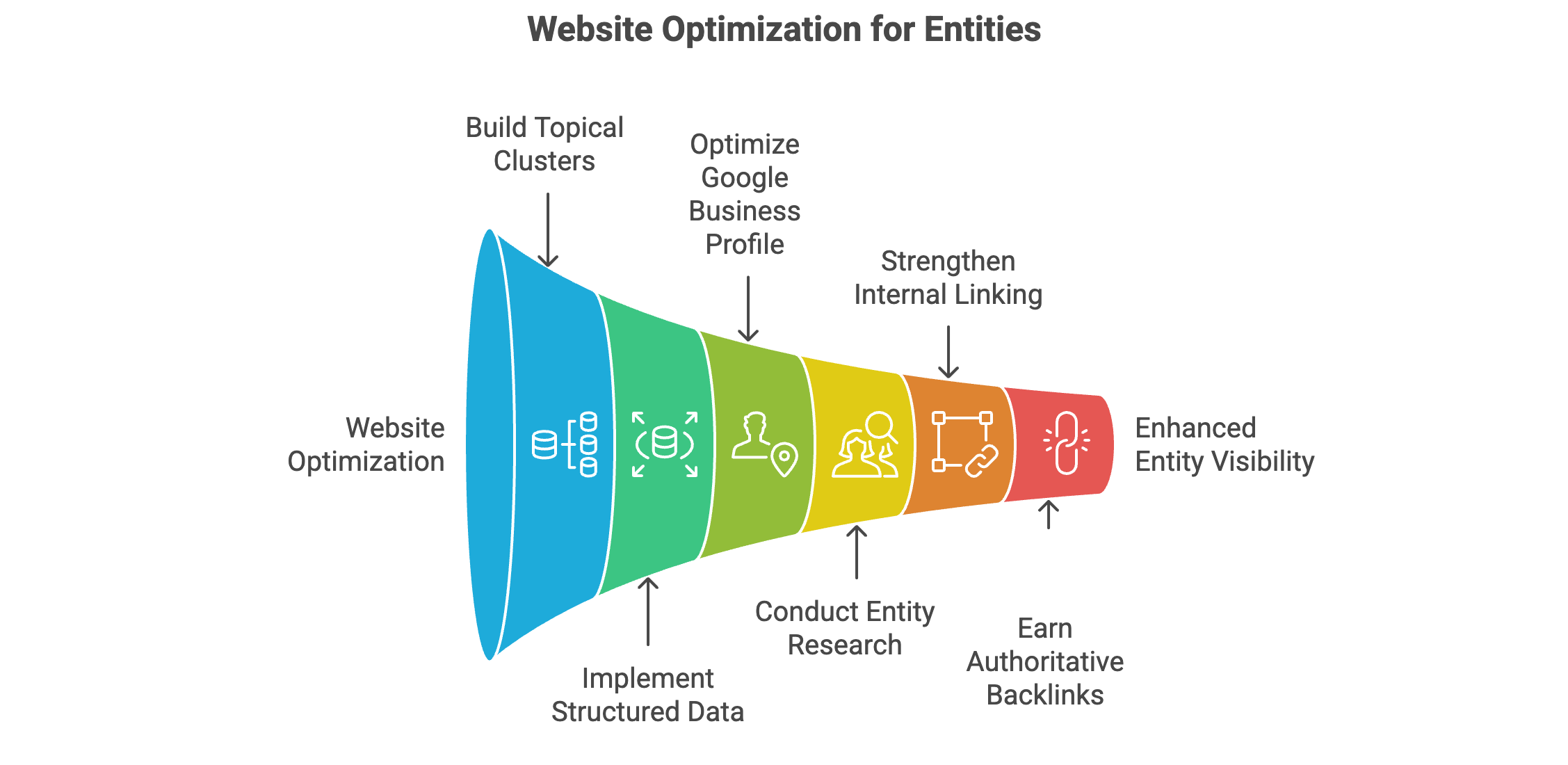
- 1Build Topical Clusters Around Core Entities
Create a pillar-cluster content structure where a central page establishes your core entity and supporting content reinforces related subtopics. A pillar page about “SEO services” might link to cluster content about technical audits, content optimization, and link building. Internal links between pillar and cluster pages signal to Google that these concepts connect.
- 2Implement Structured Data and Schema Markup
Schema markup explicitly tells search engines what entities exist on your page – removing ambiguity so Google doesn’t have to guess. Common schema types include:
- 3Optimize Your Google Business Profile for Local Entities
Your Google Business Profile serves as a primary entity signal for local businesses. Consistent NAP (Name, Address, Phone) information across all platforms, accurate business categories, and complete profile attributes all strengthen your local entity signals.
- 4Conduct Entity Research Alongside Keyword Research
Identify the entities Google already associates with your industry using tools like SEMrush or Ahrefs. Look at what appears in competitor knowledge panels and related searches. The people, places, and concepts that show up repeatedly are the entities you want to associate with your brand.
- 5Strengthen Internal Linking Between Related Entities
Use contextual internal links to help search engines understand relationships across your site. Link from service pages to relevant case studies, team bios, or location pages. Each link reinforces the connection between entities.
- 6Earn Authoritative Backlinks to Build Entity Trust
Backlinks from other recognized entities – authoritative publications, industry websites, local directories – strengthen your own entity signals. A link from a well-known industry publication carries more entity weight than dozens of links from unknown sites.
What Tools Help with Entity SEO
Check if Google recognizes specific entities
Find and implement correct structured data
Monitor performance in entity-rich results like knowledge panels
Analyze how Google categorizes entities in your content
Entity SEO & AI Search
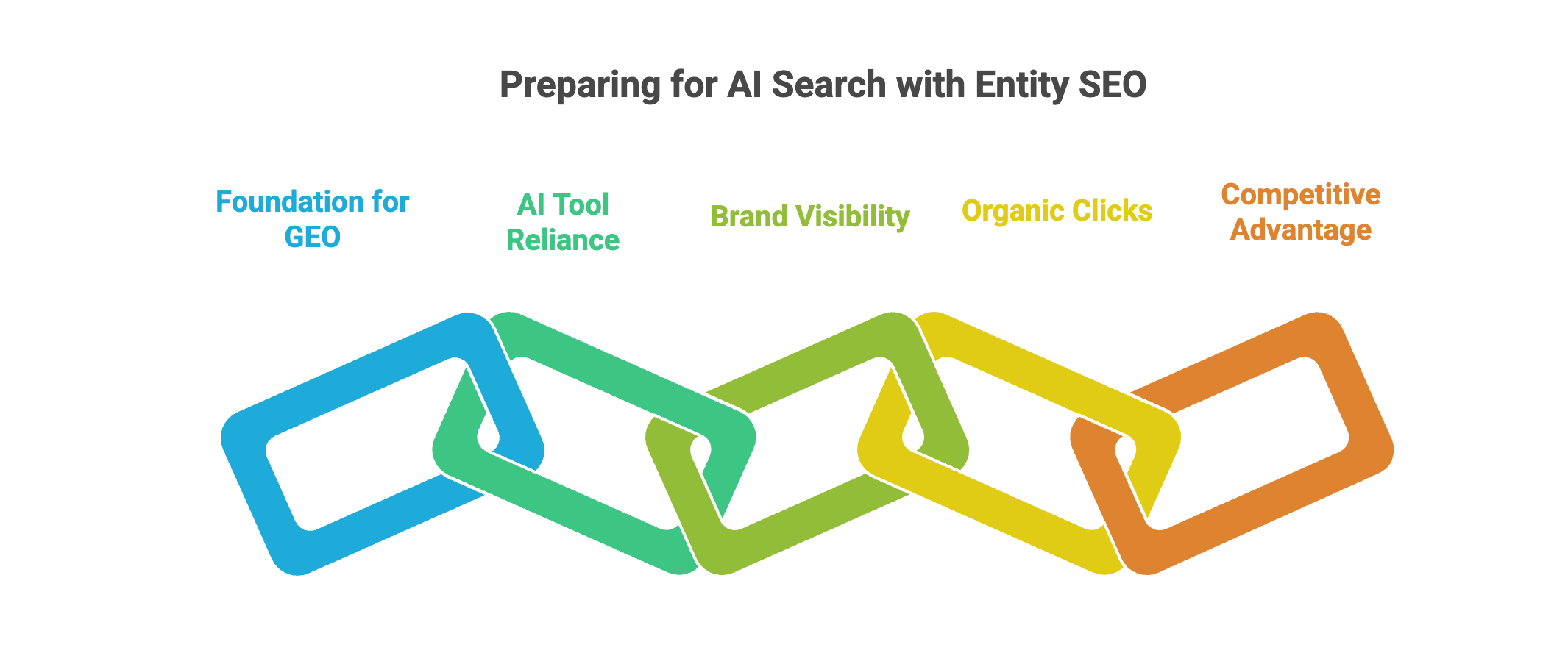
Entity SEO forms the foundation of what’s now called generative engine optimization (GEO). AI-powered tools like ChatGPT, Perplexity, and Google AI Overviews rely on entity recognition to generate answers and recommendations.
When someone asks an AI tool “What’s the best digital marketing agency in Toronto?”, the AI pulls from its understanding of entities in that space. Brands with clear, authoritative entity signals and AI-optimized content are more likely to be cited – earning organic clicks when appearing in AI Overviews. Brands without entity recognition often don’t appear at all.
Google AI Overviews reaches 2 billion monthly users. The entity work you do today compounds as AI search adoption grows – making now the highest-leverage moment to invest in entity optimization.
Common Mistakes to Avoid
- ✕
Inconsistent brand information – Different NAP data across platforms confuses search engines and weakens entity recognition.
- ✕
Missing structured data – Without schema markup, you’re relying on Google to guess what entities your content references.
- ✕
Treating keywords and entities as identical – Entity SEO requires building relationships between concepts, not just targeting isolated terms.
- ✕
Outdated content – Old information weakens entity relevance over time.
- ✕
Ignoring external mentions – Entity authority also builds through citations and mentions on other trusted sites.
Build Your Brand as a Recognized Entity
Your business can become a known entity within Google’s Knowledge Graph through consistent effort across several channels:
- Uniform brandingSame name, same logo, same descriptions across all digital platforms
- Press coverageSecure coverage from reputable sources in your industry and region
- Social proofReviews and testimonials on recognized platforms reinforce entity trust
Entity recognition is a long-term asset. Once Google understands your brand as a distinct entity, that recognition compounds – every future piece of content becomes more likely to rank because Google already knows who you are and what you do.
At Digital 6ix, we integrate entity optimization into full-funnel SEO strategies designed to drive measurable growth for Toronto businesses. Learn more about our SEO services to see how entity SEO fits alongside local SEO and paid advertising as part of a modern SEO strategy.
Frequently Asked Questions
How long does entity SEO take to show results?
Does entity SEO replace traditional keyword optimization?
How do I know if Google recognizes my brand as an entity?
What industries benefit most from entity SEO?
How does entity SEO affect local businesses?
Make Your Brand a Known Entity
We build full-funnel SEO strategies for Toronto businesses – entity optimization included from day one.
Explore Our SEO Services