

Read Time:
Modified Date:
How to Write Content That AI Tools Can Extract and Trust
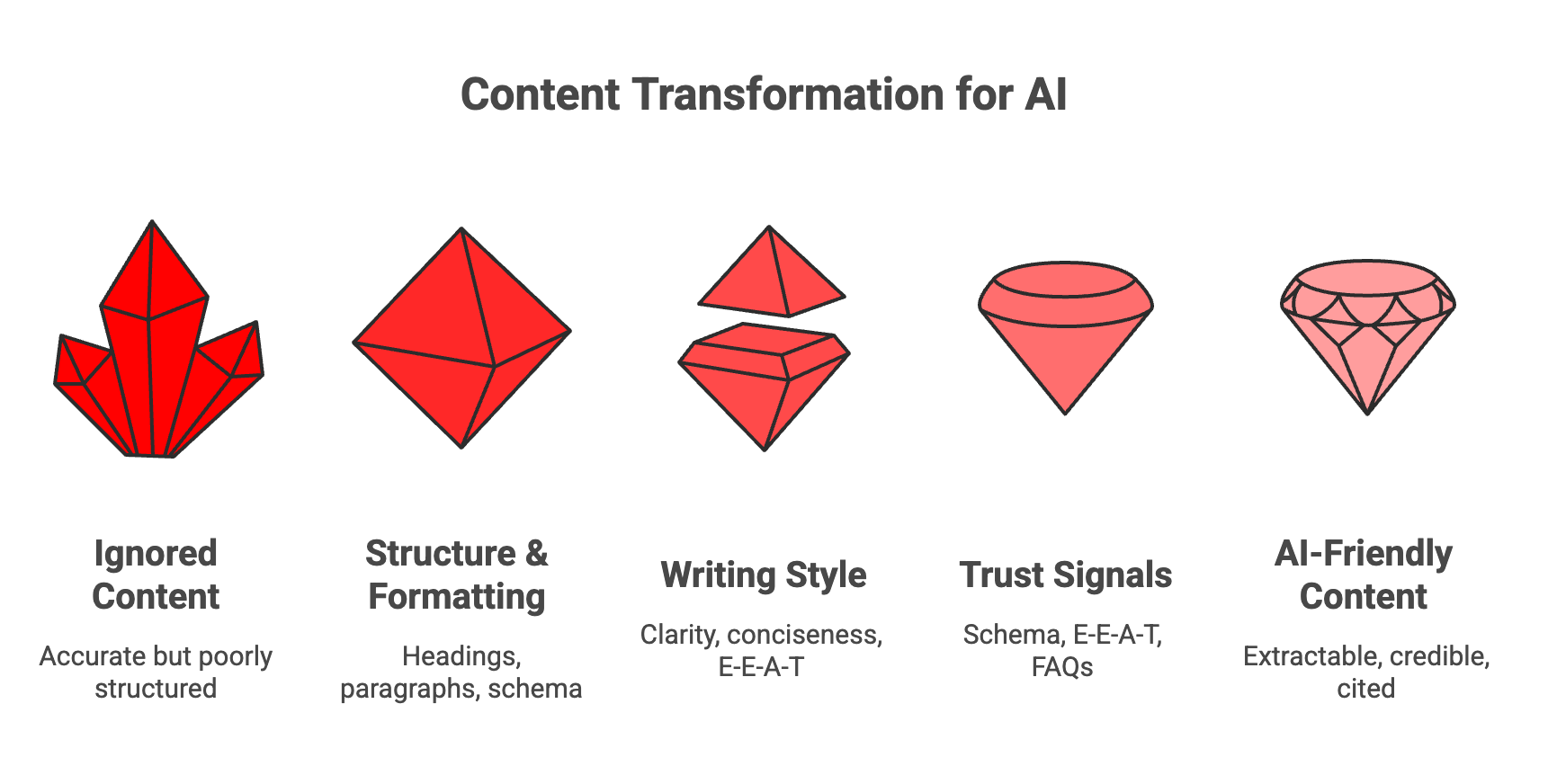
You can publish the most accurate, well-researched content on the web and still get ignored by AI tools like ChatGPT and Google AI Overviews. The difference between content that gets cited and content that gets skipped often comes down to how you structure and present information, not just what you say.
This guide covers AI content optimization – the specific formatting, writing, and trust signals that make your content extractable and credible to AI systems, from heading structure and paragraph length to schema markup and E-E-A-T signals.

TL;DR:
To get cited by AI tools like ChatGPT and Google AI Overviews, your content must be both extractable and trustworthy. That means using clear heading hierarchies, short single-focus paragraphs, direct answers at the start of sections, consistent terminology, and structured formats like lists, tables, and FAQs. AI systems scan for well-organized content they can easily chunk, summarize, and attribute, not long narratives with buried insights.
Trust signals matter just as much as structure. Demonstrate real experience, cite credible sources, show author credentials, maintain entity consistency (your brand name, services, location), and implement schema markup like FAQ, Article, or LocalBusiness. When you combine clean structure with strong E-E-A-T signals, your content becomes more likely to be extracted, cited, and recommended.
- Why AI extraction and trust matter for your content
- How AI tools read and summarize content
- What makes content trustworthy to AI
- How to structure content for AI extraction
- How to write with clarity AI can easily parse
- How to demonstrate E-E-A-T for AI systems
- How to use FAQs in AI content optimization
- How to use schema markup to signal AI
- AI-friendly content checklist
- Make your content work for AI and humans
Why AI extraction and trust matter for your content
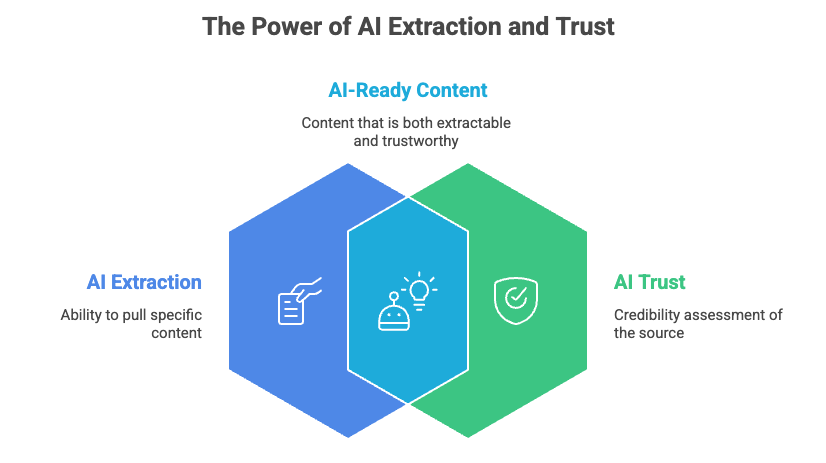
To write content that AI tools can extract and trust, you want to use clear headings, short paragraphs, plain language, lists, and direct answers to common questions. AI systems like ChatGPT, Perplexity, and Google AI Overviews now pull information directly into their responses. If your content isn’t structured for extraction or recognized as credible, it won’t appear in those answers.
Let’s break down what “extraction” and “trust” actually mean here. Extraction refers to an AI’s ability to pull specific pieces of your content into its responses. Trust is the AI’s assessment of whether your source is credible enough to cite in the first place. Both matter, and they work together.
The shift toward AI-powered discovery is already happening. 37% of consumers start searches with AI tools instead of traditional search results, and content that AI can’t easily read or doesn’t recognize as authoritative simply gets left out of the conversation.
How AI tools read and summarize content
Knowing how AI processes information helps explain why certain formatting and writing choices work better than others. Large language models don’t read the way you or I do.
AI reads in sections, not full pages
AI systems break your content into chunks based on headings and structural markers. They don’t read linearly from the first word to the last. Instead, they look for clear section breaks that help them isolate relevant information and understand context.
Without that structure, your content becomes harder to parse. The AI might pull the wrong section, misunderstand the context, or skip your content entirely in favour of something more clearly organized.
AI prioritizes direct answers over narrative
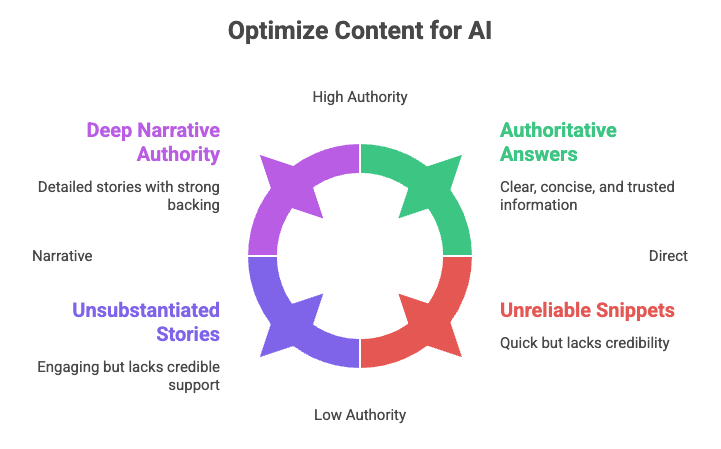
When responding to a query, AI looks for the clearest, most direct response it can find. Long narratives, meandering explanations, and buried answers often get skipped. The AI is essentially scanning for content that gets to the point quickly.
This doesn’t mean you can’t provide depth or nuance. It means your main point belongs at the beginning of each section, not at the end after several paragraphs of setup.
AI evaluates authority before citing sources
AI considers signals like domain reputation, content consistency, and markers of expertise before recommending or citing a source. Trust isn’t automatic. It’s earned through a combination of on-page factors (like author credentials and cited sources) and off-page factors (like backlinks and brand mentions elsewhere on the web).
What makes content trustworthy to AI
What Makes Content Trustworthy to AI
| Trust Factor | Why It Builds AI Trust |
|---|---|
| 01 Entity Clarity & Brand Consistency | Clear, consistent naming of your brand, founder, and services allows AI systems to recognize you as a defined entity. Inconsistent naming across platforms creates ambiguity and weakens trust signals. |
| 02 Cited Sources & Verifiable Data | Referencing authoritative publications, studies, or named experts signals that your claims are grounded in verifiable information. Unsupported assertions reduce credibility in AI evaluation models. |
| 03 Demonstrated Expertise & Real Experience | First-hand examples, specific case insights, and original perspectives distinguish expert content from generic summaries. AI increasingly prioritizes specificity and lived expertise over aggregated information. |
How to structure content for AI extraction
Structure determines whether AI can cleanly pull your information. Here’s where the tactical work happens.
Use descriptive headings with logical hierarchy
Structure your content using a logical heading hierarchy: H1 for your title, H2 for main sections, H3 for subsections. Each heading should clearly describe the content within its section.
Vague headings like “Overview” or “Details” don’t help AI understand what a section contains. Descriptive headings allow AI to categorize and extract information with precision.
Keep paragraphs short and single-focused
Write short paragraphs that focus on a single idea, ideally two to four sentences. AI extracts information more cleanly when each paragraph has a distinct focus.
When you bundle multiple concepts into one long paragraph, AI might misinterpret the relationships between ideas or pull only part of what you intended. Shorter paragraphs reduce that risk.
Use lists and tables to organize information
Lists and tables are highly structured formats that AI can parse and extract easily. They break down complex information into scannable pieces.
Front-load key information in every section
Put the main point or direct answer in the first sentence of each section. AI often extracts opening sentences, so burying your key information means it might never surface in AI responses.
This approach, sometimes called the inverted pyramid, places the most important information first and supporting details after. It’s how journalists have written for decades, and it works well for AI extraction too.
How to write with clarity AI can easily parse
| Principle | What It Means in Practice |
|---|---|
| Use Short Sentences and Plain Language | Avoid complex sentence structures and unnecessary jargon. Plain language means using everyday vocabulary that a client or non-expert would understand. Being precise and direct improves AI extraction. If you can say something in eight words instead of twenty, the shorter version usually works better. |
| Stay Consistent with Terms and Definitions | Choose a primary term for each key concept and use it consistently throughout your content. Switching randomly between different terms for the same concept confuses AI systems and weakens topical clarity. |
| Write Like You Would Explain to a Client | A conversational, approachable tone signals authenticity and is easier for AI to parse. Write as if you’re explaining the concept directly to someone who asked you the question. That natural, explanatory tone benefits both AI systems and human readers. |
How to demonstrate E-E-A-T for AI systems
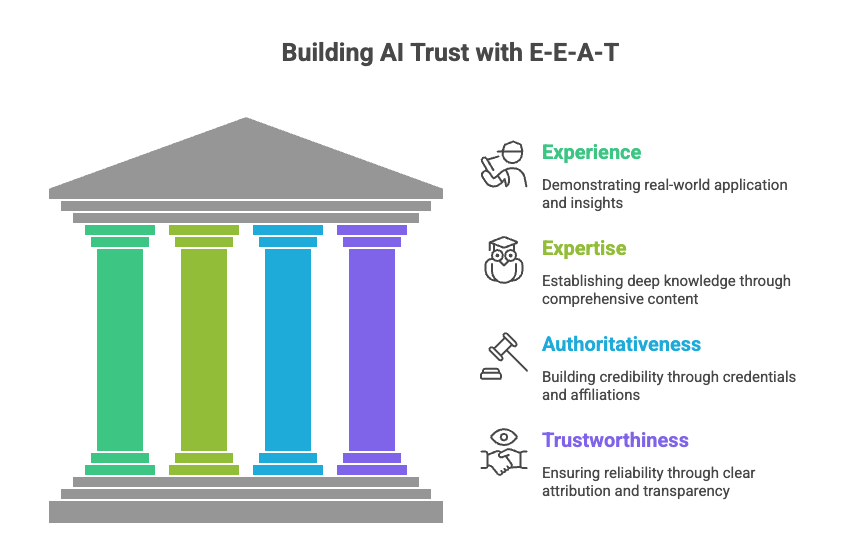
E-E-A-T stands for Experience, Expertise, Authoritativeness, and Trustworthiness. Google uses this framework to evaluate content quality, and AI systems increasingly reference similar principles when determining which sources to cite.
Show real experience with specific examples
Go beyond generic advice. Include specific scenarios from your actual work, real-world applications of your methods, and anonymized client situations where relevant.
First-hand experience differentiates your content from lower-quality information that simply rephrases what’s already ranking. AI systems are getting better at recognizing this difference.
Build topical authority with pillar content
“Pillar content” refers to comprehensive cornerstone pages that cover a broad topic thoroughly. By creating a central pillar page and linking it to more specific cluster pages, you signal deep expertise on a subject.
This pillar-cluster approach helps AI understand the relationships between your pages and recognize your topical depth. It’s a content architecture strategy central to any modern SEO strategy that balances traditional search and AI visibility.
Include author credentials and trust indicators
Display author bios with credentials, detailed company information, relevant certifications, and professional affiliations. AI looks for these markers to verify credibility.
A page with a clear author byline, credentials, and company context sends stronger trust signals than anonymous content with no attribution.
How to use FAQs in AI content optimization
FAQ sections are effective because they directly match the conversational, question-based nature of AI queries. 60% of question-based searches trigger AI summaries, and a well-structured FAQ can provide exactly what the AI is looking for.
How to use schema markup to signal AI
Schema markup is structured data code you add to your website to help search engines and AI understand your content’s meaning and context. According to Google’s structured data documentation, schema markup helps search engines understand page content explicitly, and pages with structured data are eligible for rich results that increase visibility and click-through rates.
FAQ schema for question-answer pages
Implementing FAQ schema explicitly tells AI that your content contains question-and-answer pairs. This increases the likelihood of your content being cited when users ask similar questions.
HowTo and Article schema for guides
HowTo schema signals that your content is instructional and provides step-by-step guidance. Article schema helps identify the content type, author, and publication date. Both help AI categorize your content appropriately.
LocalBusiness schema for regional visibility
For businesses serving specific geographic areas, LocalBusiness schema helps AI recommend your content for “near me” and location-specific queries. This is particularly relevant for businesses competing for local visibility in markets like Toronto and the GTA.
AI-friendly content checklist
AI-Friendly Content Checklist
- Clear heading hierarchy (H1 > H2 > H3)
- Direct answers in first sentence of each section
- Short paragraphs (one idea each)
- Consistent terminology throughout
- FAQ section matching real user questions
- Schema markup implemented and tested
- Author credentials and trust indicators visible
- External sources cited where relevant

Make your content work for AI and humans
Content optimized for AI is also valuable to human readers. Clear structure, direct answers, and demonstrated expertise serve both audiences well. The goals align rather than conflict.
For Toronto businesses looking to build extractable, trustworthy content, Digital 6ix’s AI Search Optimization services can help you get discovered, cited, and recommended by the AI tools your customers are already using.
This Blog is written by Simar Singh, Founder of Digital 6ix and a data-driven storyteller with 7+ years of experience helping Toronto businesses grow through performance-led digital strategies. Certified in Google Analytics and Google Search Console, with a strong focus on turning insights into measurable business outcomes.
How do I know if AI tools are citing my content?
You can test by entering relevant prompts into ChatGPT, Perplexity, or Google AI Overviews and checking if your brand or content appears in responses. Some SEO tools now offer AI citation monitoring features as well.
Does content length affect how AI extracts information?
Structure and clarity matter more than word count. AI can extract from short or long content equally well if it’s organized properly. That said, comprehensive coverage of a topic does help signal topical authority.
How often should I update content to maintain AI trust?
Update content when information becomes outdated or when you can add new insights and experience. Research from Ahrefs found that AI-cited content is 25.7% fresher than standard organic results, making regular content updates one of the most defensible signals you can send to both search engines and AI systems.
Do internal links help AI understand my content?
Yes. Internal links help AI understand the relationships between your pages and recognize your topical depth on a subject. They’re important for helping AI navigate your site’s content ecosystem.

