

Same website. Half the content. 8x the winning pages.
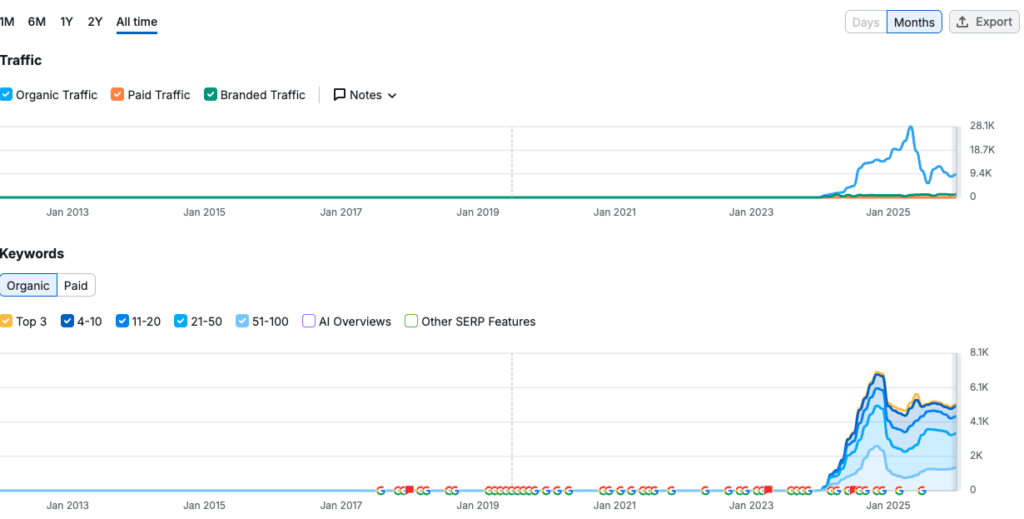
This content pruning case study from Toronto shows how a film festival website went from 435 bloated pages to 230 focused ones, and grew from 4 to 32 pages earning 100+ organic clicks a month. Six months of disciplined work, and every number below comes straight from Google Search Console.
435 pages. Only 4 doing any work.
Every year, this film festival draws creatives, critics, and industry leaders into Toronto’s cultural scene. Online, the story was different. The website had grown to 435 indexed pages, and almost none of them earned their place. Blogs were long but unstructured, pages didn’t match search intent, and the sheer bulk was diluting the site’s topical authority.
When the festival team came to us in September 2024, they weren’t asking for more page views. They wanted visibility, credibility, and performance.
- → 340 pages earning zero organic clicks
- → 91 pages scraping 1 to 100 clicks
- → Just 4 pages with any real traction
- → Content produced for volume, not value
- → Topical authority diluted across the site
Prune first. Then build deeper.
Our answer was yes. Growth here didn’t come from adding more. It came from having the discipline to remove what no longer served users, then rebuilding what remained around intent.
Half the pages. Multiples of the performance.
All figures from Google Search Console, comparing the pre-strategy baseline with 6 months post-implementation.
Straight from the dashboards.
Before vs after, 6-month comparison
| SEO metric | Before strategy | After strategy (6 months) |
|---|---|---|
| Total indexed pages | 435 pages | 230 pages |
| Pages with 0 organic clicks | 340 pages | 95 pages |
| Pages with 1 to 100 clicks | 91 pages | 99 pages |
| Pages with 101 to 1,000 clicks | 4 pages | 32 pages |
| Pages with 1,001 to 5,000 clicks | 0 pages | 4 pages |
| Content approach | High volume, low intent alignment | Focused volume, intent-aligned |
| Primary SEO action | Publishing new pages | Pruning, consolidation, re-optimization |
Data source: Google Search Console, page-level organic clicks.
Depth beats breadth.
Google rewards topical depth over raw page counts, and readers reward clarity over noise. By cutting what didn’t serve users, the remaining pages inherited the site’s full authority instead of splitting it 435 ways.
The fastest wins came from pages already sitting in positions 4 to 15. They didn’t need rescuing, they needed finishing: a sharper answer, a fresher stat, one more internal link.
“Think of your website like a film lineup. You wouldn’t showcase every submission just because it exists. You’d curate what moves people.” That’s how we pitched pruning to a hesitant client, and it’s how the strategy played out. In filmmaking, every great story has a moment where something is left behind. In SEO, that moment is content pruning.
Want the full narrative version? Read the complete content pruning story.
Frequently asked questions.
Why did deleting content improve SEO performance?+
How long does it take to see SEO results after content optimization?+
Is deleting half my website risky for SEO?+
Can small businesses compete with big brands in SEO?+
How does Digital 6ix approach content strategy differently?+
Is semantic SEO better than traditional keyword SEO?+
Publishing content that Google ignores?
Let’s look at what your website is really trying to say. Book a free 30 minute call and we’ll tell you exactly what we’d prune, what we’d keep, and what we’d rebuild first.
Book a Free Strategy Call →