Read Time:

12–18 minutes

Modified Date:

How to Discover Real Keywords From Customer Conversations

Most keyword research starts and ends with the same tools everyone else uses, which means you’re fighting over the same terms as every competitor in your market.

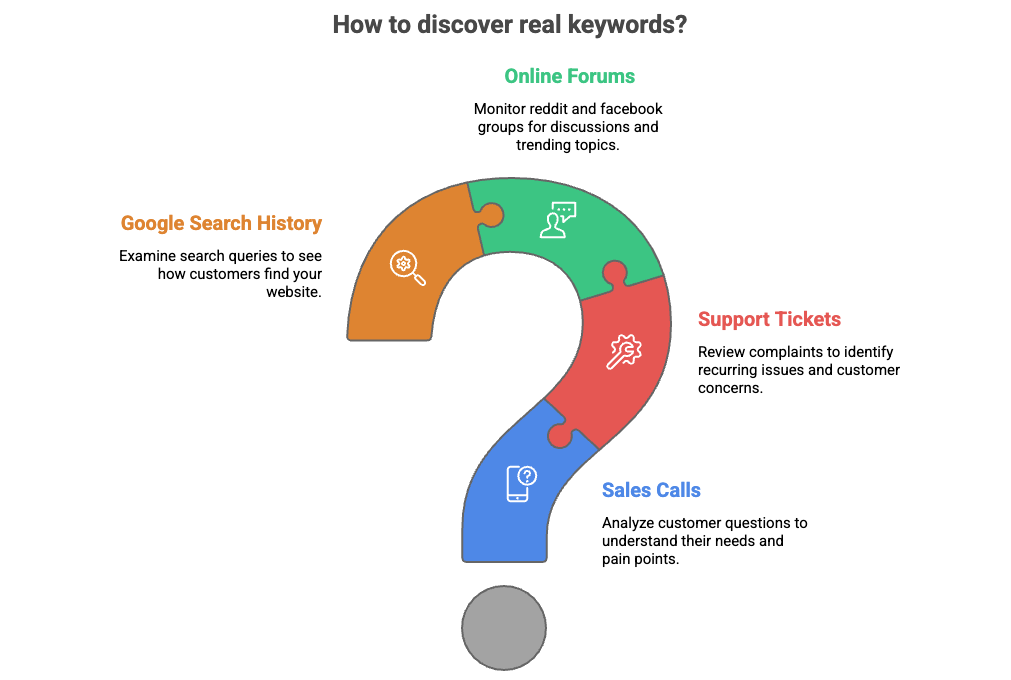
The phrases that actually convert often live somewhere else entirely:

The questions your customers ask on sales calls
The complaints buried in support tickets
The questions raised on reddit forums or facebook groups
The exact words they type into Google before they find you.

This guide walks you through how to mine real customer conversations for keyword gold, organize what you find into a usable strategy, and validate your list without paying for expensive tools. 

Diagram showing How to Discover Real Keywords From Customer Conversations using online forums, Google search history, support tickets, and sales calls

TL;DR:

Most businesses rely on keyword tools that show search volume but miss the real language customers use when they are ready to buy. The highest-converting keywords often come directly from sales calls, support tickets, reviews, Reddit threads, social media comments, and Google’s own autocomplete suggestions.

By listening to how customers describe their problems in their own words, you uncover long-tail, high-intent phrases that tools frequently overlook, especially low-volume searches with strong buying intent. The process is simple: extract recurring phrases from real conversations, group them by topic and search intent, expand them into long-tail variations, map them to the buyer journey, and validate them using free tools like Google Search Console and Google Trends.

When you apply this customer-driven language to your website copy, blog content, ads, and local SEO, you create content that feels relevant, ranks more effectively, and converts at a higher rate.

Why Keyword Tools Miss What Your Customers Actually Say
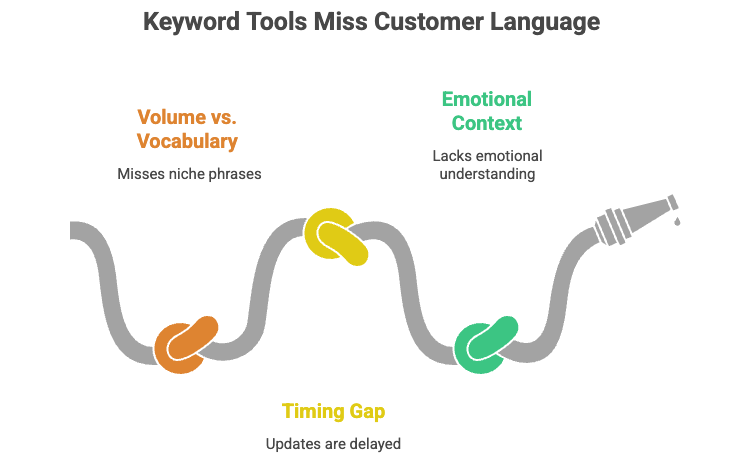
Infographic explaining why keyword tools miss customer language, emotional context, and long-tail search phrases

Keyword research by talking to customers means pulling direct, natural language from support tickets, sales calls, reviews, conversations, and surveys to find the exact problems and phrases your audience uses.

Rather than relying only on search volume metrics, this approach focuses on user intent, the reason behind a search which helps you create content that actually answers questions and converts visitors into leads.

Here’s the thing about keyword tools: they’re built to show you volume, not vocabulary. According to Ahrefs’ keyword research, the vast majority of search queries are long-tail with most receiving fewer than 10 searches per month – yet collectively they make up the bulk of all search volume.

There’s also a timing gap. Tool databases update on a delay, sometimes weeks or months behind emerging language in your industry. If your customers start describing a problem in a new way, the tools won’t catch up for a while.

And perhaps most importantly, tools can’t capture the emotional context behind a search. They tell you what people search for, but not the frustration, confusion, or urgency that led them there. That context is exactly what separates content that ranks from content that converts.

What Customer Listening Reveals That Tools Cannot
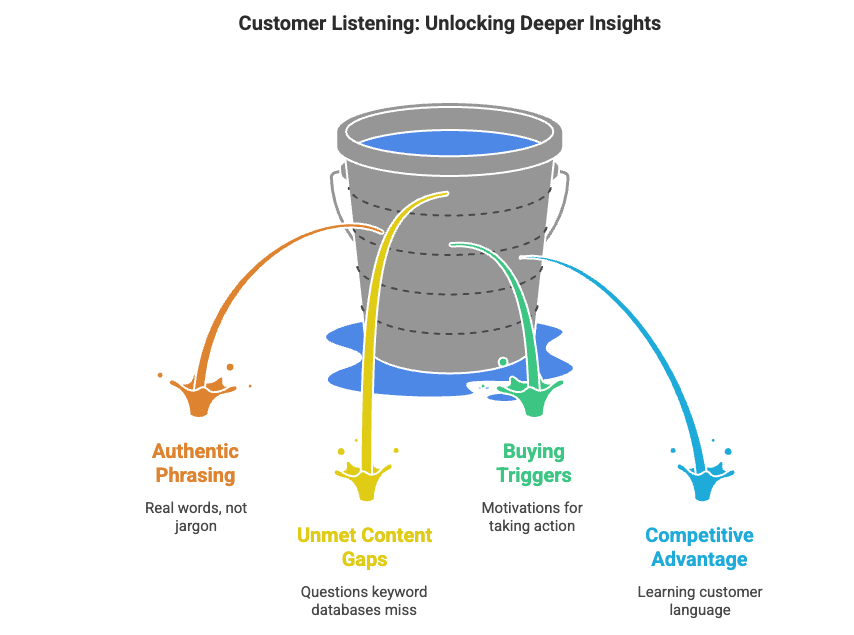
Customer listening strategy illustration showing authentic phrasing, unmet content gaps, buying triggers, and competitive advantage in keyword research.

Keyword tools give you numbers. Customer conversations give you meaning. The difference matters more than most marketers realize.

When you listen to how customers actually describe their problems, you hear authentic phrasing – the words real people use, not industry jargon. A homeowner doesn’t search “HVAC system malfunction.” They search “why is my furnace making a weird noise at night.”

Unmet content gaps: Real conversations surface questions and frustrations that keyword databases will never detect, simply because no one has written content about them yet.

Buying triggers: Customer feedback reveals what motivates someone to finally take action. Knowing why someone decided to call matters more than knowing they searched “plumber near me.”

Competitive advantage: According to Search Engine Land, tapping into the questions prospective customers ask helps you learn the language they’re using, and that language becomes your edge over competitors relying solely on the same tool data everyone else has.

Keyword Tool Approach Customer Conversation Approach
Shows search volume Reveals buying language
Updated on a delay Real-time from live conversations
Industry terminology Customer’s own words
High competition terms Low-volume, high-intent phrases

Where to Find Your Customers’ Exact Words for Keyword Research

The best keyword sources are hiding in plain sight. You likely already have access to conversations, feedback, and questions that contain exactly what you’re looking for.

Customer Interviews and Sales Calls

Recorded sales calls and live customer interviews are packed with keyword data. Listen for recurring phrases, questions, and pain points that come up across multiple conversations.

The most useful question you can ask is simple: “How did you describe this problem before you found us?” The answers often surprise you.

A mortgage broker might assume clients search “mortgage rates,” but discover they actually type “how much house can I afford on 80k salary.”

Support Tickets and Live Chat Logs

Your customer support interactions are a direct line to customer confusion.

Support tickets and chat transcripts reveal the exact language people use when they’re stuck, frustrated, or looking for a specific solution.

Search through recent tickets for repeated questions and complaints. If five customers ask the same question in slightly different ways, you’ve found a keyword cluster worth targeting.

Online Reviews and Testimonials

Both your reviews and your competitors’ reviews contain keyword-rich language.

Customers often describe the initial problem they faced and the specific outcomes they achieved in searchable terms.

Look for phrases related to the “before” state (the problem) and the “after” state (the solution). A review that says “I was tired of my website looking outdated and unprofessional” gives you a clear keyword opportunity.

Social Media Comments and Direct Messages

Scan the comments on your social media posts, as well as your competitors’, for common questions and language patterns.

People ask for recommendations and express frustrations in a casual, natural way that reflects how they actually search.

A comment like “does anyone know a good accountant who actually explains things?” tells you exactly what to target.

Community Forums and Reddit Threads

Niche forums and subreddits contain raw, unfiltered questions from your target audience.

Search for threads related to your product or service category to see how real people talk about their challenges.

A single Reddit thread asking “has anyone dealt with [problem]?” can reveal a dozen long-tail keyword opportunities that no tool would surface.

Google Autocomplete and People Also Ask

While technically a tool, Google’s own features reflect actual user behavior in real-time.

Type a root keyword into Google and watch what appears in the autocomplete dropdown.

Then look at the “People Also Ask” box to see related questions. This bridges direct customer listening with search validation, confirming that the phrases you collected are actually being searched.

How to Turn Customer Language into a Targeted Keyword List

Once you’ve collected raw customer language, the next step is organizing it into a structured list you can actually use. This process moves you from scattered phrases to a content plan with clear priorities.

1. Extract Recurring Phrases and Questions:

Go through all your notes, call transcripts, and screenshots. Pull out any specific phrases, questions, or problem descriptions that appear multiple times across different sources.

A phrase mentioned by three different customers is a strong signal. Document each phrase in a spreadsheet with the source noted so you can reference it later.

2. Group Keywords by Topic and Search Intent

Categorize your phrases by topic (pricing, installation, troubleshooting) and by search intent. Search Intent refers to the reason behind a search, what person actually wants to accomplish.

Grouping by intent helps you create the right type of content for each phrase. An informational query calls for a how-to guide, while a transactional query calls for a service page.

3. Identify Long-Tail Keyword Variations

Backlinko’s analysis of long-tail keywords found that longer, more specific queries convert at significantly higher rates than broad head terms because searchers using them already know what they want. A phrase like “fix broken website” is broad.

A phrase like “how much to fix a broken WordPress site” is specific and signals someone closer to making a decision.

Take each core phrase you discovered and expand it into variations based on what you heard from customers. The more specific the phrase, the more likely the searcher knows what they want.

4. Map Keywords to the Buyer Journey

Assign your keywords to different stages of the buyer journey to ensure you’re creating content that meets customers where they are in their decision process.

Awareness: The customer recognizes a problem but doesn’t know the solution yet (“why is my website so slow?”)

Consideration: The customer is researching possible solutions (“website speed optimization services”)

Decision: The customer is ready to choose a provider (“best agency for website speed Toronto”)

Since the majority of searches are informational in nature, making awareness-stage content essential – these are the queries where customer language, not keyword tools, gives you the real edge. A layered SEO strategy ensures each stage gets the content it deserves.

How to Validate Customer Keywords Without Paid Tools
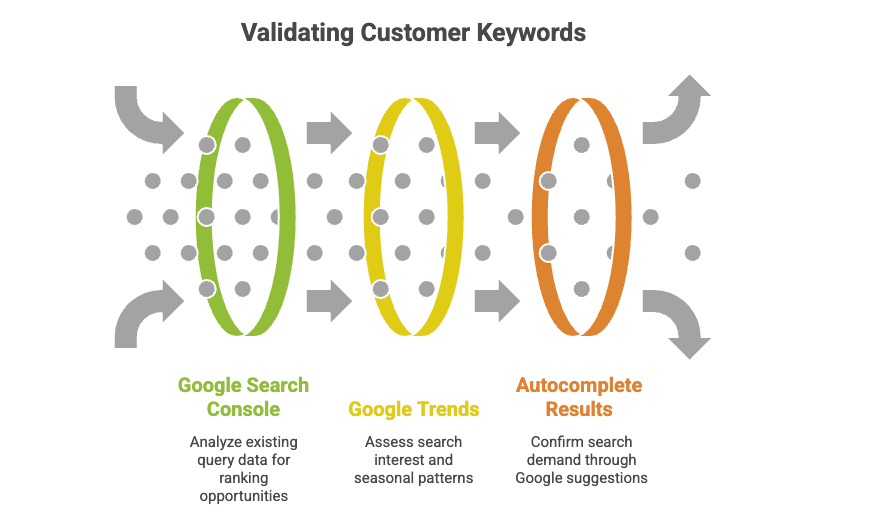
Process for validating customer-sourced keywords using Google Search Console, Google Trends, and autocomplete results

Customer-sourced keywords are valuable, but they still benefit from a quick check to confirm that search demand exists. You don’t need expensive tools for this step.

Google Search Console for Existing Query Data

If you have an existing website, Google Search Console shows the exact queries your site already ranks for. Go to the Performance report to identify low-hanging fruit – phrases where you rank on page 2 that could move up with a focused SEO audit and targeted optimization.

This data also confirms whether the language you heard from customers matches what people are already using to find you.

Google Trends for Demand Signals

Google Trends compares relative interest levels of different search terms over time. While it doesn’t provide exact volume numbers, it’s useful for spotting seasonal patterns and confirming consistent search interest.

If a phrase you collected shows steady or growing interest, that’s a green light. If it’s flatlined or declining, you might deprioritize it.

Autocomplete Results for Related Terms

If you start typing a phrase you collected from a customer and Google suggests it as a full query, that’s a clear sign other people are searching for it. No paid tool required – just a browser and a few minutes.

How to Put Customer-Sourced Keywords to Work
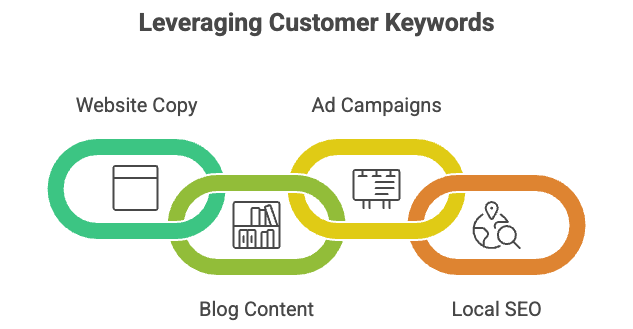
Customer-sourced keywords applied to website copy, blog content, ad campaigns, and local SEO strategy

Once you have a validated list, the next step is applying customer-sourced keywords across your digital marketing efforts.

Website copy: Incorporate authentic phrases naturally into headlines, service page descriptions, and meta titles. Using the exact language your customers use improves relevance and click-through rates.

Blog content: Build a content calendar of articles that directly answer the questions and pain points you collected. Each question can become its own post, or structured as FAQ schema content to improve visibility in AI-powered search results.

Ad campaigns: Use exact customer language in your Google Ads copy and landing pages. When the ad matches the search query and the landing page matches the ad, conversion rates improve.

Local SEO: Apply location-specific phrases (like “best roofer in Leslieville”) to your Google Business Profile posts, services, and local landing pages.

According to Simar Singh‘s Linkedin Post, Behind Every Review Is a Buyer’s Story. Are You Paying Attention ? – People write the playbook for you, if you’re willing to listen.

Build a Keywords From Customer Conversations Strategy with Digital 6ix

The most effective SEO work combines deep customer listening with data-driven analysis. At Digital 6ix, we focus on what actually matters for Toronto businesses: generating qualified leads, increasing calls, and driving real revenue.

Our approach starts with understanding your customers first, so we can build a strategy that speaks their language and meets their needs where they’re already searching.

Book a free consultation with our team today

This Blog is written by Diana Yang, Lead Content Strategist at Digital 6ix with 6+ years of experience helping Toronto businesses grow through data-driven content and SEO strategies. Google Analytics and Google Search Console certified, with a strong focus on improving visibility, engagement, and qualified lead generation.

Frequently Asked Questions

Leave a Comment

Your email address will not be published. Required fields are marked *