
Read Time:

13–20 minutes

Modified Date:

Why Local SEO Is Critical for Toronto Business Growth in 2026

Most people searching for a local business never scroll past the first few results. If your business doesn’t appear when someone nearby searches for what you offer, you’re invisible to the customers most ready to buy.

Local SEO determines whether your business shows up in those moments, and for companies serving specific geographic areas, it’s become the difference between steady growth and watching competitors capture demand you never knew existed. This guide covers what local SEO actually involves, why it matters more now than ever, and how to build a strategy that turns local searches into revenue.

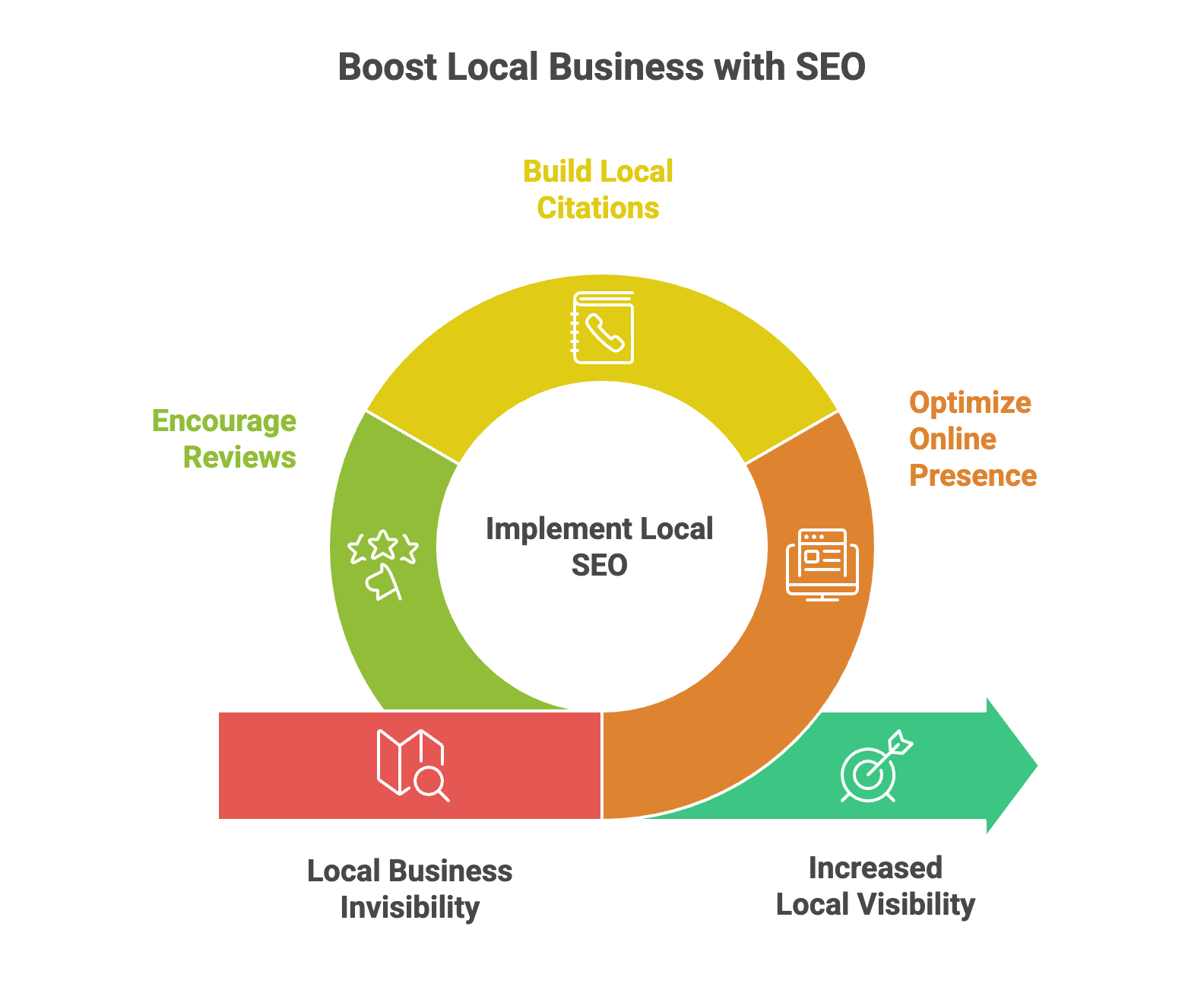
Circular infographic illustrating local SEO strategy steps including building citations, encouraging reviews, optimizing online presence, and increasing local visibility.

TL;DR:

Local SEO determines whether your business shows up when nearby customers search for what you offer and in 2026, those searches often lead directly to visits and purchases. With most users never scrolling past the Map Pack and the majority of Google Business Profile views coming from discovery searches, visibility in local results is the difference between steady growth and lost revenue. If you’re not appearing for “near me” or city-based searches, your competitors are capturing that demand.

Success in local SEO comes down to optimizing your Google Business Profile, maintaining consistent citations (NAP), generating and responding to reviews, targeting local keywords on your website, and building geographically relevant backlinks. Unlike paid ads, local SEO compounds over time, creating durable visibility and trust. For businesses serving specific areas, it’s your primary growth channel.

What is local SEO

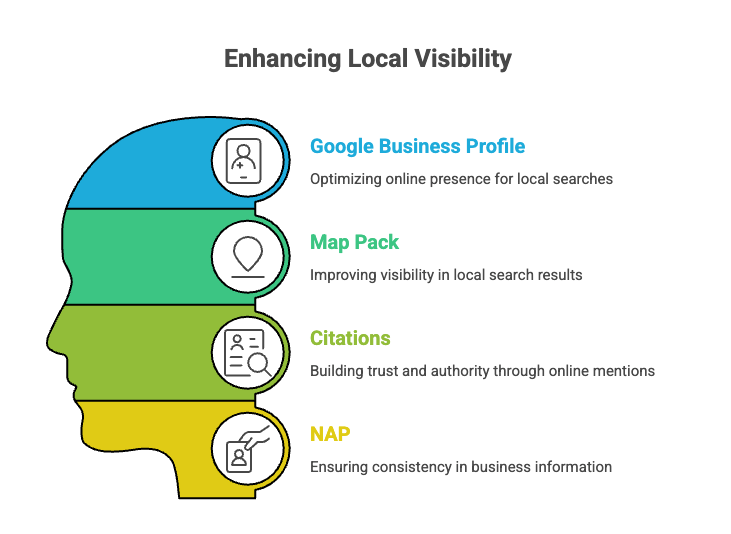
Local SEO visibility diagram highlighting Google Business Profile, Map Pack rankings, citations, and NAP consistency.

Local SEO is how you optimize your online presence so your business shows up when someone nearby searches for what you offer. When a person types “dentist near me” or “Toronto hair salon,” Google decides which businesses appear. Local SEO influences that decision.

The distinction from regular SEO is geographic intent. Traditional SEO helps you rank for broad topics regardless of location. Local SEO focuses specifically on connecting you with customers in your area who are ready to visit, call, or buy.

Before going further, here are a few terms worth knowing:

Google Business Profile (GBP): A free listing that displays your business in Google Maps and local search results.
Map Pack: The top three local results shown with a map, appearing above standard search listings.
Citations: Mentions of your business name, address, and phone number on other websites.
NAP: An acronym for Name, Address, Phone number – the core information that identifies your business online

Why local SEO matters more than ever

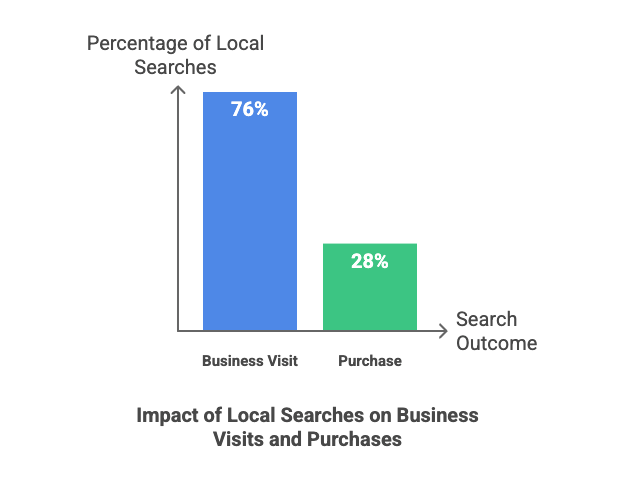
Bar chart showing 76 percent of local searches lead to business visits and 28 percent result in purchases.

Local SEO puts your business in front of people who are actively looking for what you sell, right when they’re ready to act. According to Agency Jet, 76% of people who do a local search on their phone visit a business within a day, and 28% of those searches lead to a purchase. That’s not casual browsing, but intent.

The shift toward mobile and “near me” queries has changed how people find local businesses. Someone searching “plumber near me” at 9 PM has a problem they want solved now. If your business appears, you have a real chance at winning that customer. If it doesn’t, your competitor does.

For any business with a physical location or a defined service area, local SEO has become the primary discovery channel. Skipping it means being invisible to the people most likely to become customers.

Key benefits of local SEO for your business
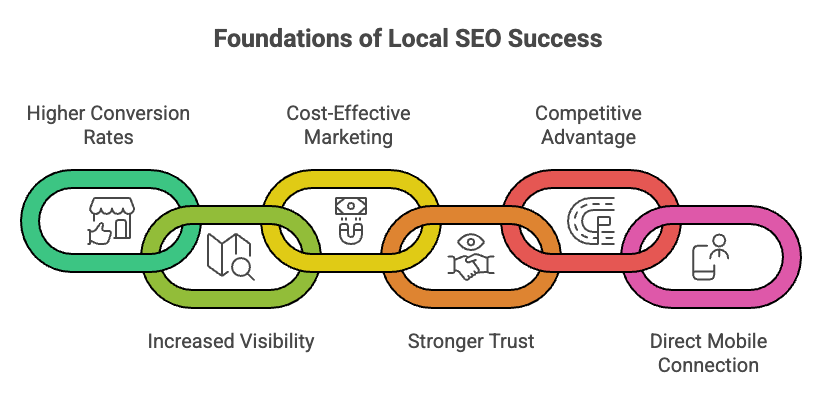
Diagram showing the foundations of local SEO success including higher conversion rates, cost-effective marketing, competitive advantage, increased visibility, stronger trust, and direct mobile connection.

Higher conversion rates

Local searches come from people with immediate intent. The person searching “emergency locksmith” isn’t comparison shopping for fun, they’re locked out and want help now. This intent makes local SEO one of the highest-converting marketing channels available.

Compare that to a billboard or social media ad, where you’re hoping to catch someone’s attention and eventually convert interest into action. With local search, the interest already exists. Your job is simply to show up.

Increased visibility in local search

The Map Pack appears at the top of search results, above traditional organic listings. Showing up there puts your business in front of people before they scroll anywhere else.

Local visibility also extends to voice search. When someone asks their phone “find a mechanic nearby,” the answer pulls from local listings. If you’re not optimized, you’re not in the running.

Cost-effective marketing with compounding ROI

Paid ads stop working the moment you stop paying. Local SEO works differently. The effort you put in today continues generating visibility months and years later.

Rankings build on themselves over time. A strong Google Business Profile, consistent citations, and positive reviews create momentum that compounds rather than resets each month. For businesses watching their marketing budget, this makes local SEO a smarter long-term investment than channels that require constant spending.

Stronger trust and credibility

A complete Google Business Profile with dozens of positive reviews signals legitimacy before anyone visits your website. People trust businesses with strong ratings. BrightLocal’s 2026 survey found 31% of consumers require 4.5 stars or higher to even consider a business.

Reviews act as social proof at scale. When potential customers see others in their community vouching for your work, the decision to choose you becomes easier. You’ve already built trust before the first conversation.

Competitive advantage in your area

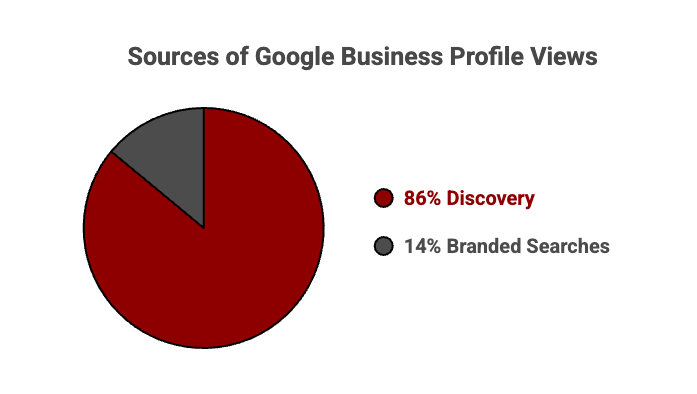
Pie chart showing 86 percent of Google Business Profile views coming from discovery searches.

Large national brands often neglect local optimization. They focus on broad campaigns and overlook the specific signals that drive local rankings. With 86% of GBP views coming from discovery rather than branded searches, this creates an opening for smaller businesses to outrank bigger competitors in geographic searches.

A local law firm can outrank a national legal directory for “family lawyer Toronto” by focusing on local signals the directory ignores. Size matters less than relevance in local search.

Direct connection with mobile searchers

Most local searches happen on phones, often while people are already out and deciding where to go. Mobile searchers represent your most valuable audience because they’re typically minutes away from making a choice.

If your business appears when someone searches “coffee shop near me” while walking down the street, you have a real shot at their business. If it doesn’t, they’ll walk into your competitor’s door instead.

How local search optimization works

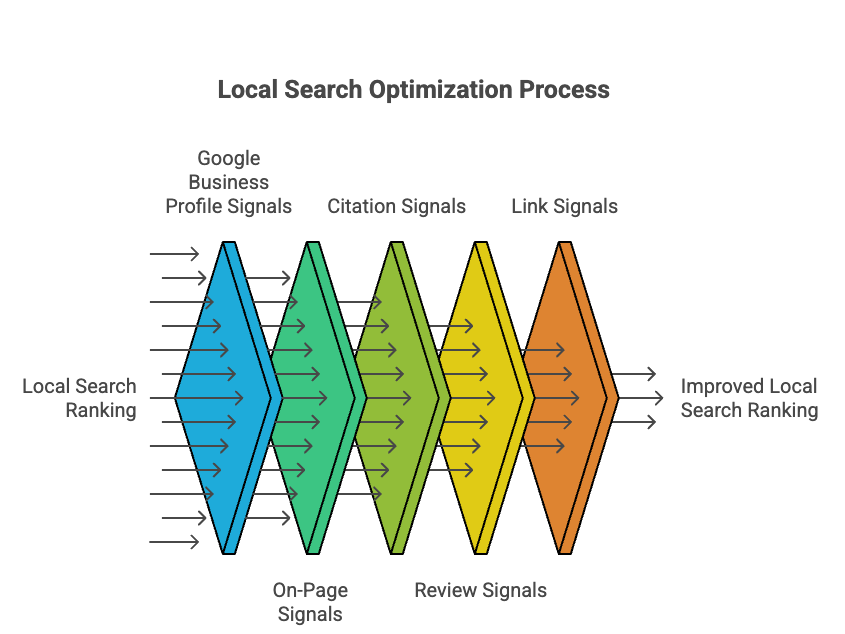
Flow diagram showing local search ranking improvement through Google Business Profile signals, on-page optimization, citations, review signals, and link signals.

Google uses different ranking factors for local results than for traditional organic search. Five signal categories determine where your business appears.

Signal Category What It Includes Why It Matters
Google Business Profile Completeness, categories, posts, photos Primary local ranking factor
On-Page Location pages, local keywords, NAP on site Tells Google where you serve
Citations Directory listings, NAP consistency Validates your business information
Reviews Quantity, quality, recency, responses Signals trust and customer satisfaction
Links Local backlinks, community mentions Builds geographic authority

Google Business Profile signals

According to Whitespark’s 2026 ranking factors report, your GBP carries more weight than any other local ranking factor at 32%. Google looks at whether your profile is complete, whether you’ve selected accurate categories, and whether you actively maintain it with posts, photos, and responses to questions.

An incomplete or neglected profile tells Google you’re not engaged. A fully built-out profile with regular activity signals a legitimate, active business.

On-page signals

Your website reinforces where you operate. Location-specific pages, local keywords in titles and headers, and consistent NAP information all tell Google which geographic areas you serve.

If your site never mentions Toronto but you want to rank for Toronto searches, Google has no reason to connect you to that area.

Citation signals

Citations are mentions of your business information on other websites – directories like Yelp, Yellow Pages, and industry-specific listings. Consistency matters here. If your phone number varies across different sites, or your address is formatted differently in multiple places, Google loses confidence in your information.

Clean, consistent citations across the web validate that your business is real and your information is accurate.

Review signals

Google considers how many reviews you have, how positive they are, how recent they are, and whether you respond to them. Reviews also influence whether people click on your listing. A business with 4.8 stars and 200 reviews gets more attention than one with 3.5 stars and 12 reviews.

Responding to both positive and negative reviews, demonstrates engagement and builds trust with future customers reading those responses.

Link signals

Backlinks from local sources build geographic authority. A link from a local news site, community organization, or nearby business tells Google you’re relevant to that area.

Local link building differs from general link building. The goal isn’t just authority – it’s establishing your connection to a specific place.

Local SEO vs traditional SEO

Both disciplines share foundational principles, but local SEO prioritizes different factors and targets different user intent.

The biggest difference is proximity. Traditional SEO doesn’t care where the searcher sits. Local SEO heavily weights how close your business is to the person searching. Two businesses with identical optimization can rank differently depending on where the searcher is standing.

Factor Traditional SEO Local SEO
Primary Goal Rank for broad keywords Rank for location-based searches
Key Ranking Factor Backlinks and content depth Google Business Profile and proximity
Results Display Standard organic listings Map Pack plus localized organic results
Target Audience Anyone searching the topic Customers in your service area
Review Importance Minimal direct impact Major ranking and conversion factor

Which businesses benefit most from local SEO
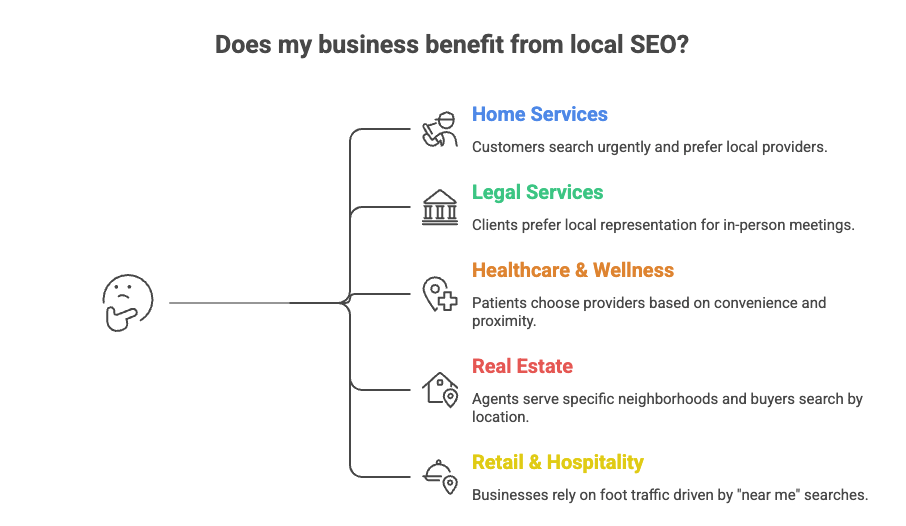
Chart showing industries that benefit from local SEO including home services, legal services, healthcare, real estate, and retail and hospitality.

Local SEO delivers the strongest results for businesses with physical locations or defined service areas. If customers come to you, or you travel to them within a geographic region, local optimization applies.

Home services: Plumbers, electricians, and contractors benefit because customers search during urgent situations and want someone nearby
Legal services: Law firms serve specific jurisdictions, and clients prefer local representation they can meet in person
Healthcare and wellness: Patients choose providers based on convenience and proximity to home or work
Real estate: Agents serve specific neighbourhoods, and buyers search by location
Retail and hospitality: Restaurants and shops rely on foot traffic driven by “near me” searches

If your business serves customers regardless of location – a software company selling globally, traditional SEO likely matters more than local optimization.

How to build a local SEO strategy that drives growth
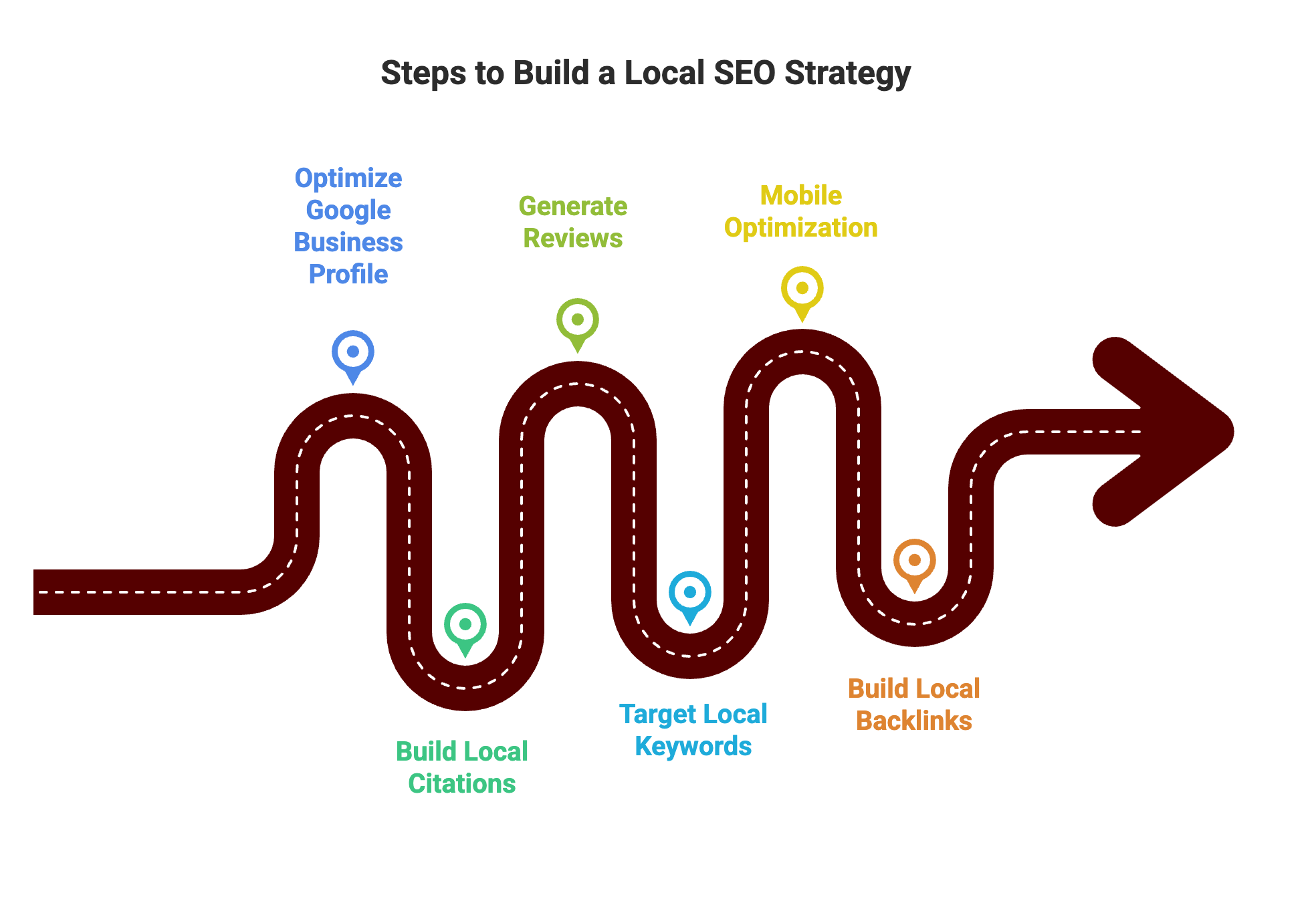
Roadmap graphic outlining steps to build a local SEO strategy including optimizing Google Business Profile, building citations, targeting local keywords, generating reviews, mobile optimization, and building backlinks.

1. Optimize your Google Business Profile

Claim and verify your profile, then complete every available field. Select accurate primary and secondary categories, add high-quality photos, and post updates regularly. For many businesses, this single step produces the fastest visibility gains.

2. Build and maintain local citations

Submit your business to major directories and ensure your NAP information matches exactly across all listings. Even small variations – “Street” versus “St.” or different phone formats, can create consistency issues that affect rankings.

3. Generate and respond to customer reviews

Create a simple system to request reviews after positive customer interactions. Respond to every review, positive or negative. Engagement signals to both Google and future customers that you’re active and attentive.

4. Target local keywords across your website

Include city and neighbourhood names in title tags, headers, and content naturally. If you serve multiple areas, create dedicated location pages for each rather than stuffing multiple locations into a single page.

5. Ensure mobile optimization

Your site benefits from fast load times, easy tap-to-call functionality, and navigation that works on small screens. Most local searches happen on mobile devices, so poor mobile optimization costs you customers at the moment of decision.

6. Build local backlinks

Sponsor community events, join your local chamber of commerce, and partner with complementary businesses. Local link building focuses on geographic relevance rather than just domain authority.

How to track and measure local SEO performance
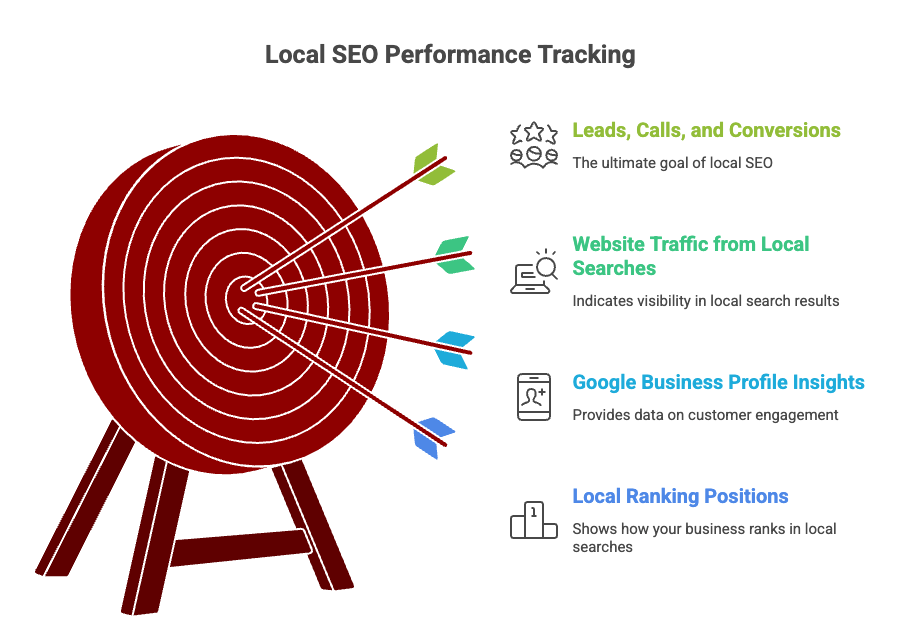
Target board visual representing local SEO performance tracking including leads, calls, website traffic, Google Business Profile insights, and local ranking positions.

Effective measurement connects optimization efforts to actual business outcomes, not just ranking positions.
Local ranking positions: Track where you appear in the Map Pack for target keywords using rank tracking tools
Google Business Profile insights: Monitor profile views, direction requests, calls, and website clicks from your GBP dashboard
Website traffic from local searches: Segment analytics by location to identify how local landing pages perform
Leads, calls, and conversions: Measure phone calls, form submissions, and appointments to connect SEO efforts to revenue
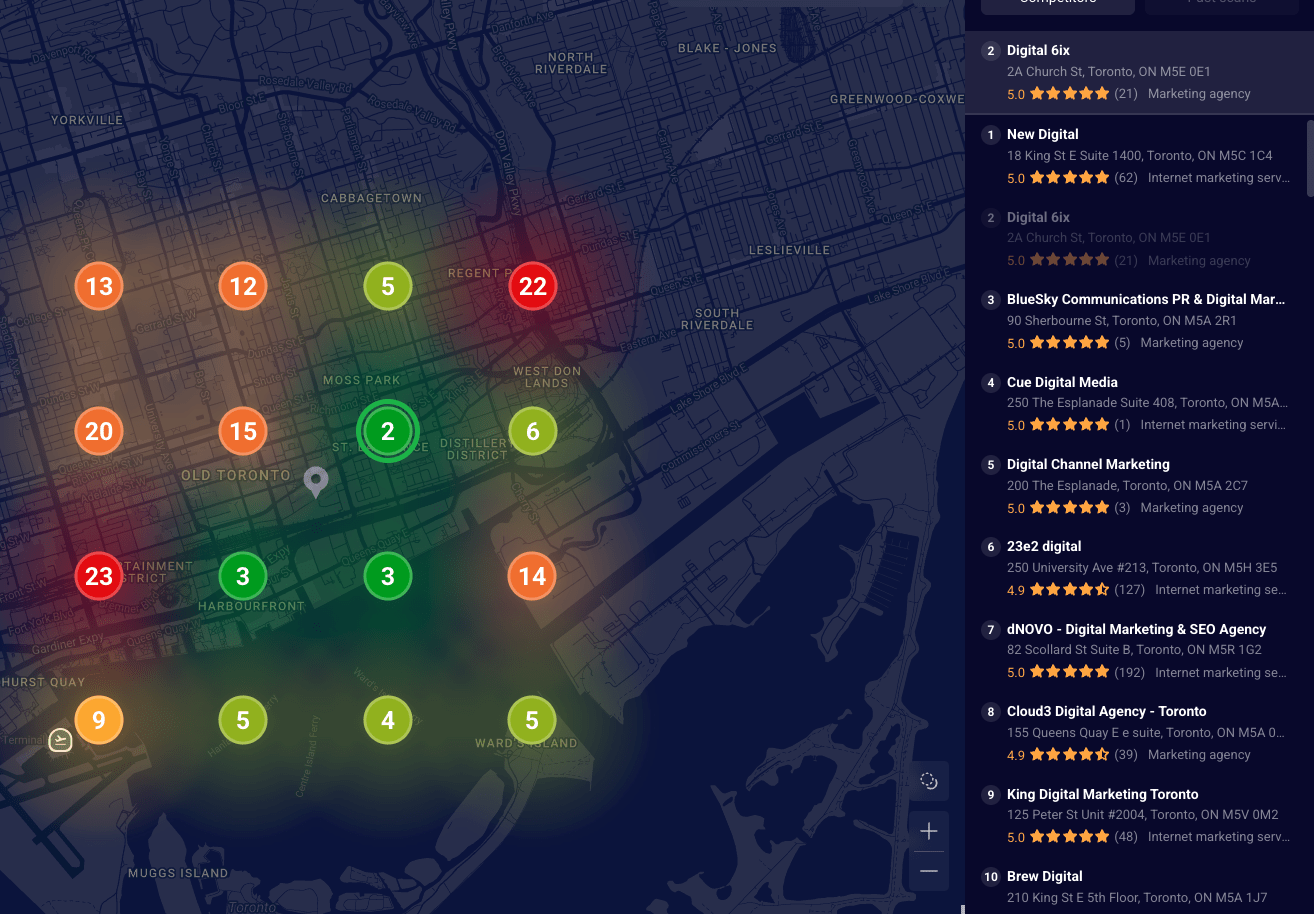
Local ranking grid heatmap showing keyword position variations across different geographic points in a city.

Local ranking grid heatmap showing keyword position variations across different geographic points in a city. Rankings matter, but they’re a means to an end. The real measure of success is whether local visibility translates into customers.

Turn local search visibility into revenue
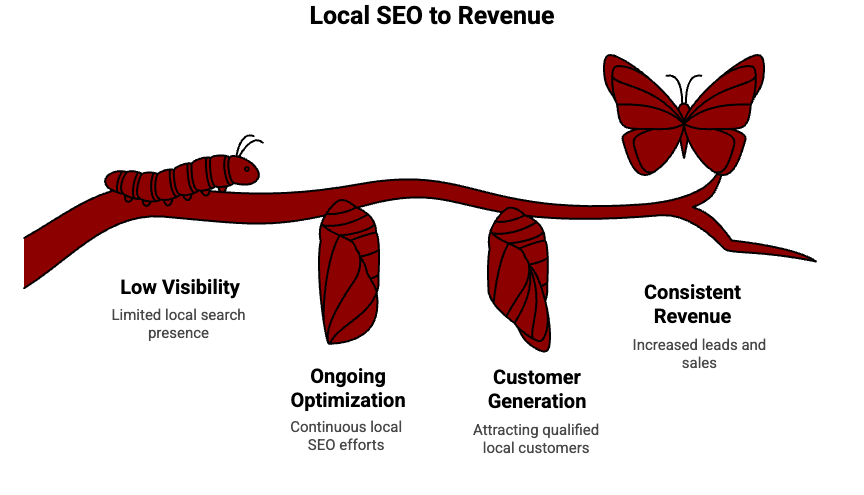
Illustration showing local SEO progression from limited search presence to increased leads and sales through continuous optimization efforts.

Local SEO works when it generates customers, not just traffic. The businesses that succeed treat local optimization as an ongoing system rather than a one-time project.

If you’re ready to turn local searches into consistent leads and revenue, Digital 6ix offers a free consultation to assess your current local visibility and identify the fastest path to growth.

This Blog is written by Simar Singh, Founder of Digital 6ix and a data-driven storyteller with 7+ years of experience helping Toronto businesses grow through performance-led digital strategies. Certified in Google Analytics and Google Search Console, with a strong focus on turning insights into measurable business outcomes.

Frequently Asked Questions

Leave a Comment

Your email address will not be published. Required fields are marked *