
What Is Topical Authority
And How to Build It(2026)
Topical authority is a website’s demonstrated expertise on a specific subject, earned by consistently publishing high-quality, interconnected content that covers a topic comprehensively. Search engines use this perceived expertise to decide which sites deserve to rank for related queries, and increasingly, so do AI tools like ChatGPT and Google AI Overviews.
Topical authority is your website’s demonstrated expertise on a specific subject, built by publishing comprehensive, interconnected content that fully covers a topic and its related subtopics. In 2026, search engines and AI tools prioritize sites that show semantic depth, strong internal linking, E-E-A-T signals, and clear entity recognition. It’s not about one well-optimized page, it’s about building an entire content ecosystem around your niche.
To build it: choose a focused core topic, map out a pillar-and-cluster structure, create in-depth cornerstone content, publish supporting articles that interlink strategically, earn relevant backlinks, and regularly update or prune weak content. Over time, this structured depth increases rankings, attracts organic links, lowers paid acquisition costs, and improves your chances of being cited in AI-generated answers.
01What is topical authority
Think of it this way: a site with dozens of well-linked articles about coffee brewing, bean origins, and equipment reviews signals far more expertise than a lifestyle blog with a single coffee post. The coffee-focused site has built topical authority. The lifestyle blog has not.
Topical authority is the degree to which search engines view your website as a trusted resource on a particular subject, based on your content depth and breadth.
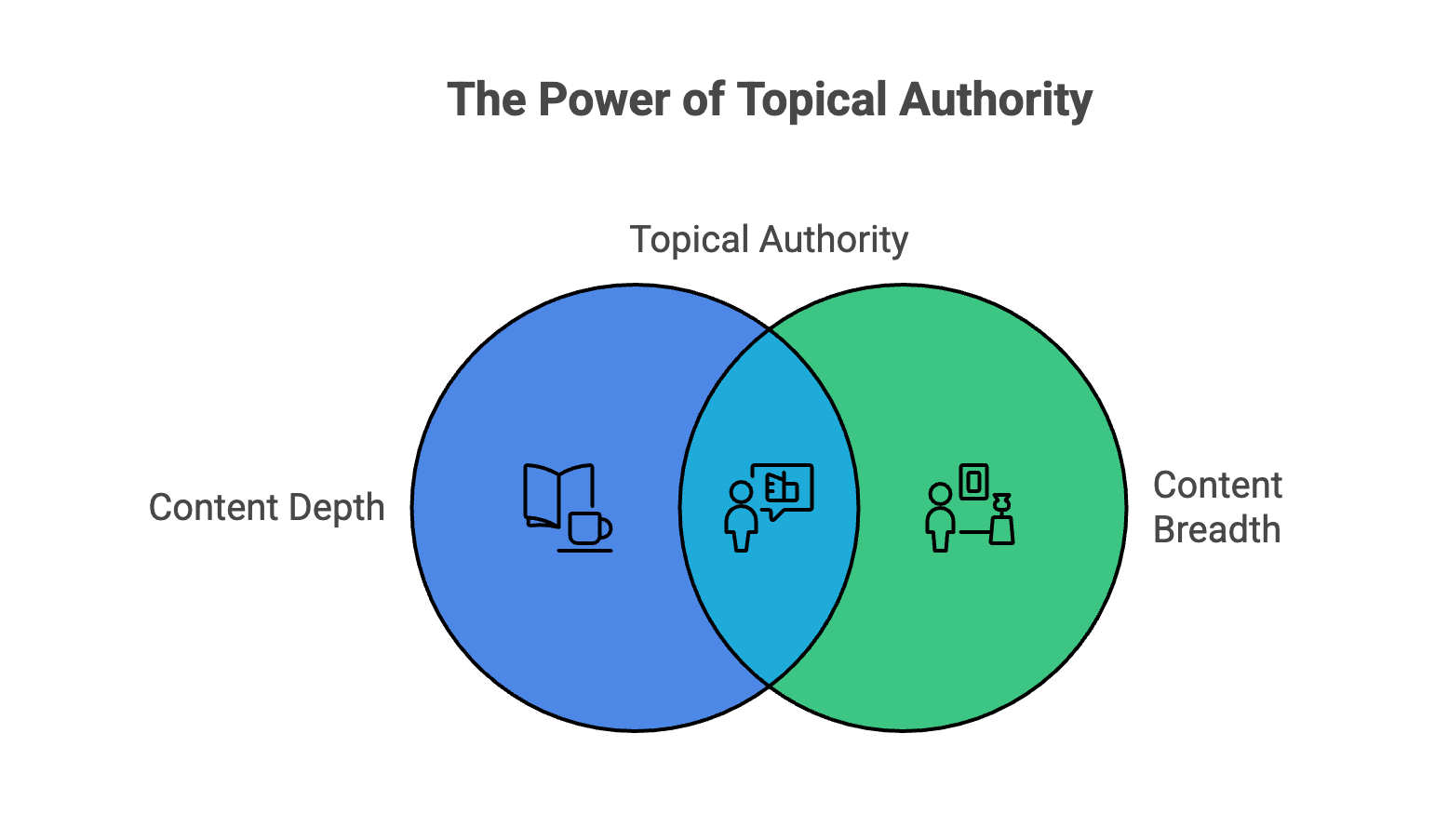
Building topical authority requires a deliberate, interconnected content strategy
02Why topical authority matters for SEO
Because it directly affects whether your content ranks, how much you spend on marketing, and whether AI tools recommend your business – making it a core pillar of any modern SEO strategy.
It reduces long-term marketing costs
Building topical authority creates compounding organic traffic over time. Once search engines recognize your site as the go-to resource on a topic, new content you publish tends to rank faster and with less effort. Unlike paid traffic, organic rankings don’t stop when you stop paying.
It builds trust with search engines and users
Comprehensive topic coverage signals E-E-A-T to Google – Experience, Expertise, Authoritativeness, and Trustworthiness. When users find multiple helpful articles on your site that answer their questions thoroughly, they’re more likely to return, share your content, and convert.
It supports organic link acquisition
Authoritative content naturally attracts backlinks. Other sites reference your expertise when you’ve published the most complete resource on a subject. This happens organically when your content genuinely helps people solve problems.
A site with one article about local SEO signals less expertise than a site covering Google Business Profile, local citations, review management, and local keyword research – all linked together.
It positions you for AI search visibility
AI tools like ChatGPT and Google AI Overviews pull answers from sources they consider authoritative. With AI-driven referral traffic having grown 527% year-over-year, and more users shifting to AI-assisted search, building topical authority now increases your likelihood of being cited in AI-generated answers.
03How topical authority works in AI search
Generative AI tools synthesize answers from sources they consider trustworthy. When someone asks ChatGPT or Perplexity a question, the system evaluates which websites have the clearest, most comprehensive information on that subject.
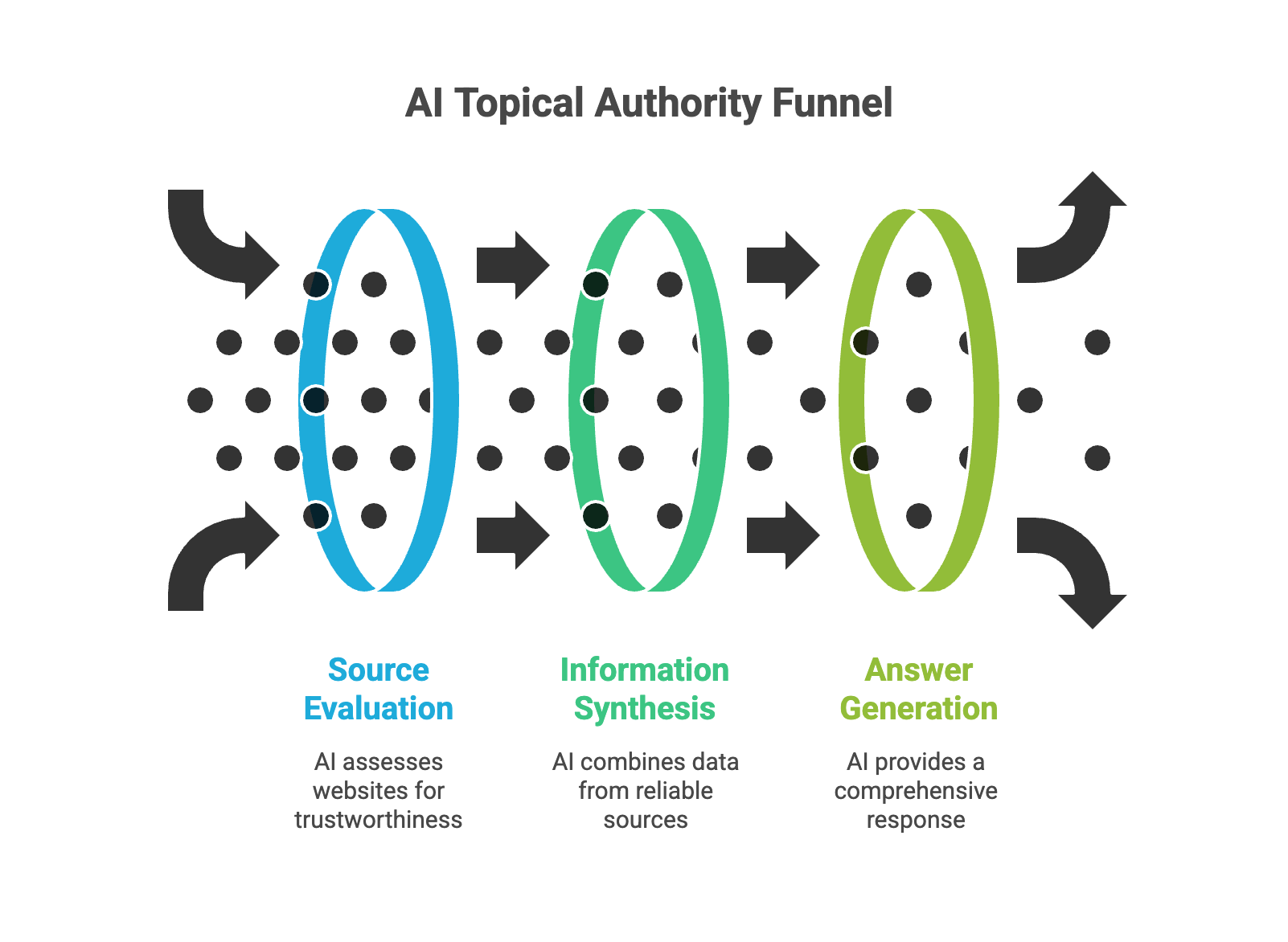
AI search tools evaluate content quality and authority before surfacing answers
AI evaluates three key signals when selecting sources to cite:
- Entity recognition: AI tools look for content that clearly identifies what your brand and content represent.
- Answer-ready content: Content structured as definitions, comparisons, and direct answers, supported by FAQ schema and clear formatting gets cited more often than vague explanations.
- Semantic completeness: Covering related subtopics signals comprehensive expertise to language models.
If your content lacks depth or clarity, AI tools will cite your competitors instead. An analysis of 36 million AI Overviews confirmed that E-E-A-T signals remain the deciding factor for source selection, making topical authority and AI content optimization increasingly critical as search behavior evolves.
04How search engines evaluate topical authority
While topical authority isn’t an official ranking factor in Google’s documentation, search engines use multiple signals to assess it.
Content depth and breadth signals
Search engines assess whether you cover a topic thoroughly (depth) and across related subtopics (breadth). A site with one article about local SEO signals less expertise than a site covering Google Business Profile optimization, local citations, review management, and local keyword research.
Internal linking structure
Interconnected content with clear pillar-cluster architecture signals topic relationships to crawlers. When your articles link to each other using descriptive anchor text, search engines understand how your content pieces relate and which pages are most important.
External authority signals
Backlinks from relevant, authoritative sites in your niche validate your expertise. A link from an industry publication carries more weight than a link from an unrelated directory. Relevance matters as much as the link itself.
User engagement metrics
Dwell time, low bounce rates, and return visits indicate content satisfies user intent. If visitors consistently spend time reading your content and exploring related articles, that signals quality to search engines.
05How to build topical authority for your website
Here’s the step-by-step process for building topical authority from scratch or strengthening what you already have.
06Content cluster architecture at a glance
| Content Type | Purpose | Example |
|---|---|---|
| Pillar page | Comprehensive topic overview | “Complete Guide to Local SEO” |
| Cluster content | Deep-dive on specific subtopic | “How to Optimize Your Google Business Profile” |
| Supporting content | Answers specific questions | “What Are Local Citations?” |
07How to measure topical authority
There’s no single “topical authority score” you can check in a dashboard. However, you can track proxy metrics to gauge progress.
- Keyword rankings across your topic cluster – monitor all keywords within your topic, not just your main target keyword.
- Topical share of voice – measure what percentage of search visibility you own compared to competitors using Semrush or Ahrefs.
- Backlink profile growth – track new referring domains from topically relevant sites; relevance matters more than quantity.
- Organic traffic by topic – segment analytics by cluster to identify which areas drive the most qualified traffic and where gaps remain.
08Best topical authority tools
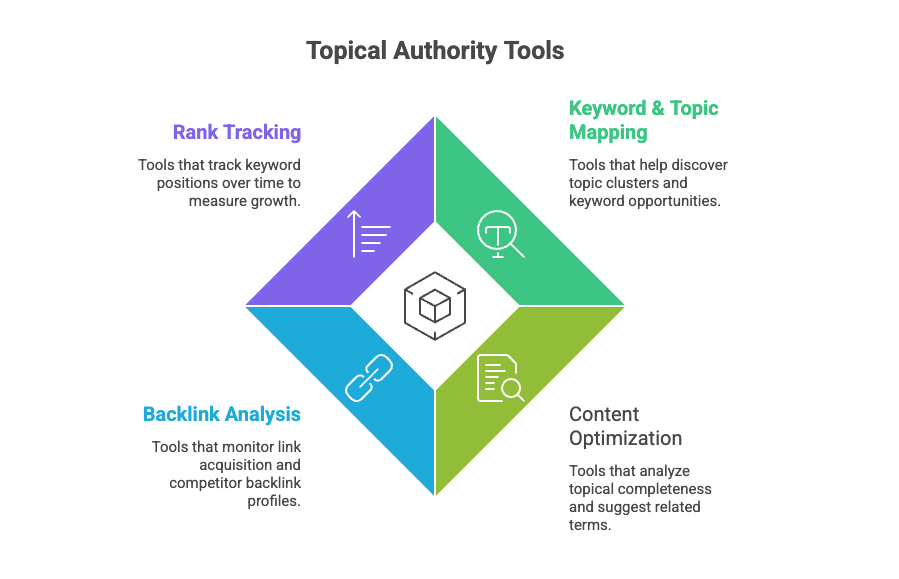
Data-driven tools are essential for measuring and growing your topical authority
Semrush, Ahrefs, and AlsoAsked help discover topic clusters and keyword opportunities. These tools reveal the questions your audience is asking.
Clearscope, Surfer SEO, and MarketMuse analyze topical completeness and suggest related terms to include, ensuring your content covers a topic thoroughly.
Ahrefs, Moz, and Semrush monitor link acquisition and competitor backlink profiles to identify link building opportunities.
Track keyword positions across your entire topic cluster over time to see whether your topical authority is growing or stagnating.