Read Time:

15–23 minutes

Modified Date:

Your Marketing Metrics Look Great – But Why Isn’t Your Phone Ringing?

Your marketing report shows 50,000 impressions and a 15% bump in followers. But your phone isn’t ringing any more than it was last month. That disconnect between activity metrics and actual business results is where most Toronto businesses get stuck.

This guide breaks down which marketing metrics actually connect to revenue, how to calculate marketing ROI without complex software, and what to demand from any agency that wants your business.

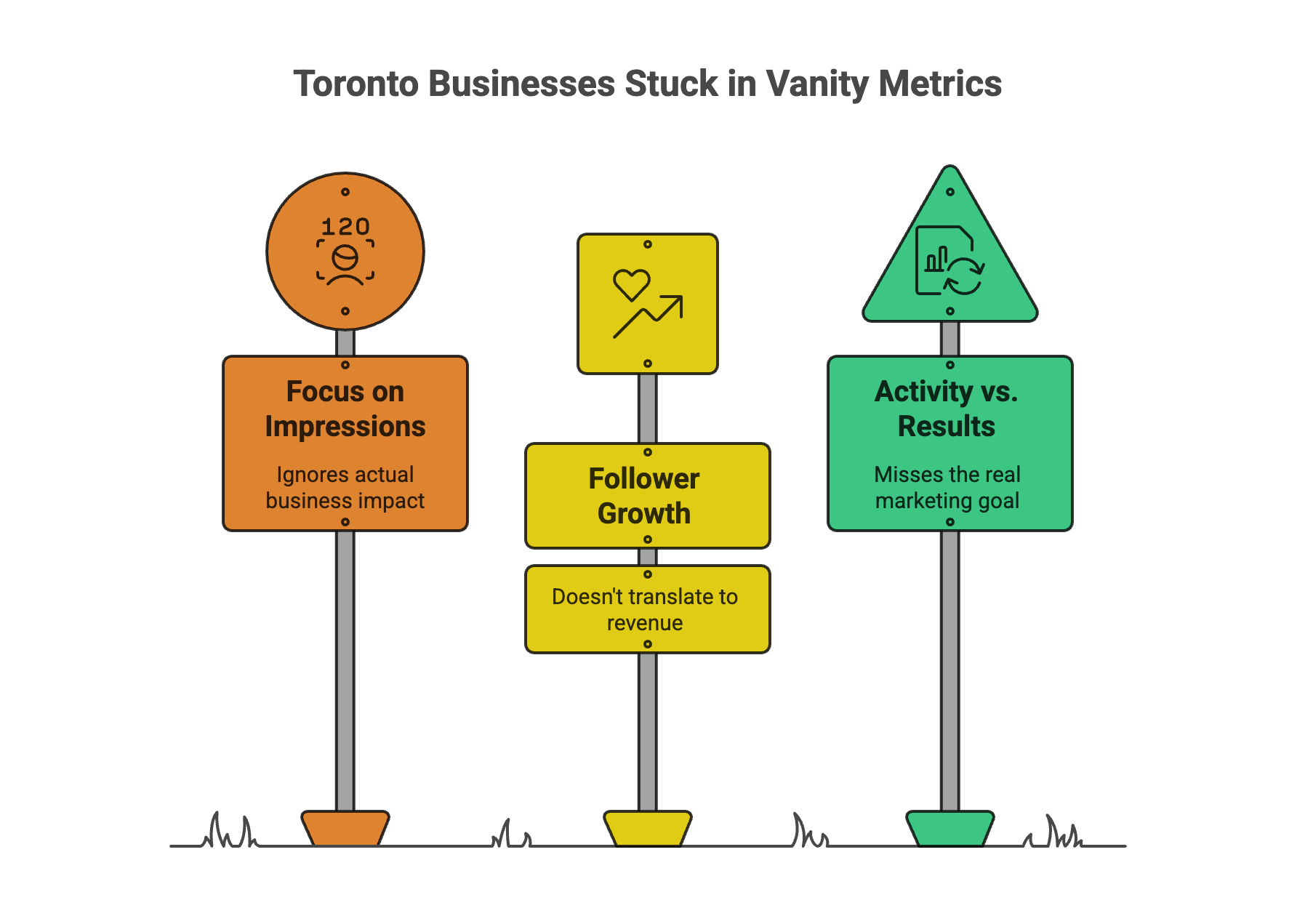
Diagram showing Toronto businesses focusing on impressions and followers instead of results

TL;DR:

Vanity metrics like impressions, follower counts, page views, and social likes may look impressive in marketing reports, but they rarely translate into actual revenue. For Toronto businesses operating in competitive markets, these numbers can hide the fact that marketing campaigns are generating little to no real leads or sales. Measuring success based only on visibility or engagement often leads to wasted budget and poor decision-making.

Instead, businesses should focus on revenue-driven metrics such as revenue attribution, cost per lead (CPL), customer acquisition cost (CAC), conversion rates, return on ad spend (ROAS), and booked calls or appointments. By implementing proper tracking through tools like call tracking, UTM parameters, analytics platforms, and CRM systems, companies can connect marketing activity directly to business outcomes. The goal isn’t more impressions, it’s more customers and measurable ROI.

Why vanity metrics fail Toronto businesses
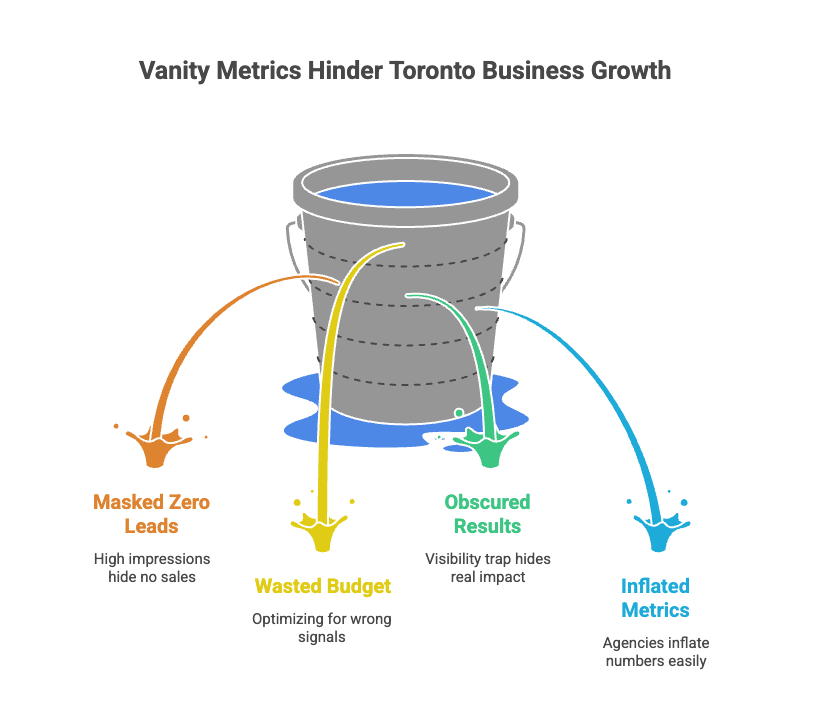
Illustration showing vanity metrics hiding zero leads, wasted budget, and inflated marketing numbers

For Toronto businesses aiming to grow sustainably, marketing success comes down to tangible business impact rather than surface-level numbers like social media likes or ad impressions. High impressions or follower counts can easily mask zero actual leads or sales.

And in Toronto’s competitive local market, where businesses are competing for the same customers, optimizing for the wrong signals wastes budget and obscures what’s actually working.

The visibility trap is real. Impressions show your ad was displayed, but they don’t indicate that anyone cared or took action. Meanwhile, a post can go viral without generating a single qualified inquiry. Some agencies lead with vanity metrics because they’re easy to inflate and look good in a report, even when real results are lacking.

What are vanity metrics in marketing
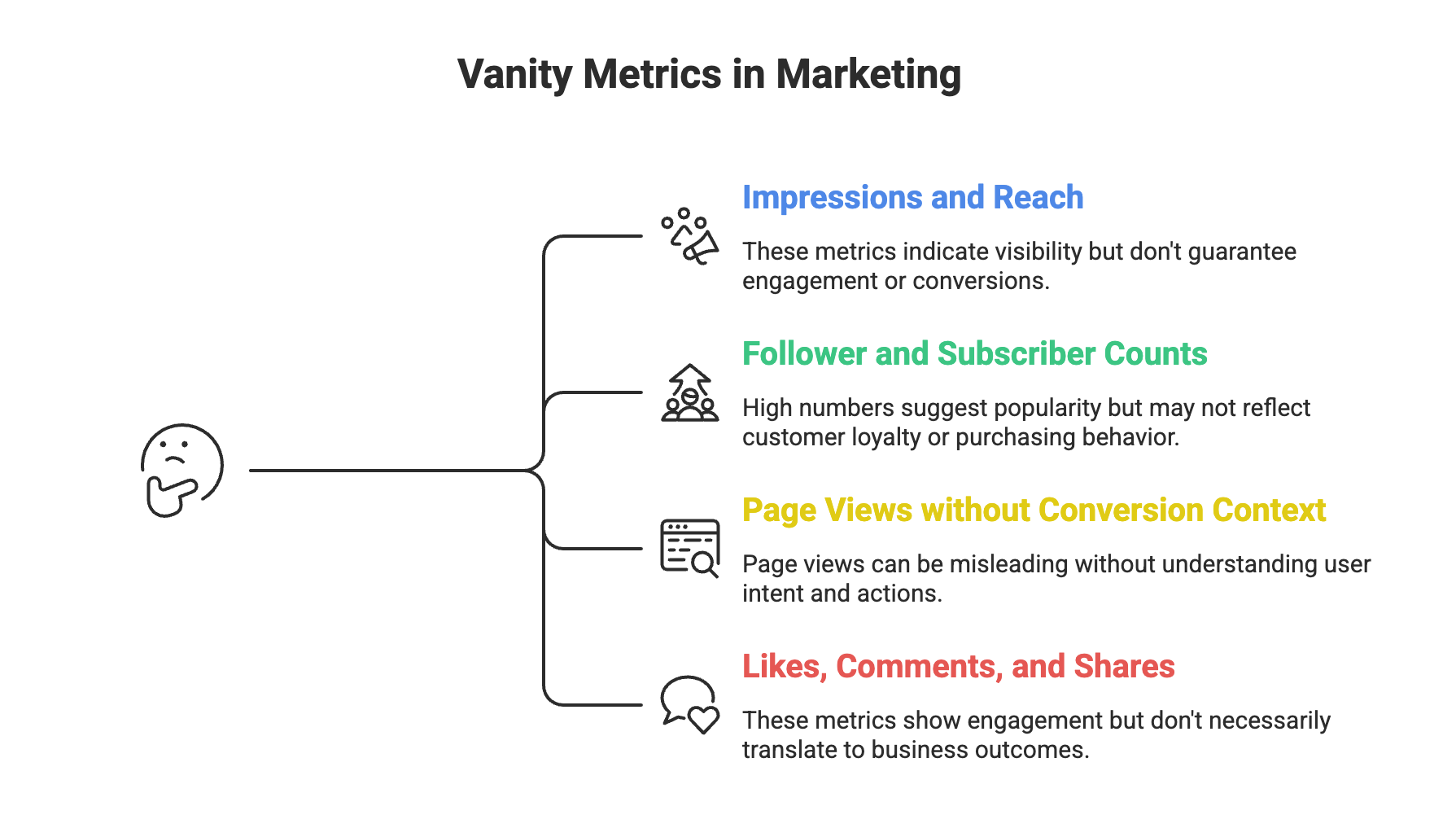
Examples of vanity metrics including impressions, followers, page views, and social engagement

Vanity metrics are easily measured, often impressive-looking numbers that give a superficial view of marketing performance without correlating to business success. They’re not entirely useless since brand awareness has value. However, they become problematic when treated as primary indicators of success.

Impressions and reach

Impressions are the total number of times your content was displayed, while reach is the number of unique users who saw it. High numbers in either category mean nothing without a corresponding downstream action like a click, a call, or a form submission. According to Lumen Research and Teads’ 2023 meta-analysis, attention metrics are a significantly stronger predictor of brand recall than viewability, outperforming it for both online ad recall and spontaneous brand awareness.

Follower and subscriber counts

Audience size does not equal audience quality. A local Toronto business doesn’t benefit from thousands of global followers. What matters is local buyers who are actually in the market for the services offered.

Page views without conversion context

Website traffic is only valuable if it converts. A page with high views but no form fills, calls, or purchases is a leak in your marketing funnel, a prime candidate for a content audit rather than an asset.

Likes, comments, and shares

Social engagement feels good and can contribute to brand awareness. Yet for most service-based businesses, it rarely correlates with actual purchases or revenue.

Vanity Metric What It Measures Why It Misleads
Impressions Number of times an ad or post is displayed No indication that users were interested or took any action
Follower count Total size of your social media audience Doesn’t indicate buyer intent, engagement quality, or local relevance
Page views Number of visits to a website page Ignores bounce rate, engagement depth, and whether visitors convert
Likes and shares Social media engagement signals Rarely correlates with qualified leads or revenue

What marketing metrics actually matter for business growth
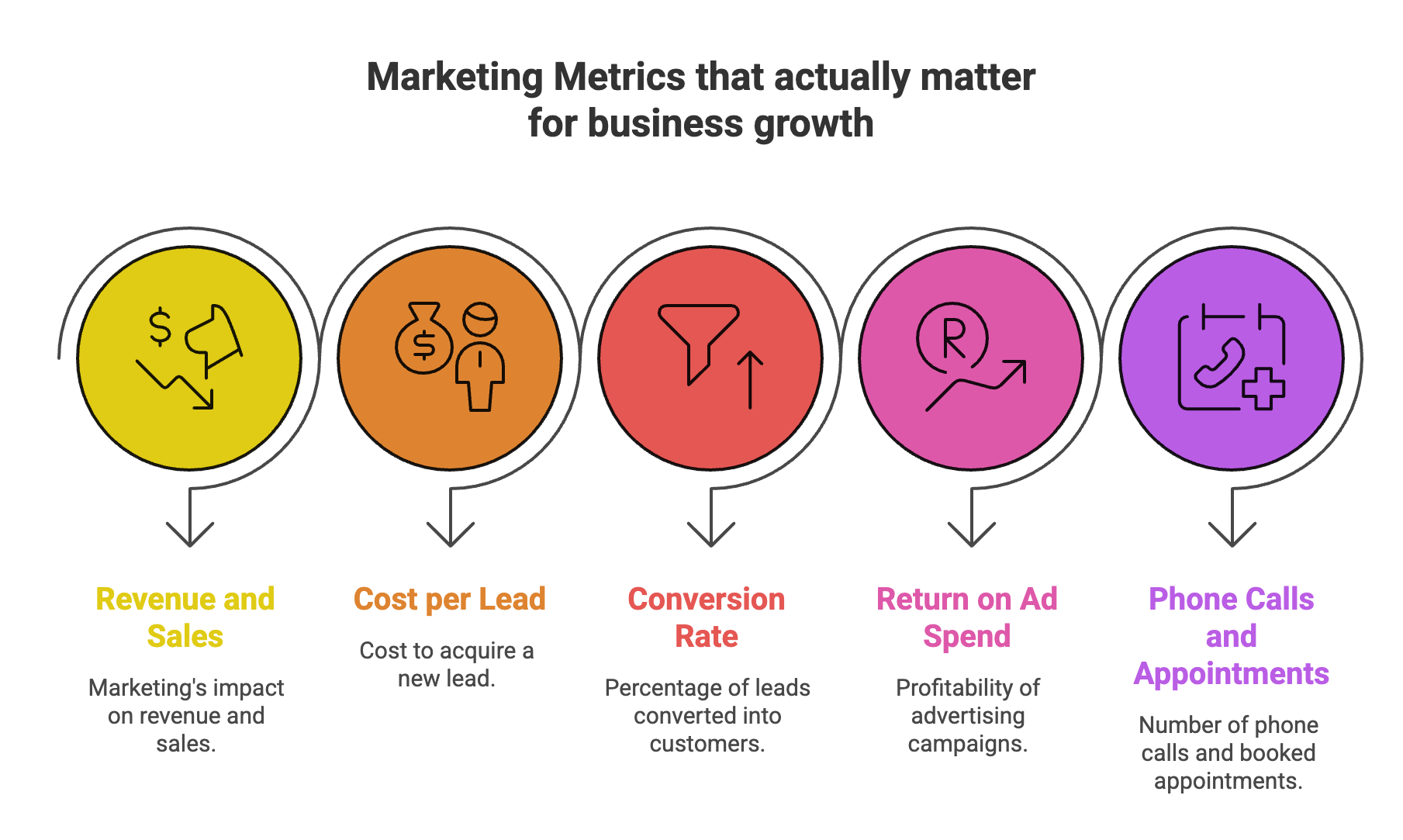
Key marketing metrics including revenue, cost per lead, conversion rate, ROAS, and phone calls

The marketing metrics that actually matter connect marketing activity directly to revenue and prove whether your investment is paying off. Here’s what to look for in every marketing report.

Revenue and sales attributed to marketing

This is the ultimate metric: how much revenue was directly generated by your marketing efforts. Achieving accurate attribution requires proper tracking setup to connect a sale back to its source, whether that’s a specific ad campaign, an organic search result, or a social media post.

Cost per lead and customer acquisition cost

Cost Per Lead (CPL) is the average cost to generate one new lead. Customer Acquisition Cost (CAC) is the total cost to acquire one new paying customer and with CAC rising 60% over the past five years according to SimplicityDX research, tracking it is more critical than ever. Together, they tell you whether your marketing spend is efficient relative to the value you earn from each customer.

Conversion rate by channel

Conversion rate is the percentage of visitors who take a desired action, such as filling out a form, making a call, or booking an appointment. Comparing conversion rates across channels reveals where to invest more budget and whether your website is built to convert that traffic effectively.

Return on ad spend

Return on Ad Spend (ROAS) measures the revenue generated for every dollar spent on advertising. It provides a direct measure of ad profitability, which stands in stark contrast to vanity metrics like impressions per dollar.

Phone calls and booked appointments

For local service businesses, phone calls and booked appointments are often the primary conversion events that matter. Implementing call tracking is essential infrastructure for measuring success in service-based industries.

Metric Definition Why It Matters
Revenue attribution Revenue traced to a specific marketing channel or campaign Demonstrates that marketing activities directly generate revenue
Cost per lead (CPL) Marketing spend divided by the number of leads generated Shows how efficiently marketing converts budget into potential customers
Customer acquisition cost (CAC) Total marketing and sales cost required to acquire one new customer Reveals the true profitability of your marketing strategy
Conversion rate Percentage of visitors who complete a desired action Measures how effectively traffic turns into leads or customers
ROAS Revenue generated divided by advertising spend Provides a direct measure of advertising profitability

How to calculate marketing ROI for Toronto SMBs
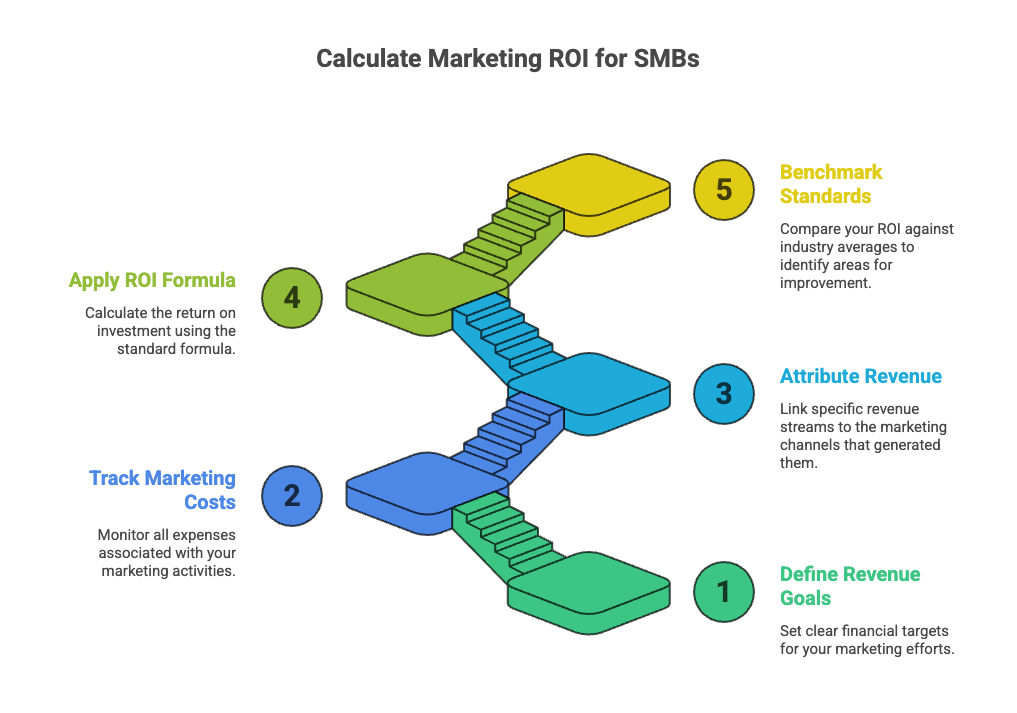
Diagram showing five steps to calculate marketing ROI including costs, attribution, and benchmarking

Calculating marketing ROI doesn’t require complex software or a finance degree, yet according to Firework’s analysis of industry data, only 36% of marketers say they can accurately measure it, and 47% struggle specifically with multi-channel attribution.

1. Define your revenue goals

Start by defining what success looks like in concrete terms. This could be a monthly revenue target, the number of new clients you want to bring in, or the average value of a deal you want to close.

2. Track all marketing costs

Be comprehensive here. Include not just ad spend but also agency fees, software subscriptions, and content creation costs. Many businesses undercount their total marketing investment, which skews ROI calculations.

3. Attribute revenue to marketing channels

Attribution means connecting a sale back to the specific campaign or channel that generated it. Key tools for accurate attribution include a CRM system and call tracking software.

4. Apply the ROI formula

The formula is straightforward: ROI = (Revenue − Marketing Cost) ÷ Marketing Cost
A positive result means your marketing is profitable. A negative result means it’s a cost center.

5. Benchmark against industry standards

A “good” ROI varies by industry and channel. The most important step is establishing your own baseline and focusing on improving it over time rather than chasing arbitrary benchmarks.

Marketing KPIs by business type

Toronto businesses are diverse, and a law firm measures metrics differently than a restaurant or a plumber. Here’s what to focus on by industry.

Local service businesses

For plumbers, HVAC technicians, and cleaners, the key metrics are:

Phone calls: The primary way customers reach out
Booked jobs: Actual appointments scheduled
Cost per job booked: Marketing spend divided by completed bookings
Repeat customer rate: Indicates service quality and long-term value

Professional services and law firms

For businesses with longer sales cycles, focus on qualified consultations booked, cost per consultation, average case value, and client retention. The sales cycle length means tracking the full journey from first contact to signed engagement.

Real estate agents and brokers

The key marketing metrics here are listing inquiries, buyer leads, cost per qualified lead, and deals closed from marketing. The high transaction value in real estate changes the math on acceptable acquisition costs significantly.

E-commerce and retail

Online stores benefit from more straightforward revenue tracking. Focus on ROAS, average order value, cart abandonment rate, and customer lifetime value.

How to track leads, calls, and revenue from marketing
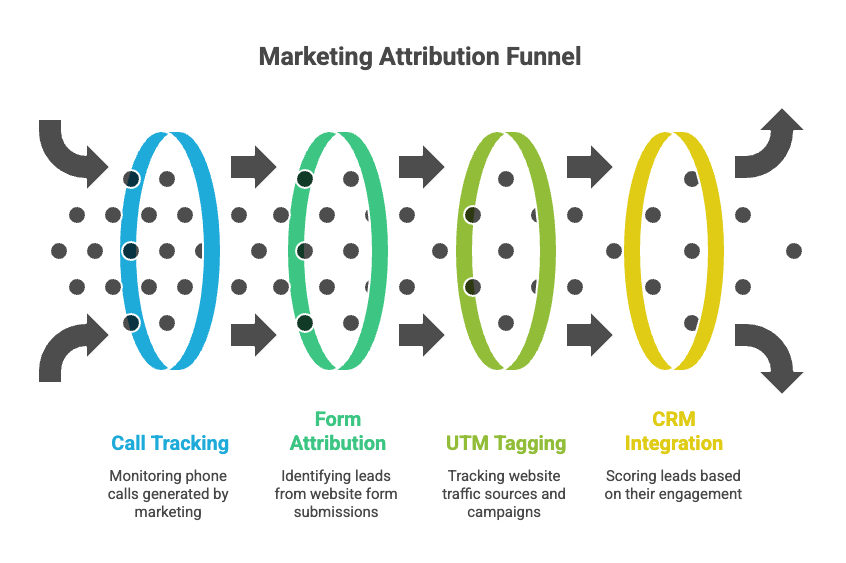
Marketing attribution funnel showing call tracking, form attribution, UTM tagging, and CRM integration

Many Toronto businesses want better metrics but don’t know how to capture the necessary data. Here’s the infrastructure that makes measurement possible.

Call tracking software setup

Call tracking uses unique phone numbers for each marketing channel. When someone calls the number displayed on your Google Ad versus the number on your website, you know precisely which source generated that call.

Form submission attribution

Form submissions on your website can be tagged to their original traffic source using hidden fields or URL parameters. This allows you to see which channels are driving the most valuable form-based leads.

UTM parameters and campaign tagging

UTM parameters are tags added to a URL that help identify where website traffic comes from. Google Analytics uses UTM parameters to determine if a visitor came from a specific email campaign, social media post, or ad. Adding them to your links is free and takes only a few minutes per campaign.

Tip: Even basic call tracking combined with UTM parameters can transform your visibility into what’s actually driving results, without expensive enterprise software

CRM integration for lead scoring

A Customer Relationship Management (CRM) system is software for managing customer interactions. Connecting your marketing data to your CRM lets you track leads from their first click all the way through to a closed sale.

What to demand from your marketing agency
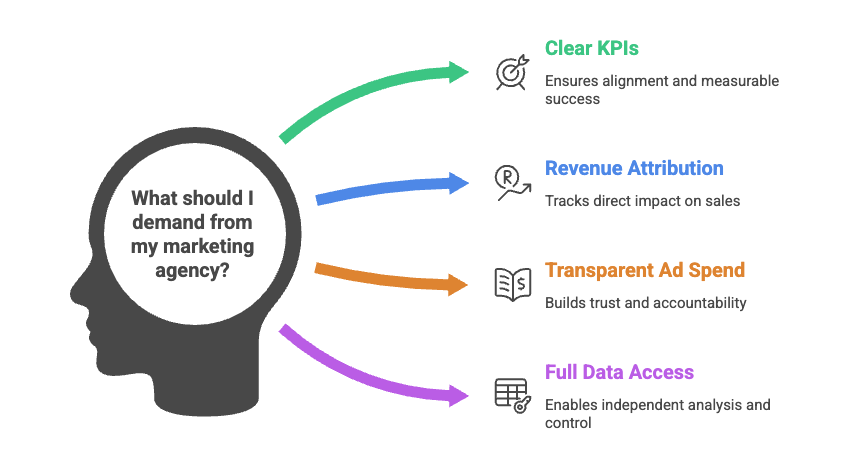
Key marketing agency expectations including clear KPIs, revenue attribution, transparent spend, and data access

A results-focused agency will provide the following without hesitation. If there’s resistance to any of these requests, that’s worth noting.

1. Clear KPI definitions before work begins

Agree on what success looks like upfront, with clearly defined Key Performance Indicators. Vague goals lead to vague reporting, which makes it impossible to evaluate performance accurately.

2. Revenue and lead attribution in every report

Reports from your agency should lead with leads generated and revenue influenced. Impressions and clicks are supporting marketing metrics, not the headline.

3. Transparent ad spend breakdowns

You deserve to know exactly where every dollar of your marketing budget is going. Hidden management fees or bundled, opaque costs are red flags worth investigating.

4. Full access to raw data and dashboards

You own your data. A trustworthy agency will provide full login access to your Google Analytics, ad accounts, and reporting dashboards. If an agency resists providing access, that’s a significant concern.

Looking for a marketing partner that leads with revenue, not vanity metrics? Digital 6ix offers transparent, ROI-focused reporting for Toronto businesses.

How to build a marketing dashboard that drives decisions
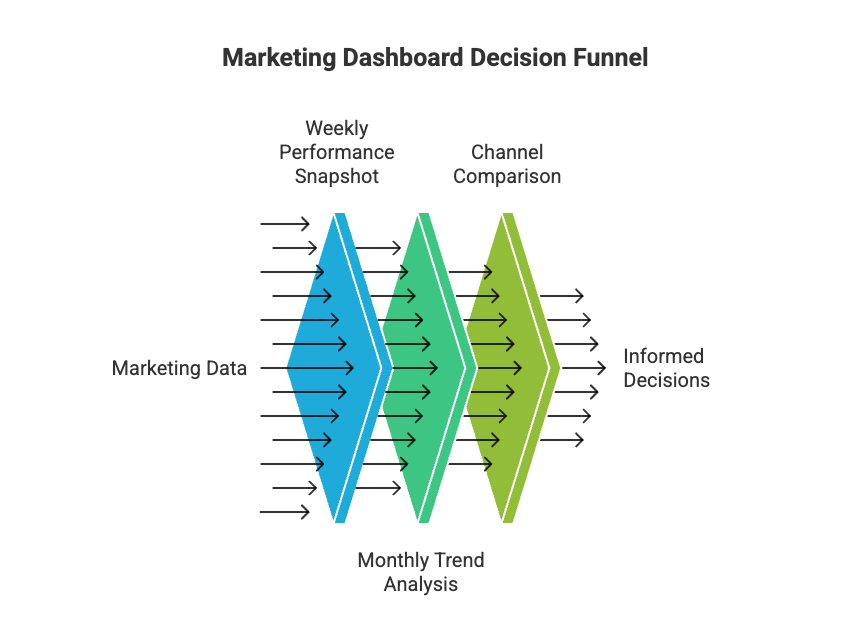
Marketing dashboard funnel showing weekly snapshot, trend analysis, and channel comparison for decisions

A dashboard centralizes your key metrics, moving you from raw data to visual analysis that enables faster decisions. Here’s what to include.

Weekly performance snapshot metrics

For a quick pulse check, include leads generated, ad spend to date, cost per lead, and total calls received. This weekly view helps catch problems early before they become expensive.

Monthly trend analysis

Month-over-month comparisons for leads, revenue, and conversion rates help identify performance patterns and account for seasonality. A single week’s data can be misleading, but monthly trends reveal what’s actually happening.

Channel comparison tables

A side-by-side view of performance by channel is critical for making decisions about where to reallocate budget. The table below shows a simple structure that works for most businesses.

Use this as a starting template — replace each row with your own monthly numbers.

Channel Leads Cost CPL Revenue ROAS
Google Ads
Organic Search
Social Media

This Blog is written by Simar Singh, Founder of Digital 6ix and a data-driven storyteller with 7+ years of experience helping Toronto businesses grow through performance-led digital strategies. Certified in Google Analytics and Google Search Console, with a strong focus on turning insights into measurable business outcomes.

Frequently Asked Questions

Leave a Comment

Your email address will not be published. Required fields are marked *