Read Time:

13–20 minutes

Modified Date:

How AI Is Changing Search Rankings in 2026 (And What Businesses Must Do Now)

Ranking used to mean one thing: where your page appeared on a list of ten blue links. That definition is breaking down as AI-generated answers appear above organic results, pulling information from multiple sources and delivering responses before anyone scrolls.

The shift changes what visibility actually looks like. This guide covers what AI search ranking algorithms evaluate now, how to optimize for generative search, and what Toronto businesses can do to build the kind of authority that earns citations rather than just clicks.

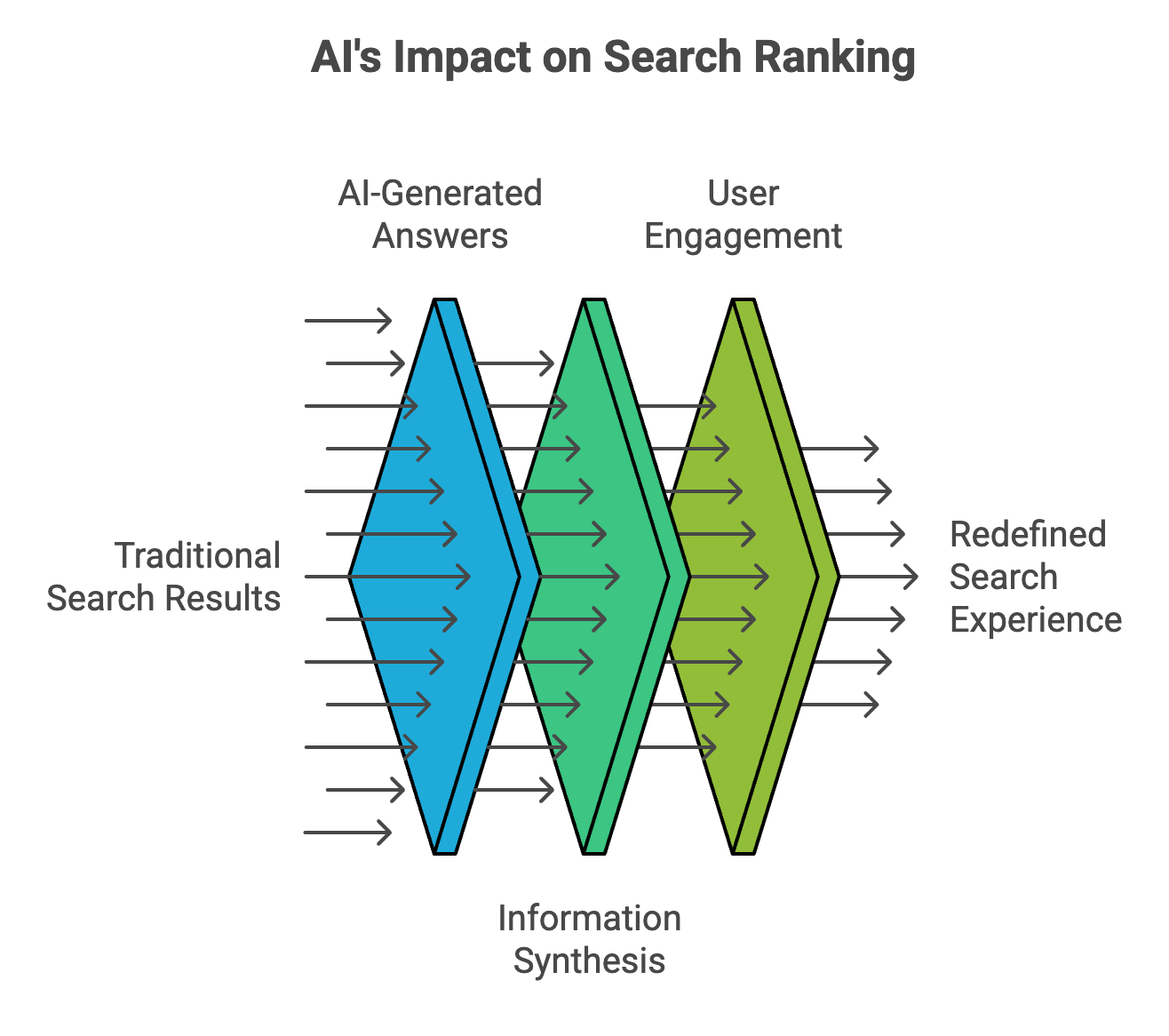
Diagram illustrating AI-generated answers and user engagement reshaping traditional search results through information synthesis and redefining search experience.

TL;DR:

Ranking in 2026 no longer means holding a top spot among ten blue links — it means being cited by AI systems that generate answers before users ever scroll. With AI overviews and zero-click searches reshaping visibility, success now depends on whether your content satisfies intent, demonstrates authority, and is structured for extraction. Position alone doesn’t guarantee traffic anymore; source credibility and answer quality determine who gets referenced.

To stay visible, businesses must blend traditional SEO with Generative Engine Optimization (GEO). That means building topical authority through clusters, creating answer-ready content, implementing schema markup, strengthening E-E-A-T signals, and earning high-quality backlinks. For Toronto businesses especially, local authority and regional relevance matter. The brands that adapt early to AI-driven discovery will build compounding visibility — not just rankings, but citations and trust.

What ranking used to mean and why it no longer applies
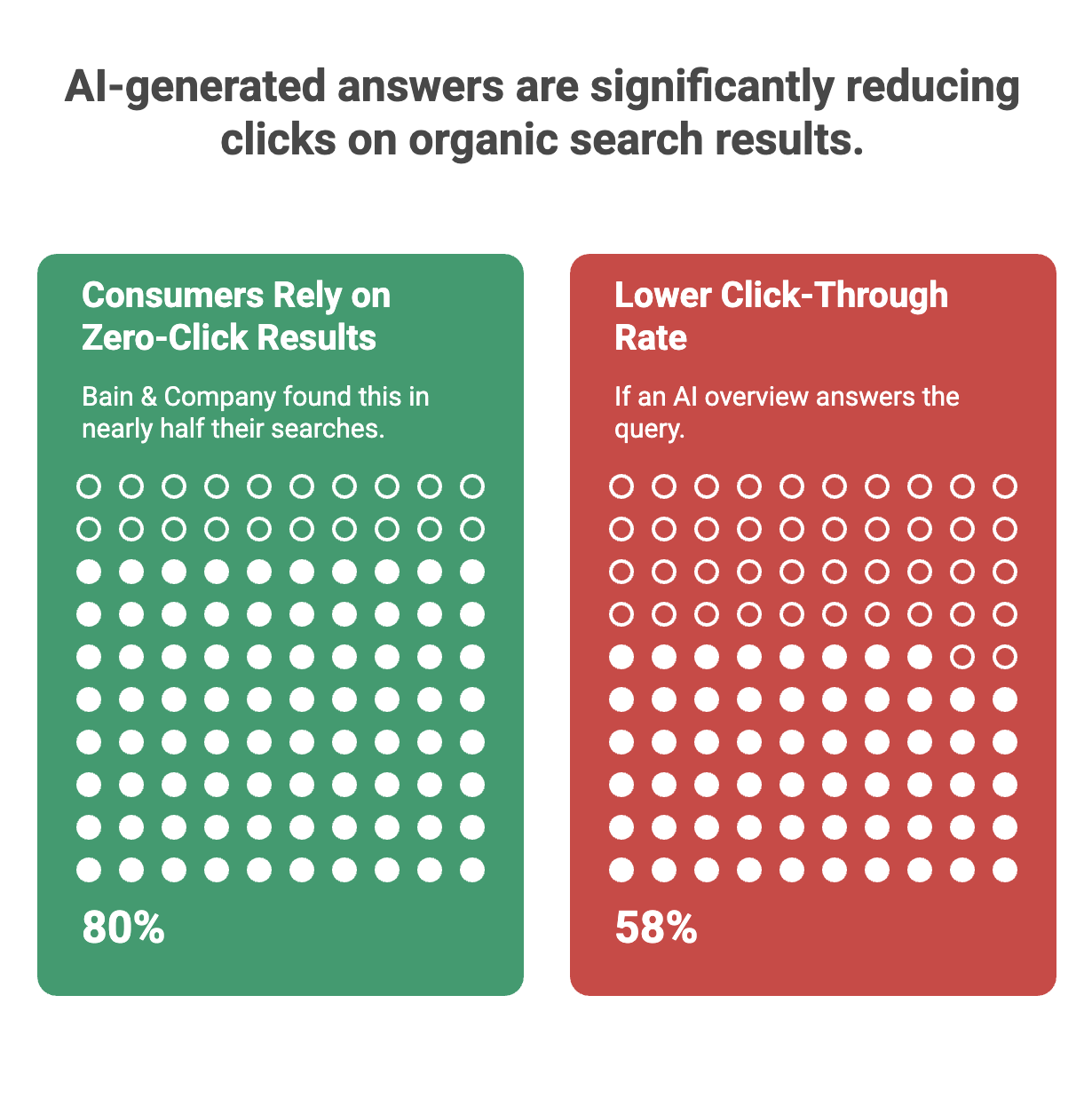
Comparison graphic showing consumers relying on zero-click results and lower click-through rates when AI overviews answer search queries directly.

For most of the internet’s history, ranking meant one thing: where your page appeared on a list of ten blue links. You picked keywords, built backlinks, and watched your position climb. The higher you sat on page one, the more clicks you earned. Simple.

That equation is falling apart. AI-generated answers now appear above organic results, pulling information from multiple sources and delivering responses directly on the search page. Bain & Company found that 80% of consumers rely on zero-click results in nearly half their searches, often getting what they came for without clicking anything at all.

So what does that mean for you? Position alone no longer guarantees visibility. You can sit at number one and still see a 58% lower click-through rate if an AI overview answers the query before anyone scrolls down.

What AI Search ranking algorithms actually evaluate now

Traditional search algorithms matched keywords to queries. If your page contained the phrase someone searched for, you had a shot at ranking. AI ranking algorithms work differently – they interpret language, context, and intent to figure out whether content genuinely answers a question.

AI systems evaluate whether your content solves the problem behind the search, not just whether it contains the right words. A page stuffed with keywords but thin on substance gets passed over for something that actually helps.

Traditional Ranking Factors AI Ranking Factors
Keyword density Semantic relevance
Exact match keywords Intent satisfaction
Link quantity Source authority and trust
Page position Answer quality and usefulness

How AI has redefined what it means to rank

Here’s the shift in plain terms: ranking now means being selected as a trusted source that AI cites when generating answers. Instead of competing for clicks on a results page, you’re competing to be the reference an AI pulls from when it synthesizes a response.

Think of it as moving from position-based visibility to source-based authority. The question is no longer “Are you on page one?” but rather “Does AI trust you enough to cite you?”

This changes the game entirely. A smaller site with clear, authoritative content on a specific topic can earn citations over a larger competitor with shallow coverage. The playing field looks different when AI decides who gets mentioned.

The shift from SEO to generative engine optimization
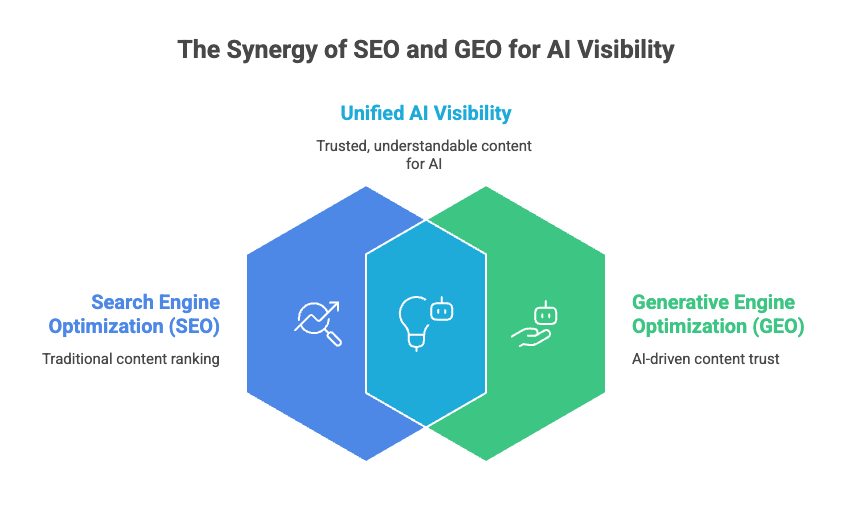
Venn-style diagram showing unified AI visibility through Search Engine Optimization (SEO) and Generative Engine Optimization (GEO) integration.

Generative Engine Optimization, or GEO, is the practice of optimizing content so AI systems can understand, trust, and reference your brand. It works alongside traditional SEO rather than replacing it

What traditional SEO optimizes for

Traditional SEO focuses on keywords, backlinks, technical performance, and earning high positions in search results. You optimize title tags, build domain authority, and make sure Google can crawl your site. All of that still matters – a solid modern SEO strategy forms the foundation AI systems build on.

What GEO optimizes for

GEO prioritizes different elements:

Entity clarity: Making sure AI systems understand exactly what your business is and what you do
Answer-ready content: Formatting information so AI can easily extract and cite it
Structured data: Using schema markup to help AI interpret your content accurately
Authority signals: Building the kind of credibility that large language models recognize and trust

Where SEO and GEO overlap and diverge

Both disciplines value quality content, E-E-A-T signals, and technical performance. However, GEO adds requirements around citation potential and semantic structure that go beyond keyword targeting.

Where they overlap: quality in-depth content, demonstrated expertise, and fast-loading pages help with both. Where they diverge: GEO cares more about how easily AI can extract and cite your content than where you rank on a traditional results page.

Core AI ranking signals that determine visibility
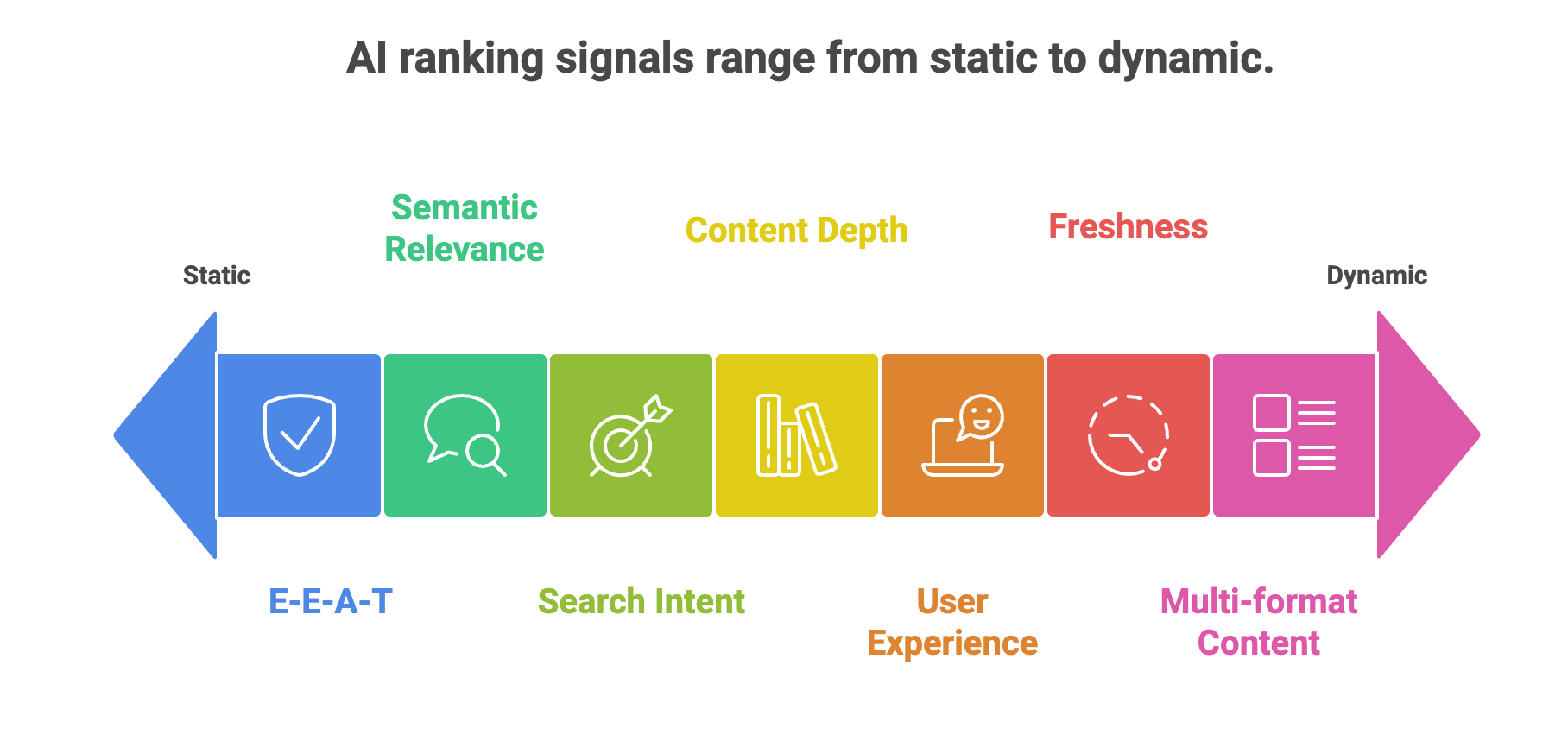
AI search ranking signals spectrum showing shift from static factors like E-E-A-T and semantic relevance to dynamic factors including user experience, freshness, and multi-format content.

AI systems use specific signals to decide which sources to cite. Knowing what they look for helps you focus effort where it counts.

Search intent satisfaction

AI evaluates whether your content actually answers the user’s question. Surface-level content that touches on a topic without resolving the query gets passed over. If someone searches “how to fix a leaky faucet,” AI wants content that walks them through the repair, not a page that defines what faucets are.

Semantic relevance and topical context

Semantic relevance measures how well your content relates to the broader topic and surrounding concepts. AI systems look for content that demonstrates deep understanding across related ideas, not just keyword inclusion on a single page.

A site that covers plumbing comprehensively with content on pipes, fixtures, water pressure, and common repairs, signals more authority than one with a single page targeting “plumber near me.”

E-E-A-T and authority signals

E-E-A-T stands for Experience, Expertise, Authoritativeness, and Trustworthiness. AI systems prioritize sources with demonstrated credibility. Clear authorship, cited sources, and an established reputation in a specific field all contribute.

For a local business, E-E-A-T might mean showcasing real project examples, displaying credentials, and earning mentions from reputable local publications.

Content depth and usefulness

Thin content that skims a topic rarely earns AI citations. Comprehensive content that fully addresses questions and anticipates follow-ups performs better. If your page answers the main question but leaves obvious related questions unanswered, AI may look elsewhere.

User experience and engagement metrics

Page speed, mobile optimization, and user behavior signals influence AI’s trust in a source. If visitors bounce quickly or struggle to navigate your site due to website design mistakes, AI systems take note. A frustrating user experience undermines even excellent content.

Freshness and ongoing relevance

AI systems consider how recently content was updated. Outdated information gets deprioritized, especially for topics where accuracy matters. A guide to “best practices in 2023” carries less weight in 2026 than recently updated content.

Multi-format content and structured data

Structured data, also called schema markup, is code that helps search engines understand your content’s meaning. It tells AI systems exactly what your page covers, who wrote it, and why it’s credible.

Properly formatted content with clear headings, lists, and tables is easier for AI to cite. If an AI can lift a clean paragraph or list from your page and present it as an answer, you’re more likely to earn the citation.

Why traditional SEO fundamentals still matter

SEO is not dead. Technical SEO, quality content, and backlinks remain foundational. AI optimization builds on top of these fundamentals rather than replacing them.

Technical SEO: Site speed, crawlability, and mobile optimization ensure AI can access and trust your content in the first place
Quality content: In-depth, accurate, well-written pages give AI something worth citing
Backlinks: Authority signals from reputable sources tell AI your content is trustworthy
User experience: Clear navigation and fast load times support both human visitors and AI evaluation

Without the basics confirmed through a proper SEO audit, AI optimization efforts have nothing to build on.

How to optimize your content for AI search

How to Optimize Your Content for AI Search
1. Structure content around topic clusters
Topic clusters connect a central pillar page to supporting content on related subtopics. For example, a pillar page on “home renovation” links to supporting pages on kitchen remodels, bathroom updates, and permit requirements.

This structure builds topical authority that AI systems recognize. Instead of isolated pages competing for individual keywords, you create a web of related content that signals expertise across an entire subject area.
2. Create answer-ready content blocks
Answer-ready content includes clear definitions, comparisons, FAQs, and direct responses that AI can easily extract. Think about how an AI might lift a paragraph from your page and present it as an answer.

Short, direct explanations work better than long-winded introductions. If someone asks “what is GEO,” your content performs better with a clear two-sentence definition than a 500-word preamble.
3. Implement entity and schema markup
Schema markup is code that helps search engines understand your content’s meaning. It tells AI systems exactly what your page covers, who wrote it, and what type of business you operate.

For local businesses, local business schema, FAQ schema, and review schema all help AI systems understand and trust your content.
4. Build authority through digital PR and backlinks
AI systems evaluate source credibility. Quality backlinks and mentions from reputable sites signal that your content is trustworthy enough to cite. A mention in a respected industry publication carries more weight than dozens of low-quality directory links.
5. Optimize for featured snippets and AI overviews
Content that wins featured snippets often gets cited in AI-generated answers. Format content with clear lists, tables, and direct answers to common questions. If your content already earns featured snippets, you’re likely well-positioned for AI citations too.

How AI search affects paid ads and organic traffic
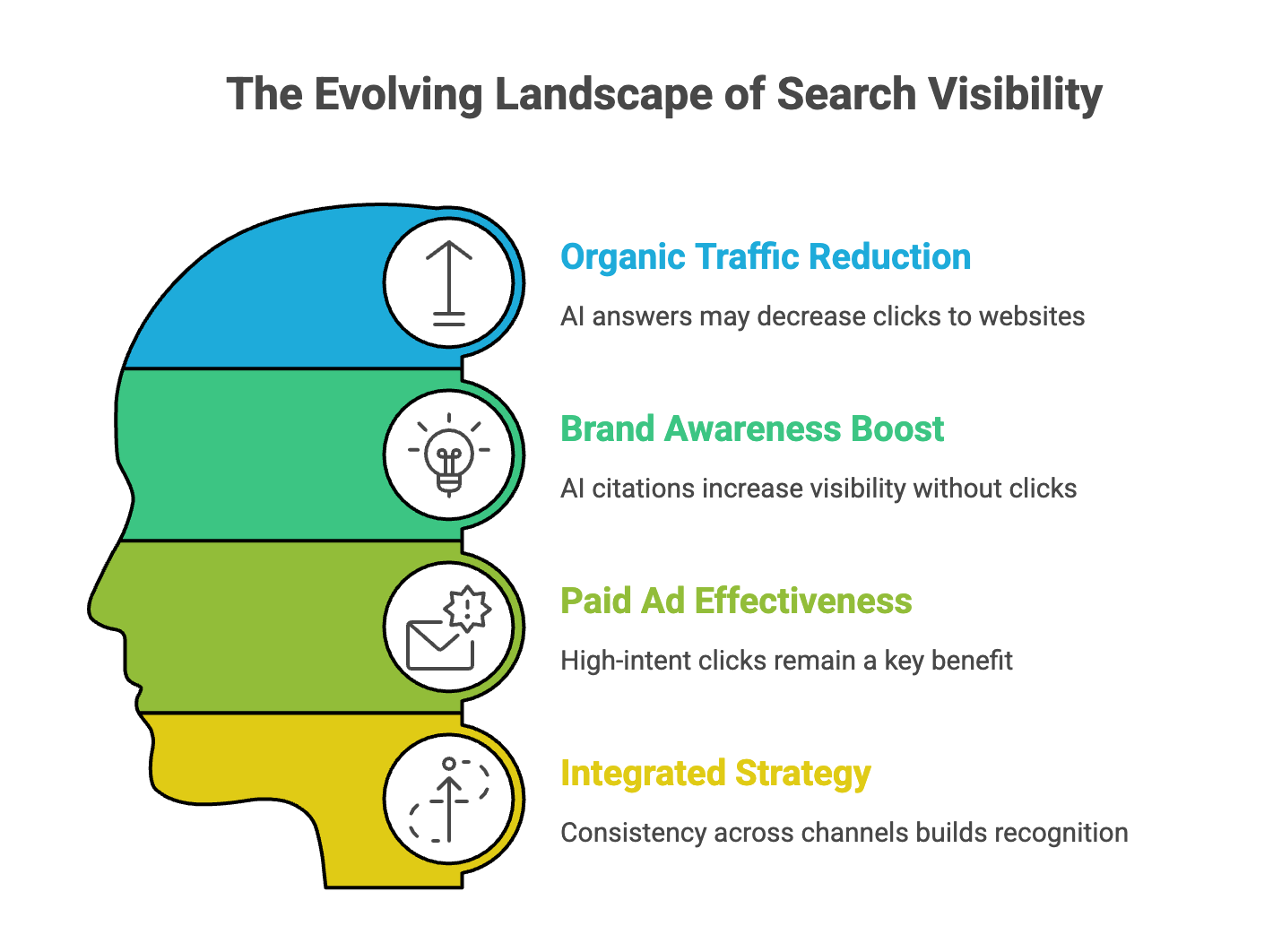
Head silhouette diagram highlighting organic traffic reduction, brand awareness boost, paid ad effectiveness, and integrated strategy in AI-driven search.

AI answers can reduce clicks to organic results. Users get what they came for without visiting your site. However, appearing in AI answers drives brand awareness even without direct clicks.

The relationship between paid, organic, and AI-cited visibility is evolving. Businesses that appear consistently across all three channels build stronger recognition than those relying on any single source. Paid ads still capture high-intent clicks, organic results still drive traffic, and AI citations build brand familiarity.

What Toronto businesses need to know about AI ranking

Local businesses can leverage AI search for “near me” queries and local discovery. Regional relevance signals matter – AI systems consider location context when generating answers for local searches.

A Toronto-based home services company that creates content addressing local concerns, references local regulations, and builds citations from Toronto publications signals regional authority. AI systems pick up on geographic relevance when answering location-specific queries.

How to measure success when ranking looks different
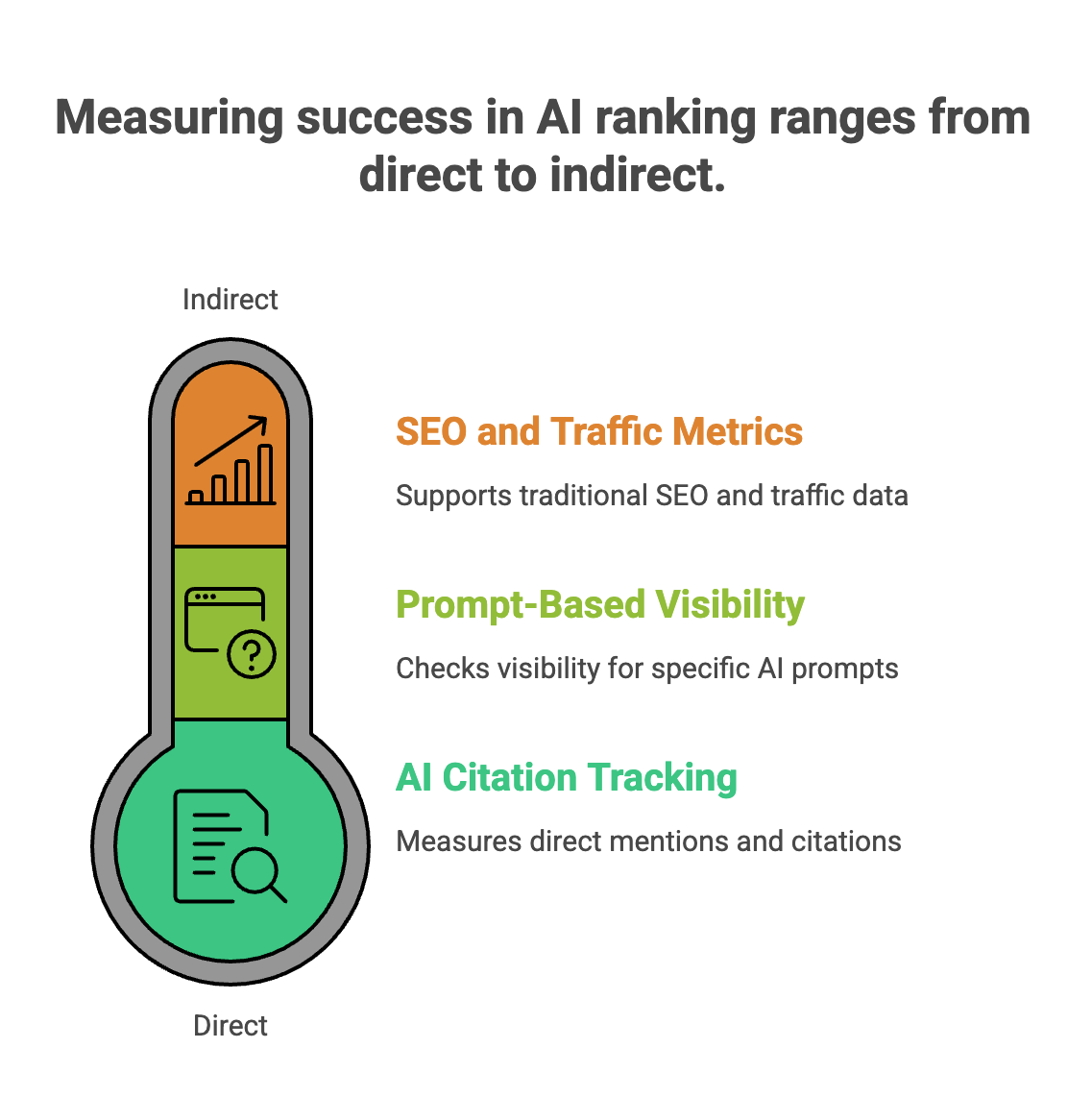
Visual scale showing measurement of AI ranking success from indirect SEO and traffic metrics to direct AI citation tracking and prompt-based visibility.

Traditional position tracking is no longer sufficient on its own. You want new metrics alongside familiar ones.

AI citation and mention tracking

Monitor whether your brand appears in AI-generated answers across platforms like ChatGPT, Perplexity, and Google AI Overviews. Tools are emerging to track AI mentions, though manual spot-checking still works for smaller operations.

Prompt-based visibility checks

Test your visibility by running relevant prompts through AI tools and checking for citations. Search for questions your customers ask and see whether your brand appears in the generated answers. This gives you direct insight into how AI systems perceive your business.

Supporting SEO and traffic metrics

Traditional metrics like organic traffic, conversions, and engagement still matter. Track them alongside AI-specific measurements for a complete picture. A drop in organic clicks paired with increased brand searches might indicate AI is driving awareness even without direct traffic.

How to build visibility that compounds in AI search
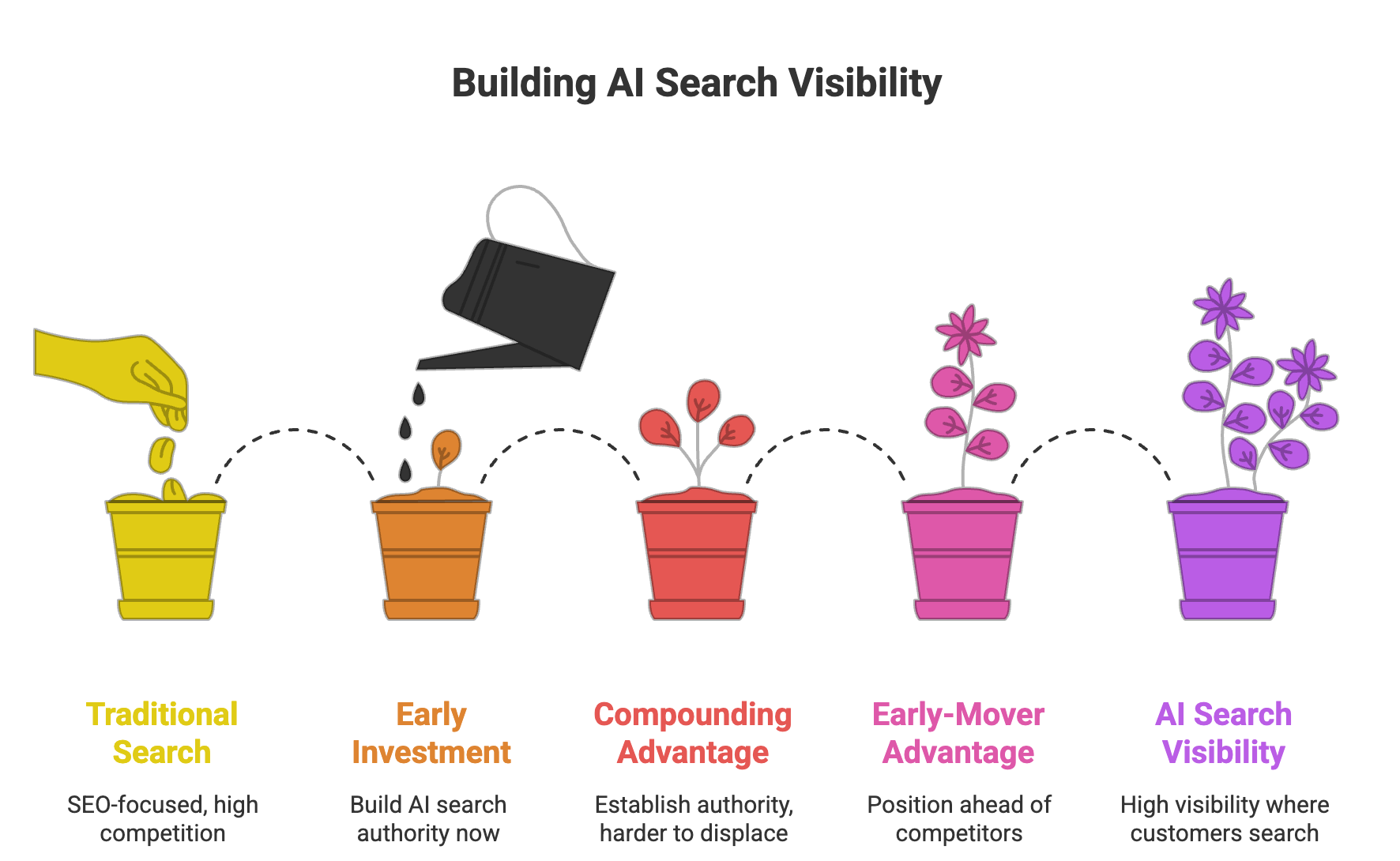
Illustration of building AI search visibility from traditional SEO to early investment, compounding advantage, early-mover advantage, and AI search visibility growth.

Early investment in AI search optimization creates compounding advantages. Brands that establish authority now will be harder to displace as AI search matures and more businesses compete for citations.

The window for early-mover advantage is open but narrowing. With Gartner projecting a 25% drop in traditional search volume by 2026, businesses that build AI visibility now position themselves ahead of competitors who wait to see how things shake out.

Looking to get ahead of AI search in Toronto? Digital 6ix’s AI Search Optimization Services help local businesses build visibility where customers are actually searching today.

This Blog is written by Simar Singh, Founder of Digital 6ix and a data-driven storyteller with 7+ years of experience helping Toronto businesses grow through performance-led digital strategies. Certified in Google Analytics and Google Search Console, with a strong focus on turning insights into measurable business outcomes.

Frequently Asked Questions

Leave a Comment

Your email address will not be published. Required fields are marked *