Read Time:

13–19 minutes

Modified Date:

AI Citation Timeline: When Will ChatGPT or Google Recommend Your Business?

You’ve optimized your content, built your authority, and now you’re wondering when AI tools will actually start recommending your business. It’s a fair question, and one without a single clean answer, because the timeline depends on factors most businesses aren’t tracking yet.

This guide breaks down realistic timelines for AI citations, the factors that speed things up or slow them down, and practical steps to accelerate your visibility across platforms like ChatGPT, Google AI Overviews, Claude, and Perplexity.

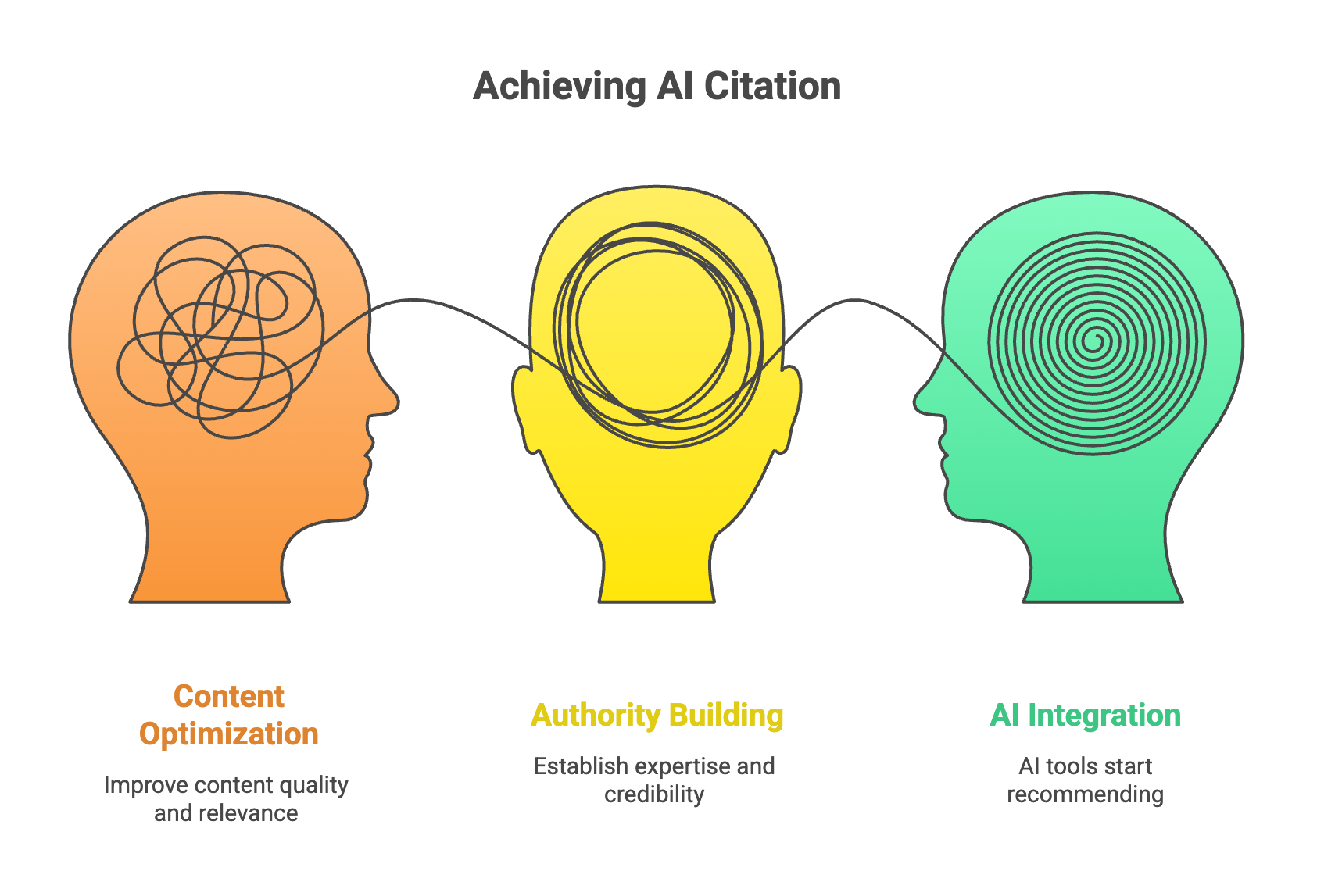
Diagram showing the path to achieving AI citation Timeline through content optimization, authority building, and AI integration where tools begin recommending the content.

TL;DR:

Generative Engine Optimization (GEO) can start producing AI citations within about 2–4 weeks, but building consistent visibility across platforms like ChatGPT, Google AI Overviews, Perplexity, and Claude typically takes 3–6 months. AI citations happen when these tools reference your content or mention your brand while generating answers similar to a backlink, but within an AI-generated response instead of a search result.

The speed of citations depends on factors like domain authority, structured data implementation, strong entity signals, and answer-ready content formatting. Sites with established authority, clear schema markup, and well-structured Q&A content tend to get cited faster, while thin content, technical issues, or weak brand signals slow things down. Businesses that consistently publish high-quality, structured content and strengthen their online authority can accelerate AI visibility and build long-term “brand memory” within AI systems.

The Short Answer on AI Citation Timelines

Generative Engine Optimization (GEO) can start producing measurable AI citations within 2–4 weeks, though building lasting authority typically takes 3–6 months. Unlike traditional SEO, where results often take 6–12 months to materialize, AI models can index well-structured content and cite it quickly when answering user queries.

So what exactly is an “AI citation”? It’s when a tool like ChatGPT, Google AI Overviews, or Perplexity references or recommends your content in its response. Think of it as the AI equivalent of a backlink, except instead of linking to your page, the AI actively mentions your brand or pulls information from your content to answer someone’s question.

Timeline Phase What to Expect
1–2 weeks High-authority, well-structured content may begin appearing in AI tools such as Perplexity or Google AI Overviews.
2–6 weeks Early brand mentions may appear in AI-generated responses, including “best of” lists or factual data references.
3–6 months Consistent citations for competitive and informational queries as your site builds topical authority and brand recognition.

The range is wide because so much depends on your starting point. A site with strong domain authority and years of content will see results faster than a newer site still building credibility.

Why GEO Timelines Differ from Traditional SEO

GEO focuses on getting your content cited by AI-powered search tools rather than just ranking in traditional search results. While the two disciplines overlap as part of a modern SEO strategy, they operate on different mechanics.

Traditional SEO ranks pages in a list. AI search retrieves and synthesizes information, then generates an answer. This distinction matters because AI platforms prioritize different signals than Google’s traditional algorithm, and organic CTR drops on queries where AI Overviews appear.

Retrieval vs. ranking: AI tools pull relevant snippets from multiple sources rather than ranking individual pages in order.
Entity recognition: AI platforms look for clear, unambiguous brand signals to recommend a business confidently.
Content structure: Answer-ready formatting like definitions, comparisons, and direct responses carries more weight for GEO than traditional SEO.

The practical implication? You can rank well in traditional search and still be invisible to AI tools if your content isn’t structured for extraction.

What Speeds Up AI Citations

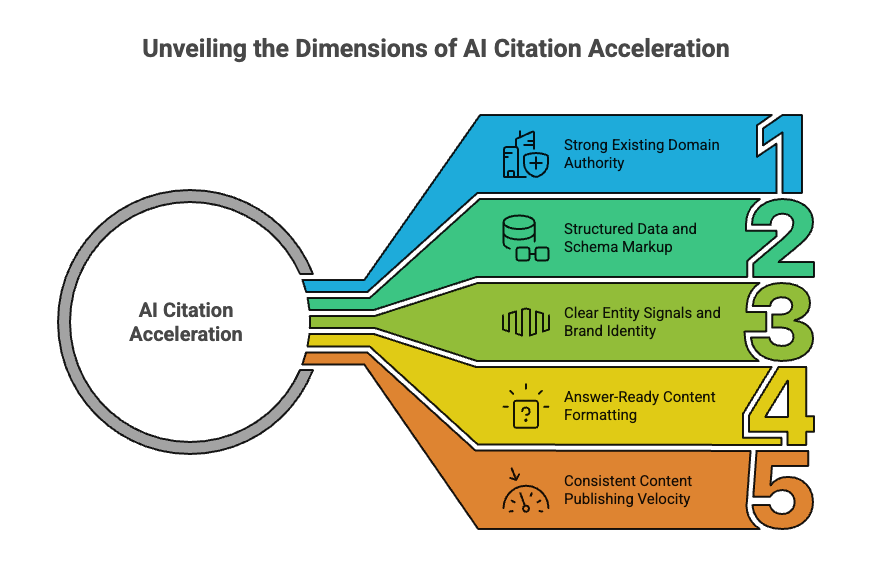
Diagram showing factors that accelerate AI citations such as strong domain authority, structured data, clear entity signals, answer-ready content, and consistent publishing.

Several factors determine how quickly an AI tool discovers and trusts your content.

Strong Existing Domain Authority

Sites already trusted by search engines tend to get cited faster by AI platforms. An SE Ranking published one of the most comprehensive studies on this topic, analyzing 2.3 million pages across 295,485 domains. Their key finding: domain traffic is the #1 predictor of AI Mode citations.

Sites with over 1.16 million monthly visitors earn an average of 6.4 citations per query, compared to just 2.4 for lower-traffic sites. If you’ve spent years building SEO equity, that investment transfers to AI visibility.

Structured Data and Schema Markup

Structured data is code that helps AI understand your content’s meaning. Implementing schema types like FAQ, HowTo, and Organization makes your content more parseable. When AI tools can clearly identify what your page is about and who created it, citation likelihood increases.

Clear Entity Signals and Brand Identity

Entity signals are consistent brand information across the web: your business name, location, services, and how they’re described everywhere. AI platforms look for unambiguous clarity before recommending a business, so inconsistent information creates friction.

If your brand appears differently across directories, social profiles, and your website, AI tools struggle to connect the dots.

Answer-Ready Content Formatting

Content structured as direct answers gets cited more easily. FAQ sections, clear headings, concise paragraphs, and definitions placed at the beginning of sections all improve AI readability. The easier it is for an AI to extract a clean answer from your page, the more likely it is to cite you.

Consistent Content Publishing Velocity

Regular publishing builds topical authority over time. AI platforms recognize patterns of expertise, and consistent output signals that your site is an active, reliable source in your niche rather than a dormant property.

What Slows Down AI Citations

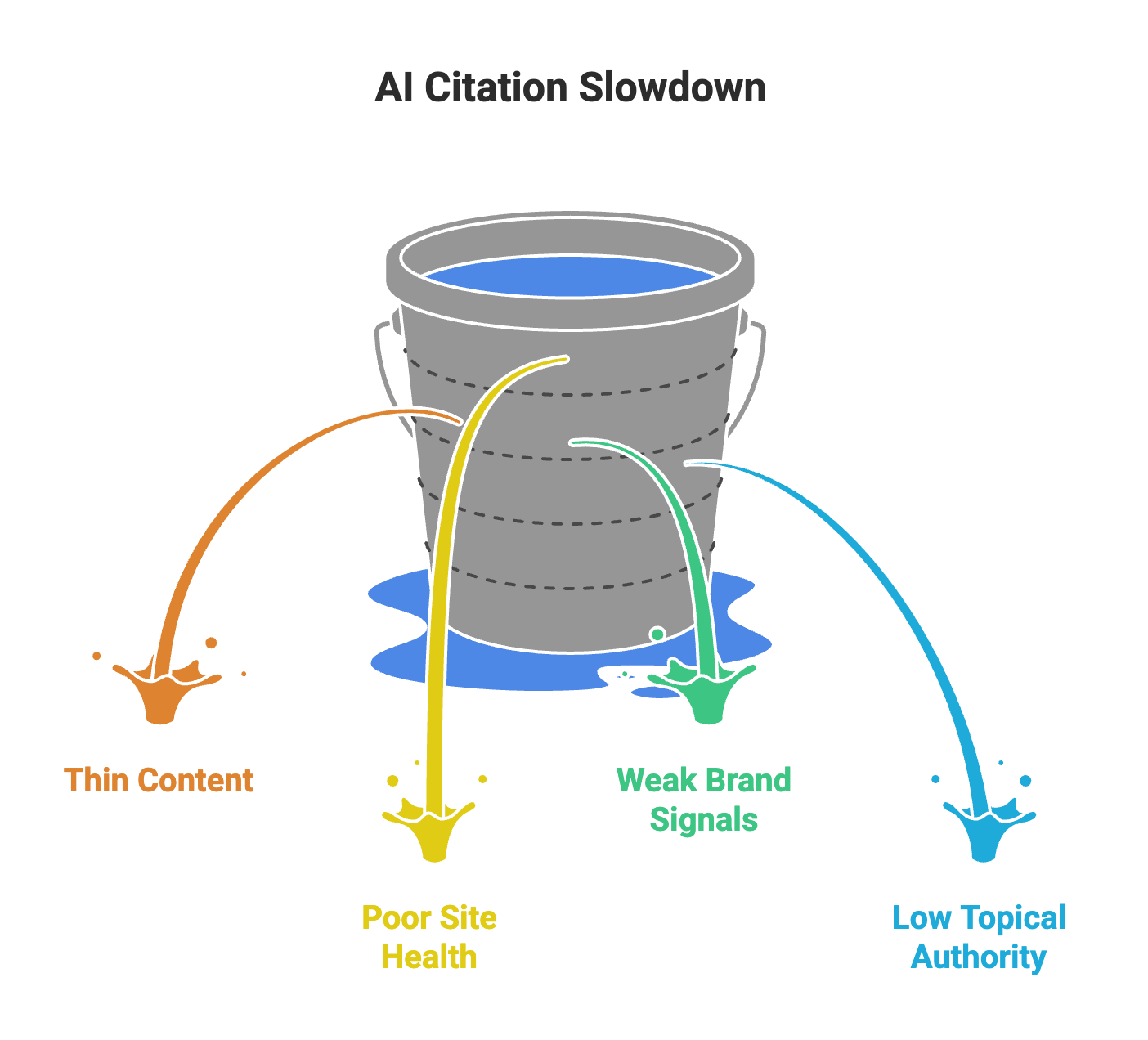
Illustration showing factors that slow AI citations including thin content, poor site health, weak brand signals, and low topical authority.

Just as certain factors accelerate citations, others create friction that delays AI visibility.

Thin or Outdated Content

AI tools deprioritize pages with shallow, old, or low-value content. If your content hasn’t been updated in years or lacks depth, a content audit can identify which pages need refreshing before AI platforms look elsewhere for answers. Freshness matters, especially for topics that evolve.

Poor Site Technical Health

Crawlability issues, slow load times, and mobile problems prevent AI from accessing your content in the first place. Technical health is foundational. Without it, even great content won’t get cited because AI tools can’t reliably retrieve it.

Weak or Ambiguous Brand Signals

Inconsistent NAP (name, address, phone) or unclear business identity confuses AI platforms. When your brand information varies across the web, AI tools can’t confidently attribute expertise to your business.

Low Topical Authority in Your Niche

Sites without depth in their subject area take longer to be recognized as authoritative sources. A single blog post on a topic won’t compete with a site that has dozens of interconnected articles demonstrating expertise. AI platforms favour sources that show sustained, comprehensive coverage.

Realistic GEO Timeline by Month

Here’s what a typical GEO engagement looks like, broken into phases with realistic expectations.

Phase Focus Areas Expected Outcomes
Weeks 1–4 Audit, technical fixes, structured data, quick content optimizations Baseline established and technical foundations in place
Months 2–3 Content expansion, entity signal strengthening, early monitoring First mentions appearing and important content gaps filled
Months 4–6 Broader distribution, backlink building, consistent optimization Consistent citations and broader query coverage
Months 7–12 Ongoing refinement and authority compounding Established authority and predictable AI recommendations

How Fast Each AI Platform Cites New Content
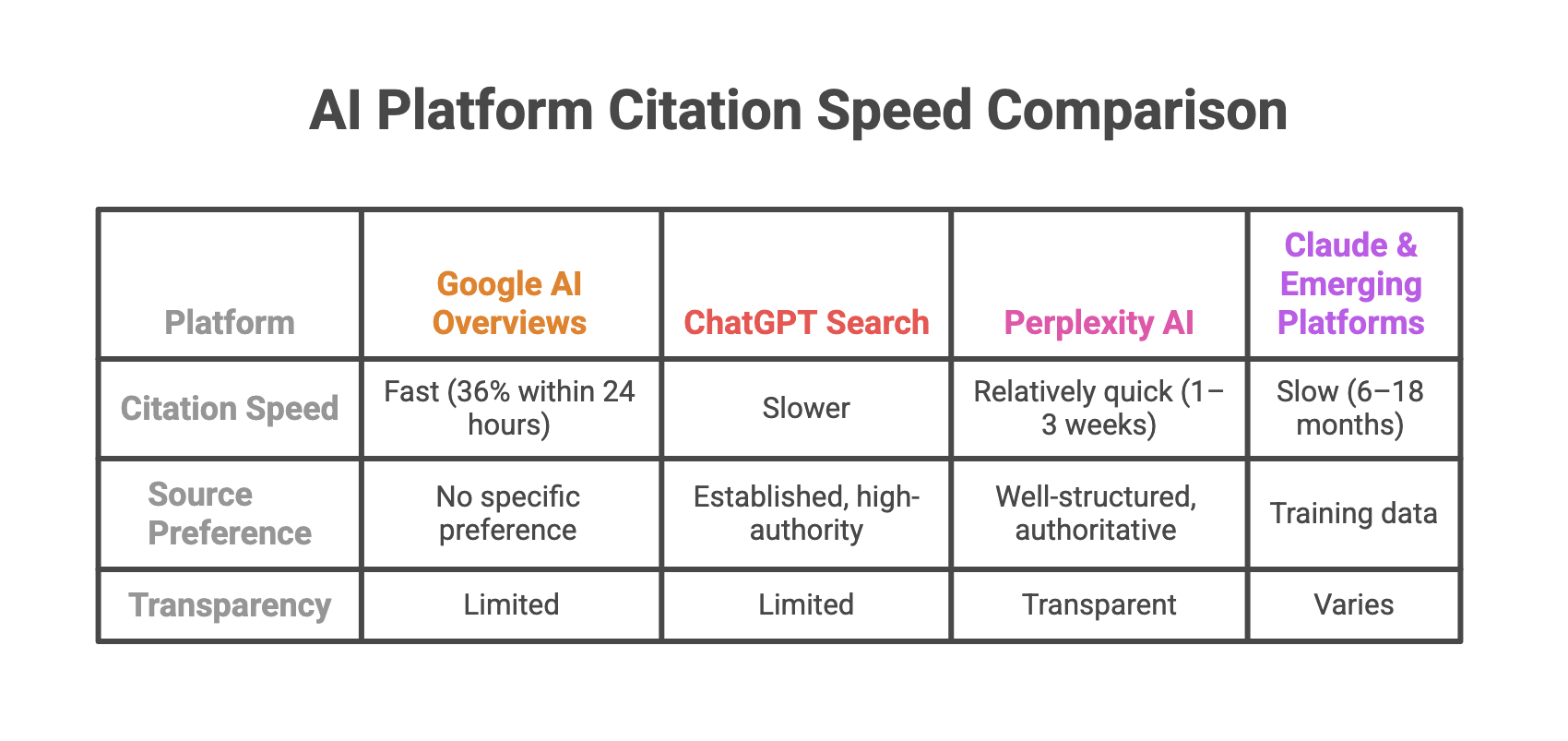
Comparison table showing how quickly AI platforms cite content including Google AI Overviews, ChatGPT Search, Perplexity AI, and Claude.

Different AI platforms have different indexing speeds and citation behaviours.

Google AI Overviews and AI Mode

Google AI Mode tends to cite content faster than other platforms. Semrush research found that 36% of pages were cited in Google AI Mode within 24 hours of publishing, which is significantly faster than other AI tools.

ChatGPT Search

ChatGPT’s browsing and citation behavior typically takes longer than Google AI. While ChatGPT can access current information through web browsing, it tends to favour established, high-authority sources over newly published content.

Perplexity AI

Perplexity uses real-time search and tends to cite content relatively quickly, often within 1–3 weeks for well-structured, authoritative pages. Its citation behavior is more transparent than other platforms, making it easier to track which sources it’s pulling from.

Claude and Other Emerging Platforms

The AI search landscape is evolving rapidly. Newer platforms may have different citation behaviors, and some rely on training data with knowledge cutoffs rather than real-time search. This means significant brand changes or new information can take 6–18 months to be fully adopted by certain AI models.

How to Track AI Citations and Measure GEO Results
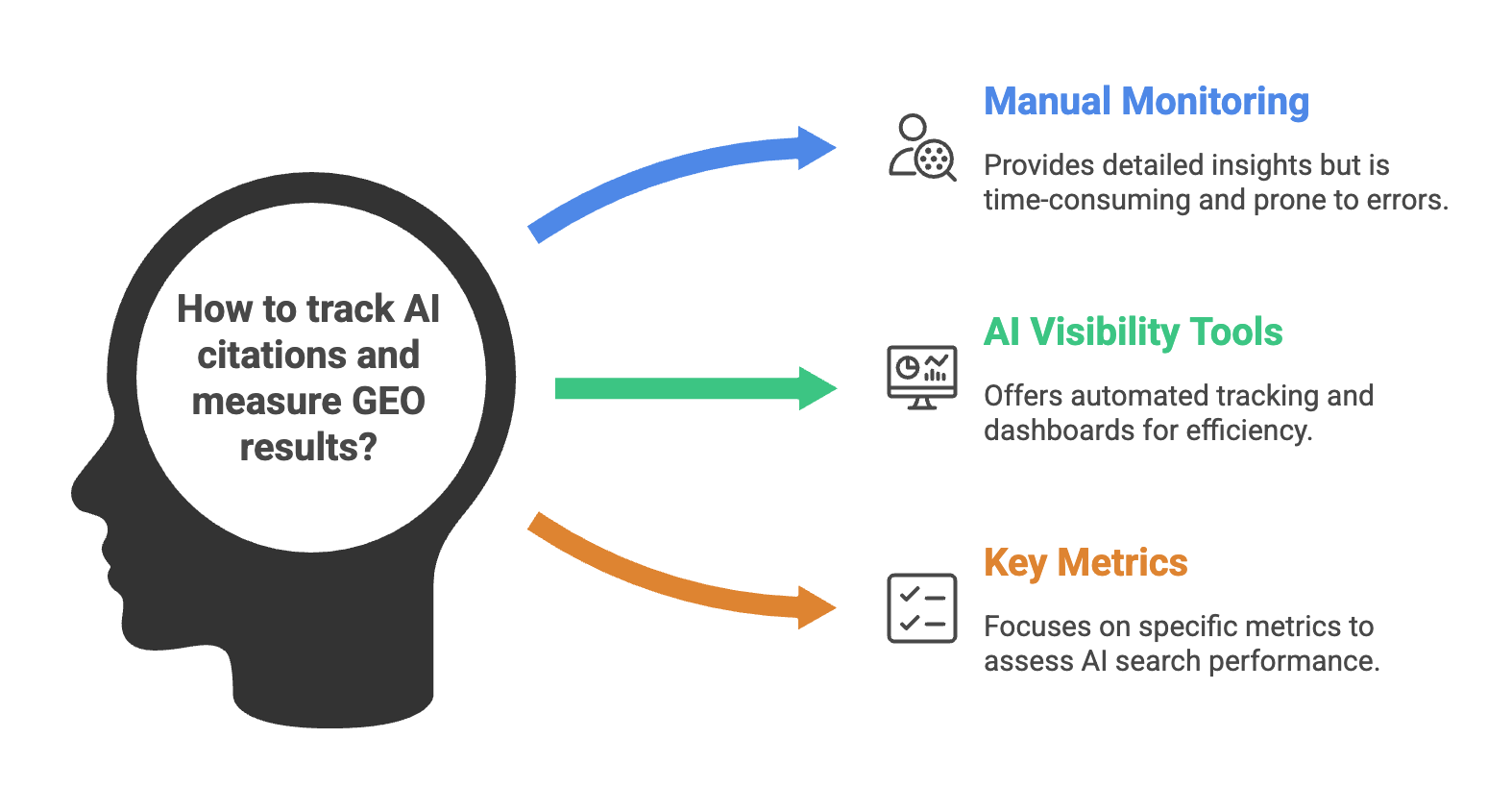
Diagram explaining how to track AI citations and measure generative engine optimization results using monitoring tools and key metrics.

Monitoring whether you’re being cited by AI tools requires different approaches than traditional SEO tracking.

Manual Citation Monitoring Methods

The simplest approach is manual prompt testing: asking AI tools questions about your services or industry and checking whether your brand appears in responses. This is time-consuming but provides direct insight into your visibility across different query types.

AI Visibility Tools and Dashboards

Emerging tools now track AI citations automatically. Platforms like Semrush have added AI visibility features, and specialized GEO monitoring solutions are entering the market. The tooling is still maturing, but options are expanding quickly.

Key Metrics for AI Search Performance

Brand mentions: How often AI tools name your business in responses
Citation frequency: How consistently you appear across relevant queries
Query coverage: The range of topics where you’re being recommended
AI-influenced conversions: Leads or actions that originate from AI recommendations

Tips to Accelerate Your AI Visibility

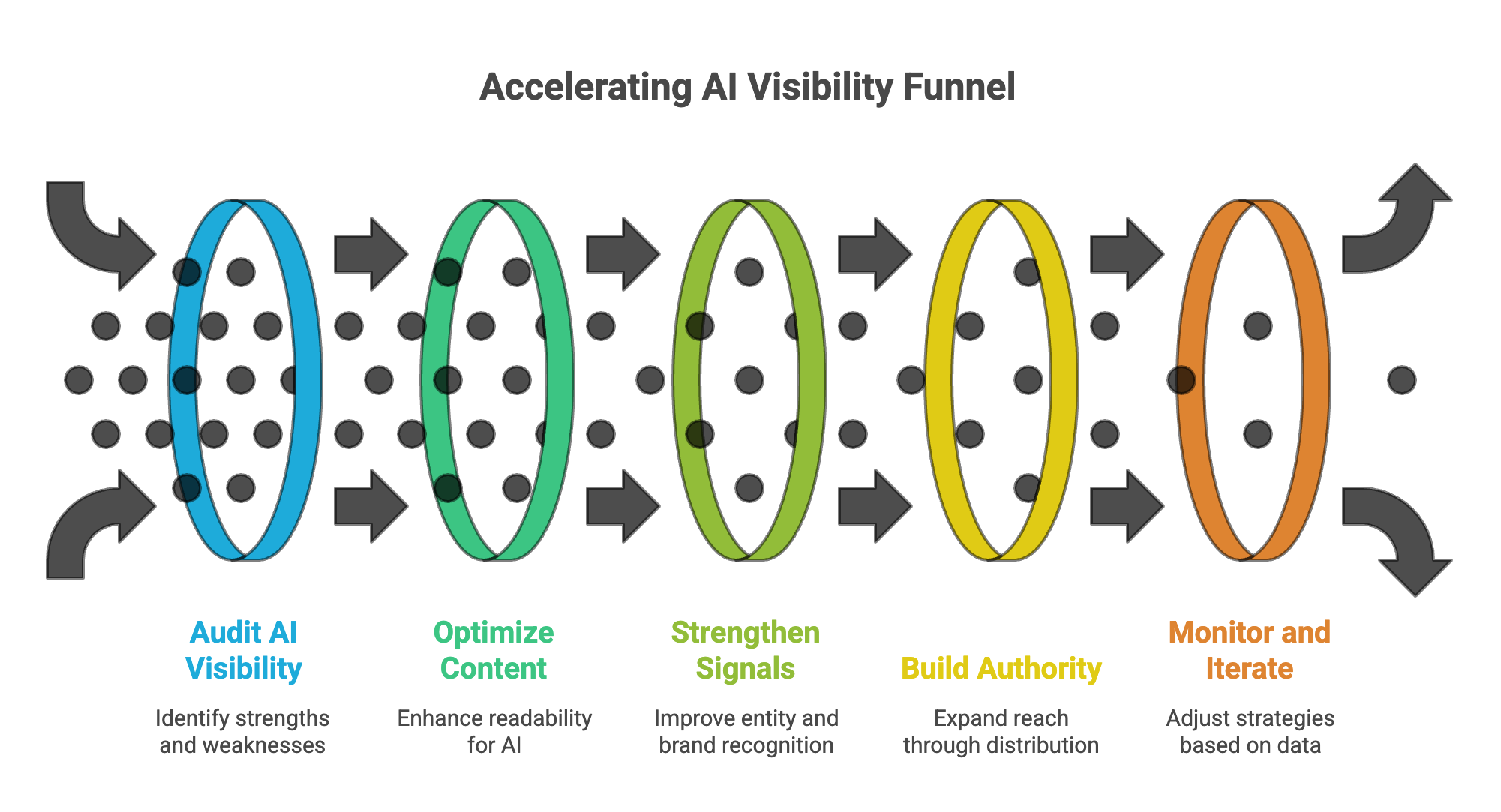
Funnel diagram showing steps to accelerate AI visibility including auditing AI visibility, optimizing content, strengthening signals, building authority, and monitoring results.

Here are actionable steps that can speed up your AI citation timeline.

1. Audit Your Current AI Visibility

Start by establishing a baseline. Test relevant queries across ChatGPT, Google AI Overviews, and Perplexity to see where you currently appear and where you don’t. This reveals gaps and priorities.

2. Optimize Content for AI Readability

Structure content with answer-ready formatting: clear definitions, FAQ sections, direct responses to common questions, and concise paragraphs that AI can easily extract. Place the most important information at the beginning of sections.

3. Strengthen Entity and Brand Signals

Ensure consistent NAP across all web properties, implement Organization schema, and maintain clear brand identity across directories, social profiles, and your website. Consistency builds the clarity AI platforms look for.

4. Build Authority Through Strategic Distribution

Digital PR, guest posts, and backlinks from authoritative sources build the trust signals AI platforms use to determine credibility. Third-party mentions on sites like G2, Capterra, or industry publications carry significant weight because they validate your expertise externally.

5. Monitor and Iterate Based on Performance Data

Track your citations regularly and adjust based on what’s working. GEO is an ongoing process, not a one-time optimization. The businesses seeing the best results are the ones treating AI visibility as a continuous effort.

Why Now Is the Critical Window for AI Search Visibility
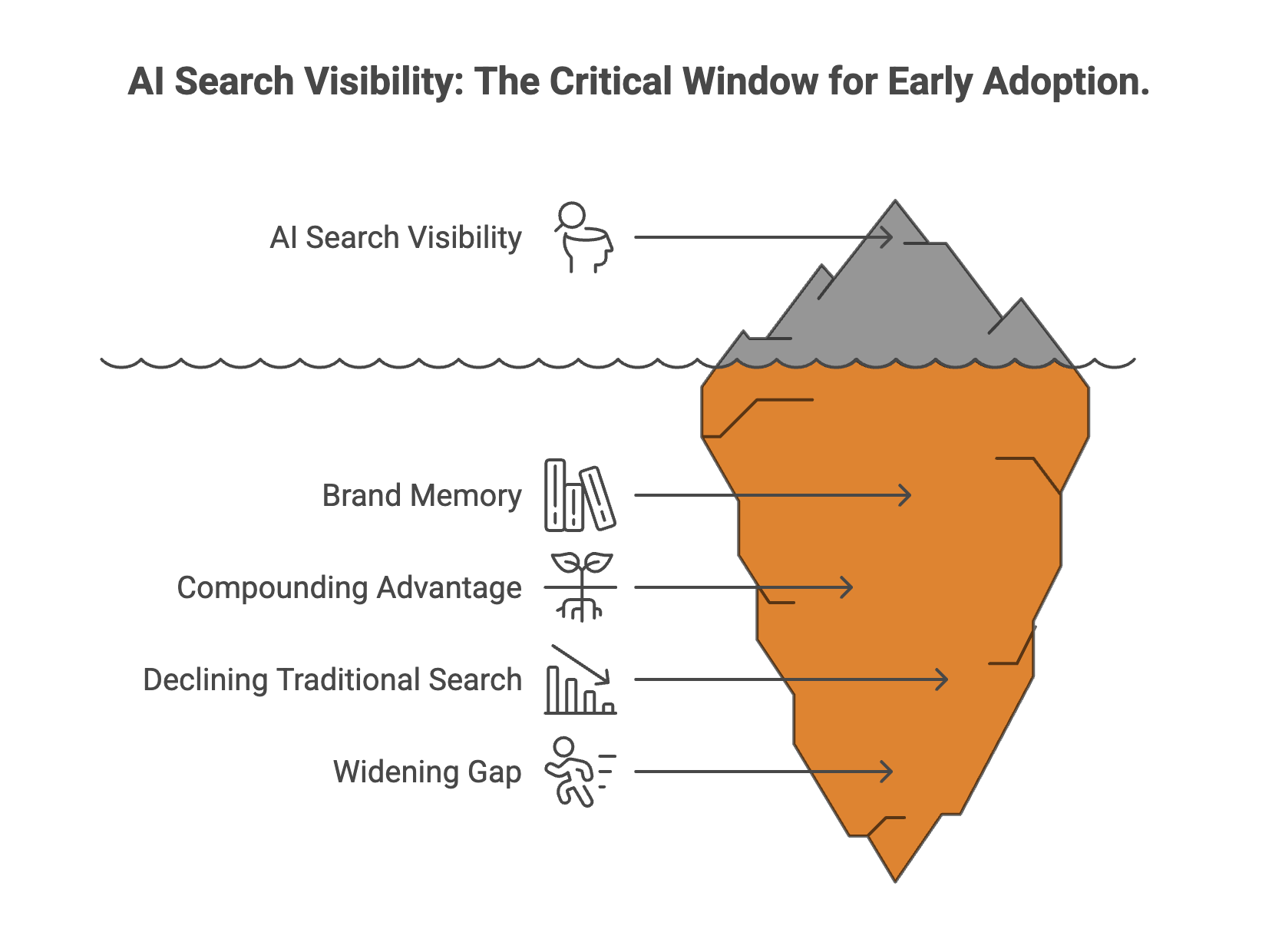
Iceberg diagram illustrating the critical window for early AI search visibility including brand memory, compounding advantage, and widening competitive gaps.

AI search is still in its early adoption phase, which creates a rare opportunity. Businesses that optimize for AI visibility now are building “brand memory,” the accumulated recognition that makes AI platforms more likely to cite them over time.This advantage compounds.

Early movers establish authority while competition is lower, making it progressively harder for latecomers to catch up. With traditional search volume dropping 25% due to AI chatbots, waiting means competing against businesses that have already built months or years of AI visibility, and that gap only widens.

How to Start Getting Cited by AI Today
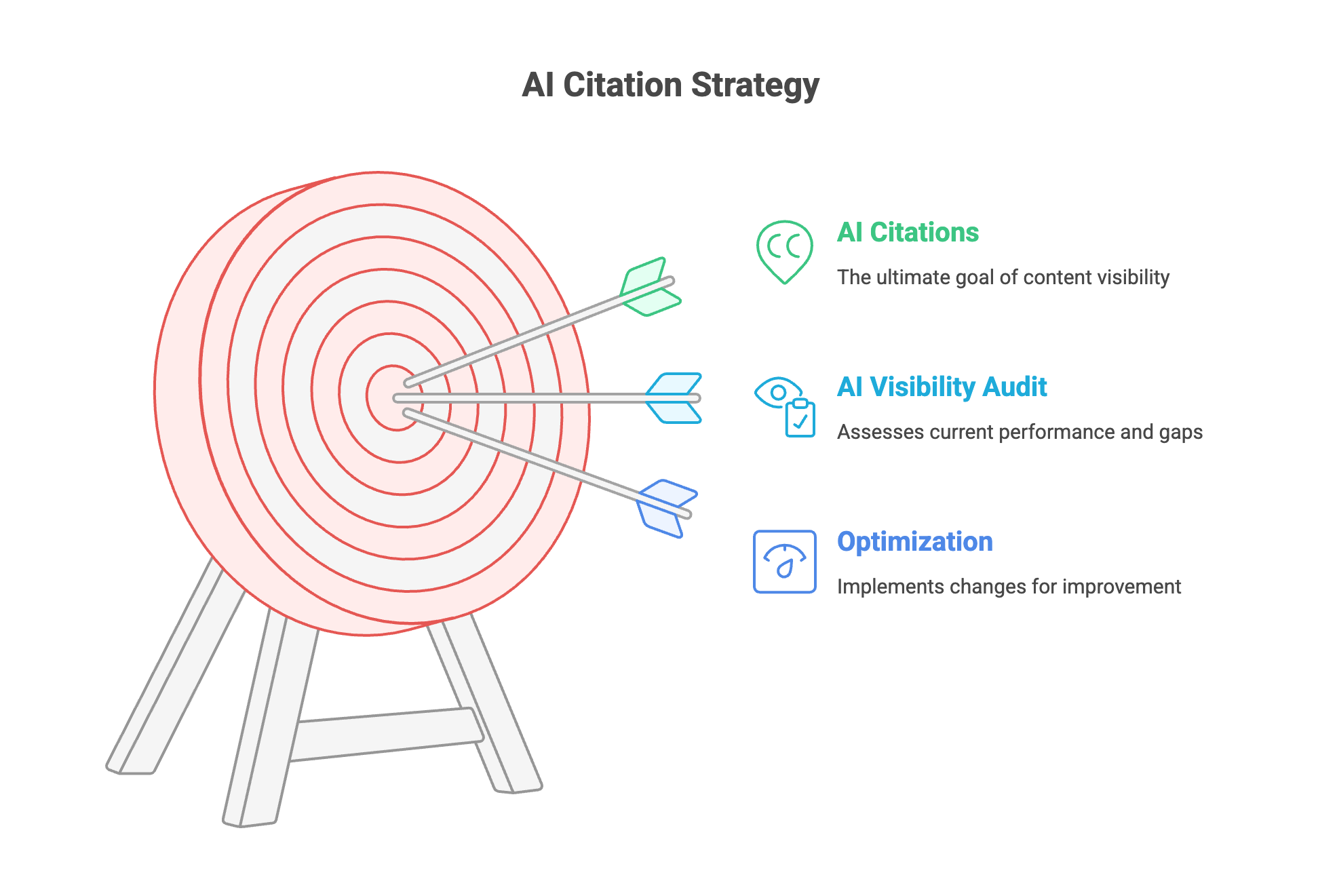
Target diagram illustrating an AI citation strategy that includes AI visibility audits, content optimization, and achieving citations in AI-generated answers.

The fastest path forward is understanding where you currently stand. An AI visibility audit reveals which queries you’re appearing for, where gaps exist, and what optimizations will have the highest impact.

Digital 6ix’s AI Search Optimization services help Toronto businesses build AI visibility through structured data implementation, entity optimization, and answer-ready content development, backed by ongoing measurement of AI mentions, citations, and AI-influenced conversions.

This Blog is written by Simar Singh, Founder of Digital 6ix and a data-driven storyteller with 7+ years of experience helping Toronto businesses grow through performance-led digital strategies. Certified in Google Analytics and Google Search Console, with a strong focus on turning insights into measurable business outcomes.

Frequently Asked Questions

Leave a Comment

Your email address will not be published. Required fields are marked *