
Read Time:

14–21 minutes

Modified Date:

How to Build a Small Business SEO Strategy on Any Budget

Most small business owners assume SEO requires either a massive budget or a dedicated marketing team. Neither is true – what it actually requires is knowing where to focus when you can’t do everything at once.

This guide walks through how to build an SEO strategy that fits your resources, from free tools and DIY tactics to knowing when professional help makes sense.

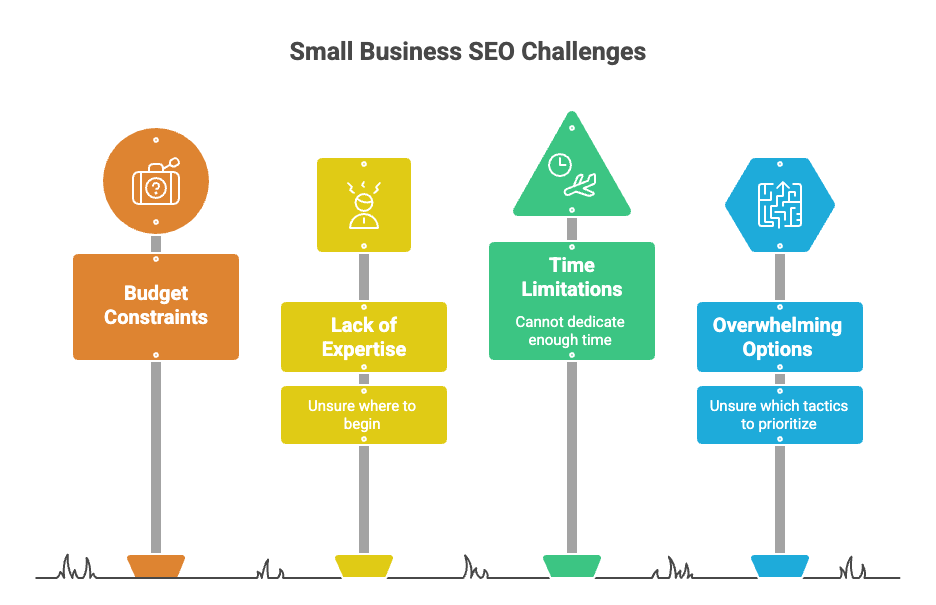
Small business SEO challenges such as budget constraints, lack of expertise, time limitations, and difficulty prioritizing SEO tactics

TL;DR:

You don’t need a massive budget or a full marketing team to build an effective small business SEO strategy — you need focus and prioritization. Start by fixing technical basics, optimizing existing pages, and claiming your Google Business Profile. Target long-tail, high-intent keywords, build cornerstone content, and improve internal linking before worrying about advanced tactics. Consistency beats complexity, especially on a limited budget.

As your business grows, layer in content expansion and link building, and only invest in professional help when technical issues, competition, or time constraints demand it. Track performance monthly, focus on leads rather than just traffic, and double down on what drives results. Done right, budget SEO compounds over time — delivering sustainable visibility and leads long after the initial work is complete.

What Is a Small Business SEO Strategy

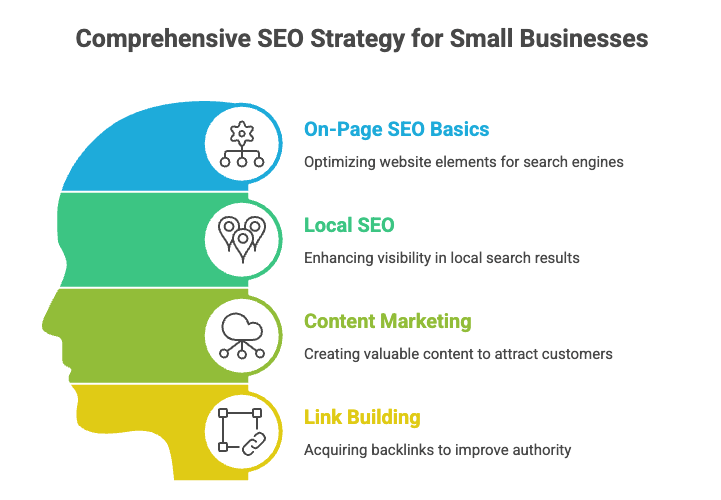
Comprehensive SEO strategy for small businesses including on-page SEO basics, local SEO, content marketing, and link building

The Small Business SEO Strategy centres on high-impact, manual work:

Optimizing your Google Business Profile
Writing content around long-tail keywords
Building backlinks through guest posts
Tracking performance with free tools like Google Search Console

The key is consistent effort over time rather than spending money upfront. So what exactly is an SEO strategy? It’s a documented plan for improving how often your website appears in search results.

The Small Business SEO Strategy plan typically covers four areas: 

Technical SEO: Fixing site speed, mobile usability, and crawl errors so Google can actually access your pages
On-page SEO: Optimizing your content, keywords, headers, and internal links
Off-page SEO: Earning backlinks and mentions from other websites
Local SEO: Appearing in “near me” searches through your Google Business Profile and local directory listings

When you’re working with limited resources, “strategy” really means deciding what to tackle first. You’re not doing everything at once. You’re picking the actions that will move the needle fastest given your constraints.

How Much Could a Small Business Spend on SEO

Your SEO investment depends on your goals and how competitive your market is. A solo consultant targeting one neighbourhood faces different challenges than a multi-location company competing across the GTA.

SEO Investment Benchmarks by Business Size

SEO Strategy by Business Stage

Business Stage Typical Approach What It Covers
Startup or Solo
DIY with free tools
Basic on-page optimization, local listings
Established Local
Hybrid DIY plus freelancer
Content creation, technical fixes, local SEO
Growth-Focused
Agency partnership
Full strategy, link building, ongoing optimization

What You Get at Different Budget Levels

At the DIY level, you can achieve foundational visibility. Your site gets indexed, your Google Business Profile is claimed, and your pages target relevant keywords. With modest professional support, you add consistent content production and technical fixes that compound month over month.

A full-service partnership delivers strategic planning, authority building through backlinks, and measurable organic growth. Regardless of which level you’re at, expect SEO to take several months before you see meaningful results. This is a compounding investment, not a quick fix.

How to Build Your SEO Strategy Step by Step
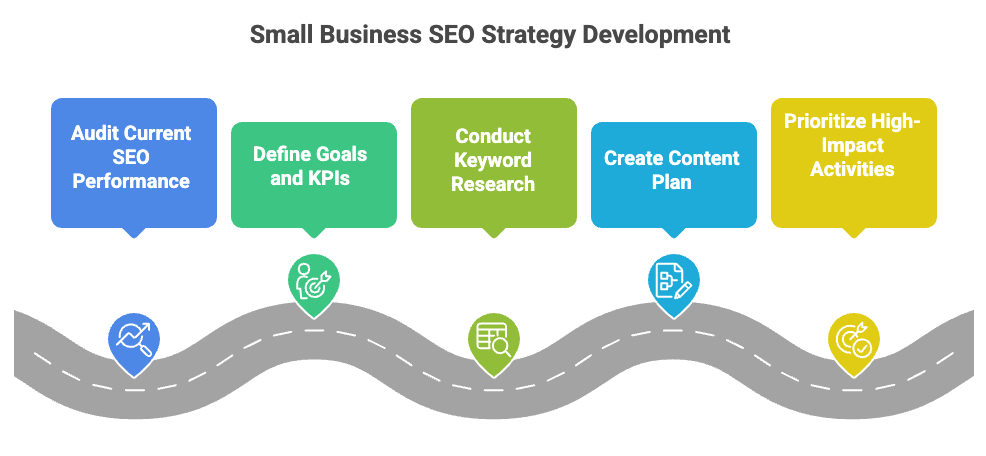
Small business SEO strategy roadmap showing audit, goal setting, keyword research, content planning, and prioritizing high-impact SEO activities

1. Audit Your Current SEO Performance

Before changing anything, figure out where you stand. An SEO audit reveals indexing issues, broken links, page speed problems, and your current keyword rankings.

You can run a basic audit for free using Google Search Console and Screaming Frog, which is free for sites under 500 URLs. Look for pages returning errors, slow-loading pages, and content that isn’t ranking for anything relevant.

2. Define Your Goals and KPIs

Choose goals tied to business outcomes. Leads, phone calls, and local visibility matter more than raw traffic numbers. Your KPIs, might include organic leads from service pages, rankings for “[service] + [city]” keywords, and Google Business Profile views.

3. Conduct Keyword Research on a Budget

You don’t need expensive tools to find keywords. Google’s autocomplete suggestions, the “People Also Ask” boxes in search results, and free tiers of tools reveal what potential customers are actually searching for. Read full blog on How to Discover Real Keywords From Customer Conversations for more details.

Focus on long-tail keywords, which are phrases with three to five words that are more specific and less competitive. Backlinko’s analysis of long-tail keywords found that longer, more specific search phrases convert at significantly higher rates than broad head terms, because searchers using them already know what they want. “Emergency plumber Scarborough” is easier to rank for than “plumber Toronto,” and the person searching for it is usually closer to making a decision.

4. Create a Content Plan That Scales

Start with cornerstone pages that cover your main services or topics comprehensively. Then build supporting content like blog posts, FAQ pages with schema markup, and location pages that link back to those cornerstone pieces.

This pillar-and-cluster approach builds topical authority over time. Quality matters more than volume, so one well-researched article per month beats four thin posts that don’t say anything useful.

5. Prioritize High-Impact Activities First

When resources are limited, focus on quick wins before investing in new content or link building:

Fix technical errors flagged in your audit
Optimize existing pages with better titles and meta descriptions
Claim and complete your Google Business Profile
Add your business to relevant local directories

SEO Tactics That Work on Any Budget

Strategy Area What It Includes
On-Page SEO Basics Every Small Business Needs On-page optimization is free to implement and has immediate impact. The fundamentals include:

Title tags: Include your primary keyword and location within 60 characters
Meta descriptions: Write compelling summaries under 160 characters that encourage clicks
Header structure: Use H1 for your page title, H2 for main sections, H3 for subsections
Internal links: Connect related pages to help visitors and search engines navigate your site
Local SEO for Small Business Visibility According to Google’s Think With Google research, 46% of all Google searches have local intent — making local optimization essential for any small business with a physical presence or service area.

Start with your Google Business Profile by completing every field, adding photos regularly, and responding to reviews. Birdeye’s State of Google Business Profiles report found that 86% of consumers use Google Maps to discover local businesses — meaning your GBP functions as your storefront.

NAP consistency matters too. NAP stands for Name, Address, and Phone number, and keeping this information identical across listings helps search engines trust your business information. List your business in relevant directories and industry-specific sites to build citations.
Content Marketing Without a Big Budget You don’t need a large content team to publish useful material. Repurpose answers you already give customers into blog posts, create location-specific pages if you serve multiple areas, and update older content with fresh information instead of always starting from scratch.
Link Building That Costs Little or Nothing Backlinks from other websites signal authority to search engines. Budget-friendly approaches include guest posting on industry blogs, partnering with complementary local businesses for mutual links, and getting listed in local directories.

Avoid paid link schemes entirely — they violate Google’s guidelines and can lead to ranking penalties.

Free and Low-Cost SEO Tools Worth Using
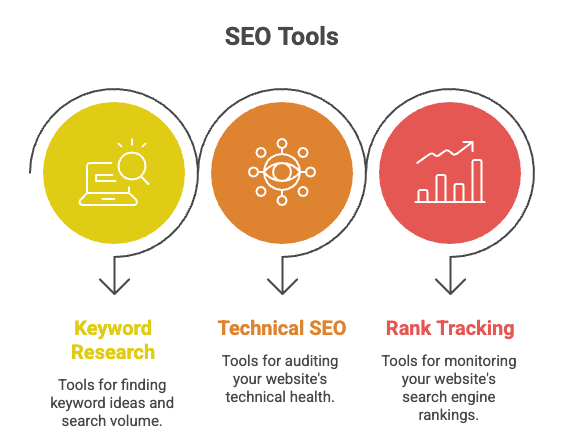
SEO tools overview including keyword research tools, technical SEO auditing tools, and rank tracking software

Keyword Research Tools

Google Keyword Planner: Best for search volume estimates, though it’s designed for advertisers
Semrush free tier: Provides keyword ideas and difficulty scores
AnswerThePublic: Useful for finding question-based content ideas

Technical SEO and Site Audit Tools

Google Search Console is essential and completely free. It shows how Google sees your site, flags indexing issues, and reveals which queries bring traffic. Screaming Frog’s free tier audits up to 500 URLs for broken links and missing metadata. PageSpeed Insights identifies performance problems affecting load time.

Rank Tracking and Analytics Tools

Google Analytics tracks visitor behaviour and conversions. Search Console shows your average ranking positions for different queries. For dedicated rank tracking, free tools like Ubersuggest or limited-feature versions of paid tools can monitor your most important keywords.

How to Allocate Your SEO Budget Across Activities
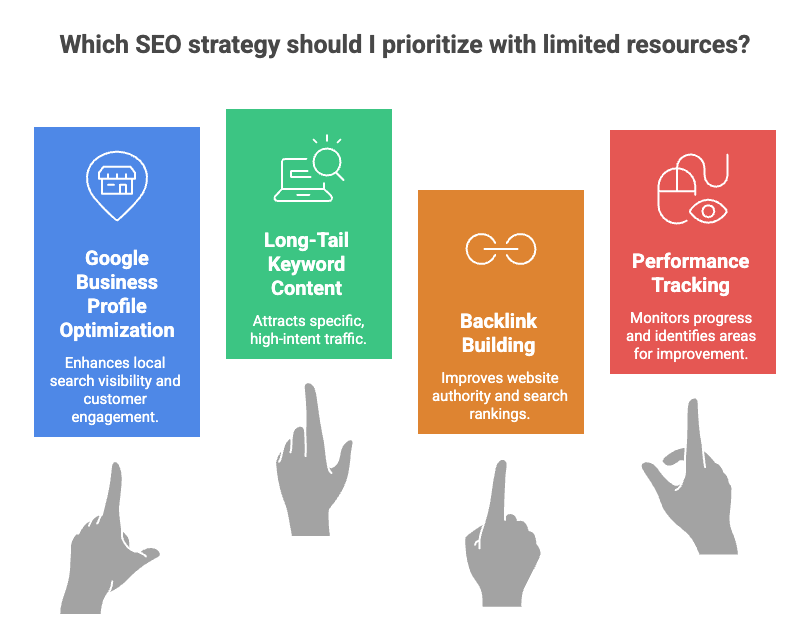
Small business SEO priorities with limited budget including Google Business Profile optimization, long-tail keyword content, backlink building, and performance tracking
SEO Investment Area How to Allocate Your Budget
Content and On-Page Investment Most small business budgets deliver the best return when focused here first. Optimizing what already exists — such as improving title tags, adding internal links, and updating thin content — often generates better results than constantly creating new pages.

Recommendation: This is usually the best first focus for most businesses.
Off-Page and Link Building Investment Link building becomes more valuable after your on-page foundation is strong. For most small businesses, the most effective strategy is investing time in outreach and partnerships rather than spending money on paid link services.

Recommendation: Time investment often works better than budget-heavy approaches.
Technical SEO Investment Basic technical improvements are often manageable without hiring outside help. However, complex issues such as site migrations, CMS errors, or persistent crawl problems may require professional support to avoid damaging your search visibility.
Local SEO Investment If your business depends on local customers, local SEO may deserve a larger portion of your budget than general SEO tactics. A well-optimized Google Business Profile can generate more leads than many traditional content strategies for service-based businesses.

Recommendation: High ROI for service-area and local businesses.

How to Track SEO Performance and Adjust Your Strategy

Key Metrics to Monitor Monthly

Organic sessions: How many visitors find you through search
Keyword rankings: Where you appear for target terms
Click-through rate: How often searchers click your listing versus competitors
Conversions: Leads, calls, or sales attributed to organic traffic

How to Use Data to Refine Your Approach

Review your metrics monthly or quarterly. Identify what’s working and double down on those pages or topics. Fix or retire content that isn’t performing. SEO is iterative, meaning your strategy evolves as you learn what resonates with your audience and what search engines reward.

What You Can Do Yourself vs. When to Hire an Expert

What You Can Do Yourself vs. When to Hire an Expert

SEO Tasks You Can Handle In-House

Many SEO activities are learnable and manageable without specialized training:

  • Writing and publishing blog content
  • Updating title tags and meta descriptions
  • Managing your Google Business Profile
  • Responding to customer reviews
  • Basic keyword tracking
DIY-friendly and high impact

Signs You Might Benefit from Professional Help

Consider bringing in expertise when traffic declines despite consistent effort, when technical issues exceed your skills, when you’re competing in a crowded market, or when you simply lack time to execute consistently. Sometimes the ROI of professional help outweighs the cost of slow DIY progress.

Hire when complexity or time becomes the bottleneck

Why Budget SEO Pays Off for Small Businesses

Unlike paid ads that stop delivering the moment you stop spending, SEO compounds over time. A page that ranks well today can generate leads for years with minimal maintenance.

For small businesses competing against larger players with bigger ad budgets, organic search levels the playing field. You’re competing on relevance and quality, not just spend.

Ready to turn your SEO strategy into measurable leads? Digital 6ix helps Toronto businesses build SEO systems that drive real growth, not just traffic.

This Blog is written by Simar Singh, founder of Digital 6ix and a data-driven storyteller with 7+ years of experience helping Toronto businesses grow through performance-led digital strategies. Certified in Google Analytics and Google Search Console, with a strong focus on turning insights into measurable business outcomes.

Frequently Asked Questions

Leave a Comment

Your email address will not be published. Required fields are marked *