Read Time:

19–29 minutes

Modified Date:

15 Best LLM Tracking Tools to Monitor Brand Visibility in 2026

Your brand might be getting recommended by ChatGPT dozens of times a day, or it might be completely invisible while competitors get all the mentions. Without dedicated tracking tools, you’d never know which scenario applies to you.

LLM tracking tools monitor how your brand appears in AI-generated answers across platforms like ChatGPT, Gemini, Perplexity, Claude, and Google AI Overviews. This guide covers the 15 best options for 2026, what features actually matter, and how to choose the right tool for your business size and budget.

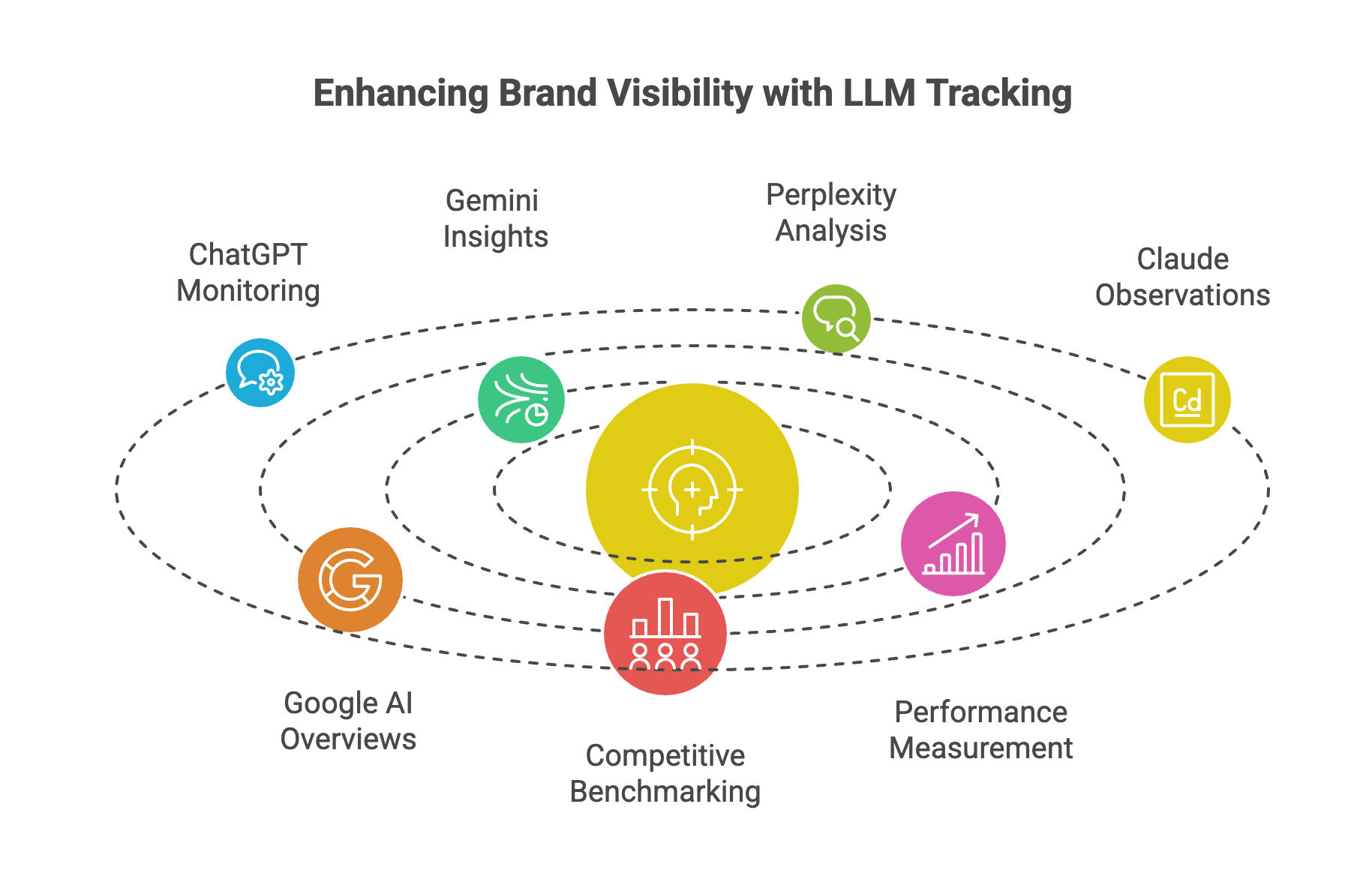
Orbital diagram illustrating how LLM tracking enhances brand visibility across multiple AI platforms, including ChatGPT monitoring, Gemini insights, Perplexity analysis, Claude observations, Google AI Overviews, competitive benchmarking, and performance measurement at the center.

TL;DR:

Best LLM Tracking Tools at a Glance

Tool Best For Platforms Tracked Pricing Tier
Semrush AI Toolkit Existing Semrush users ChatGPT, AI Overviews, Perplexity Mid-tier
Ahrefs Brand Radar Benchmarking brand performance Multiple LLMs Mid-tier
SE Ranking Comprehensive AI mode tracking AI Overviews, ChatGPT Mid-tier
Similarweb Enterprise market visibility Multiple LLMs Enterprise
BrightEdge Large-scale content teams AI Overviews, ChatGPT Enterprise
Conductor Content intelligence integration Multiple LLMs Enterprise
Profound All-in-one enterprise needs All major LLMs Enterprise
Peec AI Smart improvement suggestions Conversational AI Mid-tier
Otterly AI Budget-conscious teams ChatGPT, Perplexity Affordable
Scrunch AI Citation accuracy detection Multiple LLMs Mid-tier
ZipTie Deep analysis and reporting All major LLMs Mid-tier
Trackerly.ai Real-time alerts ChatGPT, AI Overviews Mid-tier
Nightwatch Combined SEO and AI tracking Multiple LLMs Mid-tier
Keyword.com Keyword-focused tracking AI Overviews, ChatGPT Mid-tier
Quno AI Specialized prompt analysis Multiple LLMs Mid-tier

What Are LLM Tracking Tools

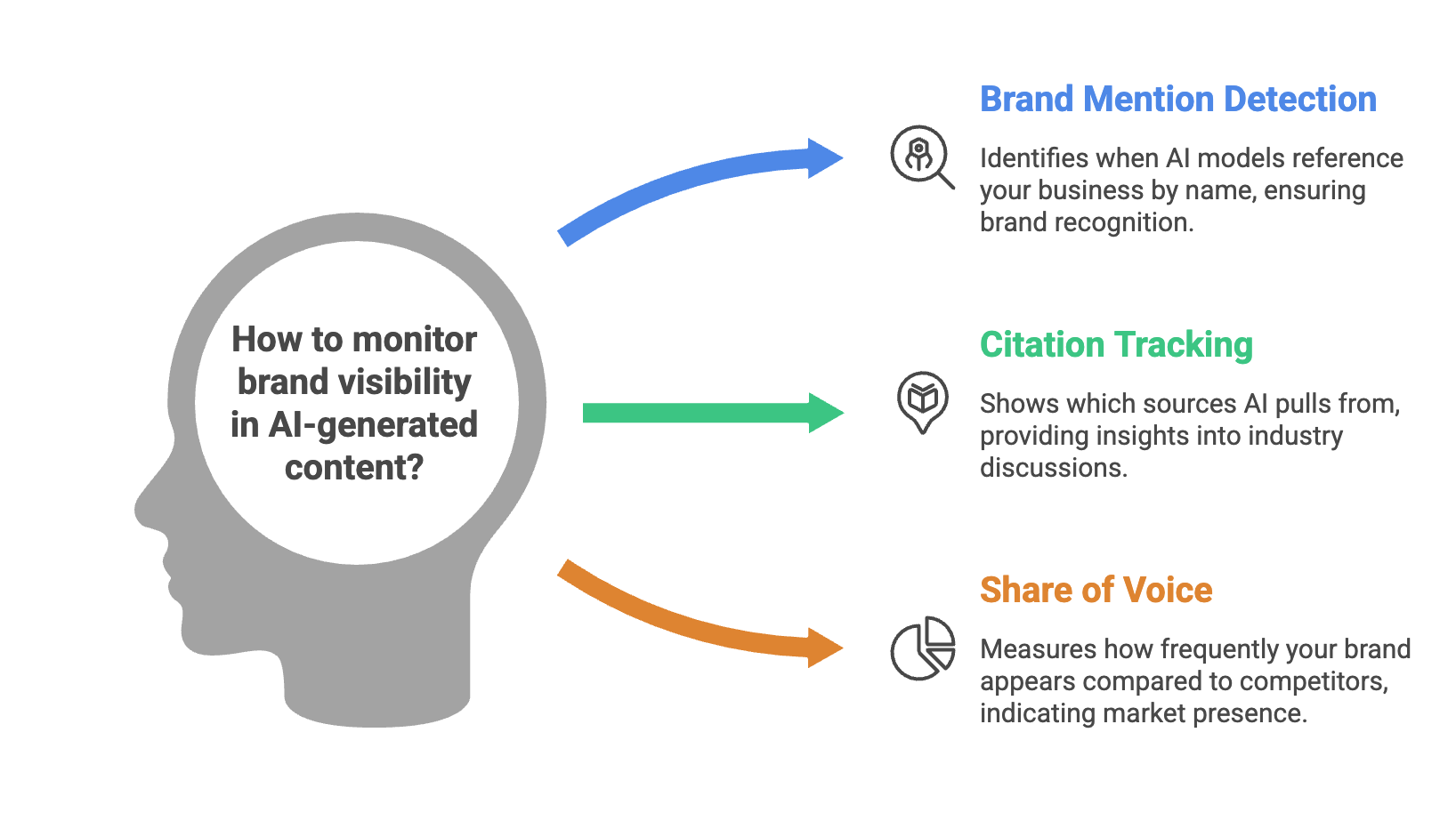
Infographic explaining how to monitor brand visibility in AI-generated content through three methods: brand mention detection, which identifies when AI models reference your business by name; citation tracking, which shows which sources AI pulls from; and share of voice, which measures how frequently your brand appears compared to competitors with LLM Tracking Tools.

LLM tracking tools monitor how your brand appears in AI-generated answers across platforms like ChatGPT, Gemini, Perplexity, Claude, and Google AI Overviews. Popular options include ZipTie, Semrush AIO, Otterly AI, Profound, and Scrunch AI, each designed to track brand mentions, sentiment, and citation frequency in generative search results.

So what does that actually mean in practice? When someone asks ChatGPT “What’s the best digital marketing agency in Toronto?” an LLM tracking tool tells you whether your brand shows up in the response. It also tells you how often you appear, what context surrounds your mention, and whether the AI recommends you or a competitor instead.

Brand mention detection: Identifies when AI models reference your business by name
Citation tracking: Shows which sources AI pulls from when discussing topics in your industry
Share of voice: Measures how frequently your brand appears compared to competitors for the same prompts

Traditional SEO tools like Google Search Console track rankings on search engine results pages. LLM tracking tools do something different entirely, monitoring conversations happening inside AI assistants where traditional rankings don’t exist.

Why AI Brand Visibility Tracking Matters

The way people find businesses is changing. 37% of consumers start searches with AI instead of typing keywords into Google. If your brand isn’t appearing in AI-generated answers, you’re invisible to a growing segment of potential customers.

Here’s the practical problem: Google Analytics and rank trackers don’t capture AI mentions at all. Your brand might be completely absent from ChatGPT responses while competitors get recommended daily. Without dedicated tracking, you’d never know.

The businesses that start monitoring now will have months of baseline data to work with when they begin optimizing. Those that wait will be guessing while competitors build on real performance insights.

What to Look for in an AI Visibility Tracking Tool
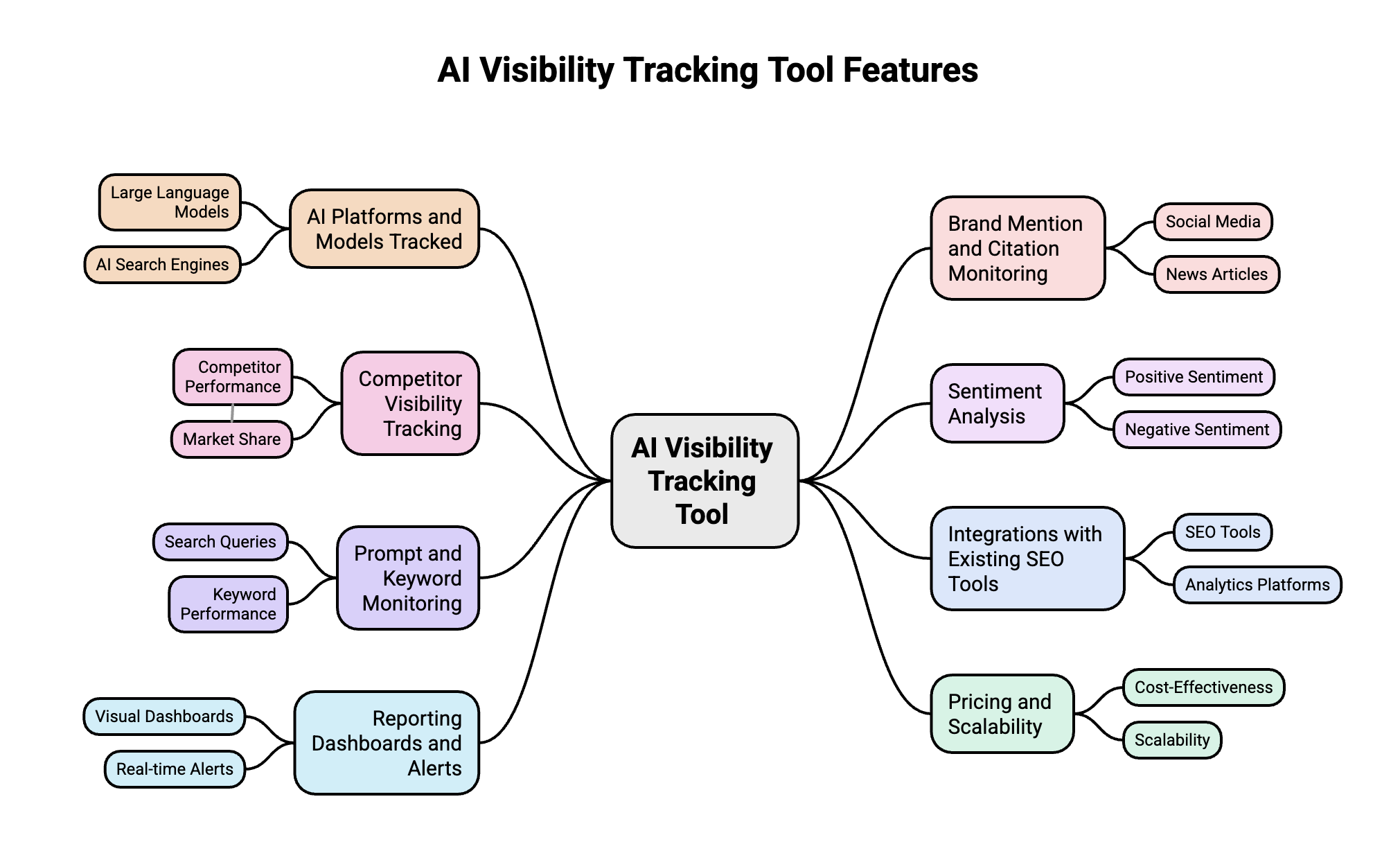
Mind map showing the core features of an AI visibility tracking tool, including AI platforms and models tracked, competitor visibility tracking, prompt and keyword monitoring, reporting dashboards and alerts, brand mention and citation monitoring, sentiment analysis, integrations with existing SEO tools, and pricing and scalability.

Not every tool tracks the same platforms or offers the same depth of analysis. Before comparing specific options, it helps to know which features actually matter for your situation.

Key Features to Look for in LLM Tracking Tools

Feature Why It Matters
Multi-model tracking Covers ChatGPT, Gemini, Claude, and Perplexity in a single dashboard
Citation monitoring Shows which sources AI pulls when mentioning your brand
Competitor tracking Reveals which competitors AI recommends instead of you
Sentiment analysis Flags negative mentions before they spread
Prompt monitoring Tracks specific queries your audience uses
Integrations Connects with your existing SEO and analytics stack
Alerts Notifies you of visibility changes in real time

AI Platforms and Models Tracked

The most useful tools monitor multiple LLMs at once such as ChatGPT, Gemini, Claude, Perplexity, and Google AI Overviews, rather than requiring separate dashboards for each platform. Single-platform tools work fine if you only care about one AI assistant, but one in five AI users now uses multiple apps, so most businesses need broader coverage.

Brand Mention and Citation Monitoring

This is the core function of any tracking tool. You want to see exactly when your brand gets named, linked, or recommended in AI responses, along with the surrounding context. A mention in a negative comparison is very different from a direct recommendation, and your on-page SEO strategy directly influences which one you get.

Competitor Visibility Tracking

Side-by-side comparisons reveal how your visibility stacks against competitors. If a rival appears three times more often than you for the same prompts, that’s specific, actionable information you can work with.

Sentiment Analysis

Some tools flag whether AI mentions your brand positively, negatively, or neutrally. A mention isn’t always good – context matters, and catching negative sentiment early gives you time to respond.

Prompt and Keyword Monitoring

You can track specific prompts or keywords to see when your brand appears for queries your audience actually uses. Rather than monitoring everything, you focus on the questions that matter most to your business.

Integrations with Existing SEO Tools

Compatibility with platforms like Semrush, Ahrefs, and Google Search Console means less manual work and more unified reporting. If you’re already using an SEO platform, check whether it offers AI visibility features before adding another tool.

Reporting Dashboards and Alerts

Real-time alerts notify you when visibility changes significantly. Scheduled reports keep stakeholders informed without requiring manual exports every week.

Pricing and Scalability

Tools range from free tiers to enterprise pricing at several hundred dollars monthly. Match the cost to your business size and the depth of data you actually plan to use.

The 15 Best AI Brand Visibility Tools

If you’ve already built a Comprehensive SEO strategy around platforms like Semrush or Ahrefs, adding AI tracking often requires minimal setup. The data appears alongside your existing reports, which makes adoption straightforward for teams already comfortable with the interface.

#ToolPlatforms TrackedPricingPros & ConsBest For
01 Semrush AI ToolkitMid-tier ChatGPT
AI Overviews
Perplexity
Pricing$99/mo per domain as add-on. Semrush One bundle from ~$199/mo. No free trial on standalone; 7-14 day trial on Semrush One. Additional users $99/seat. Pros
  • Integrates seamlessly with existing Semrush projects – no extra setup
  • Tracks sentiment, share of voice, and AI citations across three platforms in one dashboard
  • Generates presentation-ready client reports
  • Shows exactly which pages on your site AI tools are citing
Cons
  • Struggles with sparse data for smaller or niche brands
  • Brand Performance uses AI-generated queries, not real search data
  • Adding a team member costs $45-$100/mo + $99 more for AI Toolkit access
Best ForAgencies and mid-size businesses already on Semrush who want AI visibility without managing a separate tool.
02 Ahrefs Brand RadarEnterprise ChatGPT
Perplexity
Gemini
AI Overviews
Copilot
PricingBase Ahrefs plan from $129/mo required. AI indexes $199/mo per platform or $699/mo for all six. Full coverage from $828-$1,148/mo total. Pros
  • 250M+ real search-backed prompts – not synthetic queries
  • “Others only” filter reveals competitor-only prompts instantly
  • Beta tracking for YouTube, TikTok, and Reddit mentions
  • Historical data back to 2024 – rare among dedicated AI trackers
Cons
  • Major accuracy gaps – one test: 3 mentions reported vs. 123 actual in ChatGPT
  • Does not track Claude or Grok
  • Prohibitive pricing for most SMBs and growing agencies
Best ForEnterprise brands in the Ahrefs ecosystem needing broad competitive intelligence across AI platforms.
03 SE RankingMid-tier ChatGPT
Perplexity
Gemini
AI Overviews
AI Mode
PricingBase plans from $65/mo (Essential), $119/mo (Pro), $259/mo (Business). SE Visible AI module is an add-on priced by prompt volume. Unlimited user seats on all plans. Pros
  • Traditional SEO + AI visibility in one platform – no tool sprawl
  • Real interface scraping – verifiable cached mention snapshots
  • Unlimited user seats – great for agencies
  • Lower entry price than most dedicated GEO tools
Cons
  • AI tracking is an extension, not the core product – less depth than dedicated tools
  • Add-on costs escalate as tracking scope expands
  • Newer AI module still maturing
Best ForSEO teams adding AI visibility to their existing workflow without switching platforms or adding extra cost.
04 SimilarwebEnterprise Multiple LLMs PricingCustom enterprise pricing. Requires an existing Similarweb subscription. Contact sales for a quote. Pros
  • SEO and GEO data combined for competitive market intelligence
  • Market-level visibility comparisons across entire categories
  • Natural fit for teams already in the Similarweb ecosystem
Cons
  • Not accessible for SMBs or budget-conscious agencies
  • Requires an active Similarweb subscription to unlock AI features
  • Less prompt-level granularity than dedicated GEO tools
Best ForEnterprise teams using Similarweb for competitive intelligence who want AI visibility layered into existing dashboards.
05 BrightEdgeEnterprise AI Overviews
ChatGPT
PricingCustom enterprise pricing. Direct contact with sales required. Positioned for large-scale content teams with dedicated analytics budgets. Pros
  • Deep integration between AI visibility and content performance tracking
  • Connects AI citations to content strategy and revenue attribution
  • Robust enterprise-grade reporting infrastructure
Cons
  • Pricing and implementation complexity put it out of reach for SMBs
  • Heavier onboarding than purpose-built AI tracking tools
  • Overkill for teams with basic brand monitoring needs
Best ForLarge enterprise content teams connecting AI visibility to content performance within the BrightEdge ecosystem.
06 ConductorEnterprise Multiple LLMs PricingCustom enterprise pricing. Content intelligence platform with AI visibility as one integrated capability among several. Pros
  • AI visibility feeds directly into content planning and editorial calendars
  • Multi-LLM tracking in a unified interface
  • Suited for organizations where content and SEO share ownership
Cons
  • Enterprise pricing limits accessibility for smaller teams
  • AI visibility is one feature among many – not the platform’s primary focus
  • Less prompt-level control than dedicated standalone GEO tools
Best ForLarge organizations wanting AI visibility woven into a broader content strategy platform rather than a standalone tool.
#ToolPlatforms TrackedPricingPros & ConsBest For
07 ProfoundEnterprise All major LLMs PricingStarter (ChatGPT only) $99/mo. Growth ~$399/mo with 7-day free trial. Enterprise custom. Sits 48% above the $337/mo industry average for AI tracking tools. Pros
  • Deepest data pipeline: 5M+ citations, 4M+ crawler visits, 1M+ prompts processed daily
  • Agent Analytics ties AI crawler visits to traffic and revenue attribution
  • Prompt Volumes shows real search volume so you know which queries to prioritize
  • SOC 2 Type II & HIPAA compliant – essential for enterprise and healthcare brands
  • Agency Mode with consolidated client workspace billing
Cons
  • 3-4x the cost of alternatives with comparable monitoring features
  • No multi-account agency setup on lower tiers
  • AI-generated recommendations can feel generic rather than specifically actionable
Best ForEnterprise brands and well-resourced agencies needing the deepest available data on AI citations, crawler behaviour, and prompt volumes.
08 Peec AIMid-tier ChatGPT
Perplexity
AI Overviews
+ add-ons
PricingStarter €89/mo (25 prompts). Pro €199/mo (100 prompts). Enterprise €499+/mo. 7-day free trial. 15% annual discount. Extra platforms €20-30/mo each. Pros
  • Daily data refresh – faster cadence than most tools at this price point
  • 115+ language support – rare breadth for non-English markets
  • Unlimited user seats on all plans – practical for agencies with larger teams
  • Simulates real user interactions rather than API calls for more accurate results
Cons
  • No hallucination detection – won’t flag factually wrong brand information in AI responses
  • Add-on costs for platforms beyond the three core engines accumulate quickly
  • Limited utility for newer brands with minimal existing AI presence
Best ForMarketing teams needing daily AI visibility data across multiple languages with built-in improvement guidance – without enterprise pricing.
09 Otterly AIAffordable ChatGPT
Perplexity
AI Overviews
PricingLite $29/mo (15 prompts). Standard $189/mo (100 prompts). Extra 100 prompts $99 add-on. All tiers get full feature access. Free trial available. Pros
  • Lowest entry price on this list at $29/mo – accessible for any team size
  • Best-in-class GEO Audit with full SWOT analysis at this price range
  • Slack alerts fire in real time when your brand appears in ChatGPT responses
  • Native Semrush App Center integration for teams already in that ecosystem
Cons
  • Steep jump from $29 to $189 beyond 15 prompts
  • No brand sentiment overview metric – available per prompt only
  • Weekly refresh on lower plans may be too slow for fast-moving industries
Best ForSmaller teams and agencies testing AI visibility for the first time. The $29 entry point and detailed GEO audit make it the strongest starting point on this list.
10 Scrunch AIMid-tier 9+ LLMs incl. Claude, Gemini, Grok PricingFrom $300/mo (350 custom prompts, 3 personas). Enterprise plans custom-priced. Recently raised $15M Series A funding. Pros
  • Best-in-class segmentation – auto-labels prompts by intent, funnel stage, branded vs. unbranded
  • Agent Experience Platform (AXP) actively serves AI-optimized content to AI crawlers
  • Tracks 9+ LLMs at enterprise tier including Claude, Grok, and Meta AI
  • Misinformation detection flags when AI is misrepresenting your brand
Cons
  • Insights can be surface-level for the price – teams often identify next steps independently
  • Enterprise pricing puts it out of reach for most SMBs
  • Data refreshes every three days – slower than some competitors at similar price points
Best ForEnterprise teams wanting both passive monitoring and active AI content optimization through the AXP platform.
11 ZipTieMid-tier ChatGPT
AI Overviews
Perplexity
PricingBasic ~$58.65/mo annually (500 checks, 10 optimizations). Standard ~$84.15/mo (1,000 checks, 100 optimizations). 14-day free trial. ~15% annual discount. Pros
  • Purpose-built for AI search tracking – not a retrofitted SEO tool
  • Mimics real user behaviour rather than relying on APIs
  • URL-level filtering – not just domain-level – for deeper citation insight
  • AI Success Score prioritizes which prompts to optimize first by revenue impact
  • Google Search Console integration pulls real query data into the setup
Cons
  • Credit-based billing can be hard to predict month-to-month
  • Only tracks three AI engines – no add-ons available for additional platforms
  • Limited regional coverage – global teams should treat data as partial
Best ForSEO teams wanting deep, granular AI Overview and ChatGPT tracking with built-in content optimization guidance.
12 Trackerly.aiMid-tier ChatGPT
AI Overviews
PricingMid-tier – contact vendor directly. Positions around real-time alerting rather than published prompt-volume tiers. Pros
  • Real-time alerts – visibility changes notify your team as they happen
  • Covers the two platforms driving the majority of AI search traffic
  • Practical for teams where speed of response is a strategic priority
Cons
  • Smaller public footprint – fewer third-party reviews to validate claims before buying
  • Less depth on historical trends and segmentation analysis
  • May need pairing with a broader tool for optimization guidance
Best ForMarketing and PR teams needing immediate alerts when brand AI visibility changes – especially during product launches or reputation events.
13 NightwatchAffordable ChatGPT
Claude
Gemini
Perplexity
AI Overviews
PricingFrom $32/mo – one of the most affordable options combining traditional SEO and AI visibility tracking. 14-day free trial available. Pros
  • Tracks LLM responses, AI lookup searches, prompt performance, and sentiment in one place
  • Covers five major AI platforms including Claude
  • Precise localization across 107,000+ locations with zip-code accuracy
  • Pulls from Google data centers for more accurate traditional rank data
Cons
  • AI/LLM features are newer additions – core strength remains traditional SEO
  • Limited public reviews specifically about the AI tracking module
  • Less comprehensive than dedicated GEO tools for pure AI visibility goals
Best ForAgencies and SEO professionals wanting affordable unified tracking across traditional rankings and AI visibility without managing two separate platforms.
14 Keyword.comAffordable ChatGPT
Claude
Gemini
Perplexity
AI Overviews
PricingCredit-based from $24.50/mo (50 credits). Credits scale by check frequency and engine count. 14-day free trial available. Pros
  • Broad platform coverage including Claude – wide mid-market engine set
  • Automated white-label PDF and CSV reporting for agency client delivery
  • Full integration with Looker Studio, GA4, and Search Console
  • Built on Serpbook’s established rank tracking infrastructure
Cons
  • Limited public reviews for the AI module specifically
  • Credit burn rates can be unpredictable at higher monitoring frequencies
  • Refresh cadence may miss rapid visibility shifts in fast-moving topics
Best ForBudget-conscious agencies wanting cross-engine AI tracking in their existing keyword monitoring workflow – especially if white-label reporting matters.
15 Quno AIMid-tier Multiple LLMs PricingMid-tier – contact vendor directly. Positions around specialized prompt analysis rather than broad monitoring volume. Pros
  • Specialized prompt sensitivity analysis – reveals what framing gets your brand recommended
  • Helps align brand language with prompts most likely to generate positive AI mentions
  • Useful for content teams going deeper than surface-level monitoring
Cons
  • Limited third-party documentation and reviews – harder to validate before committing
  • Narrow focus – needs pairing with a broader tool for full competitive benchmarking
  • Not suited for teams whose primary need is platform coverage or real-time alerting
Best ForContent strategists going deep on prompt-level optimization – best used once baseline visibility data is already established with a broader tool.

How to Track AI Mode, AI Overviews, and ChatGPT

Google AI Mode, Google AI Overviews, and ChatGPT work differently, so tracking approaches vary for each.

Google AI Mode: This conversational search interface requires prompt-based tracking since 93% of AI Mode searches are zero-click. You’re monitoring how Google’s AI responds to natural language questions rather than keyword queries.
Google AI Overviews: Summarized answers appear at the top of traditional search results. SERP monitoring tools can capture AI Overview data alongside regular rankings since both appear on the same page.
ChatGPT: As a standalone AI assistant, ChatGPT requires direct query testing and citation tracking. The responses aren’t tied to traditional search at all, so separate monitoring is necessary.

Most comprehensive tools track all three platforms, though the depth of coverage varies. Check whether your chosen tool refreshes data daily or weekly, frequency matters for fast-moving industries where visibility can shift quickly.

How to Choose the Best Visibility Tracker for Your Business
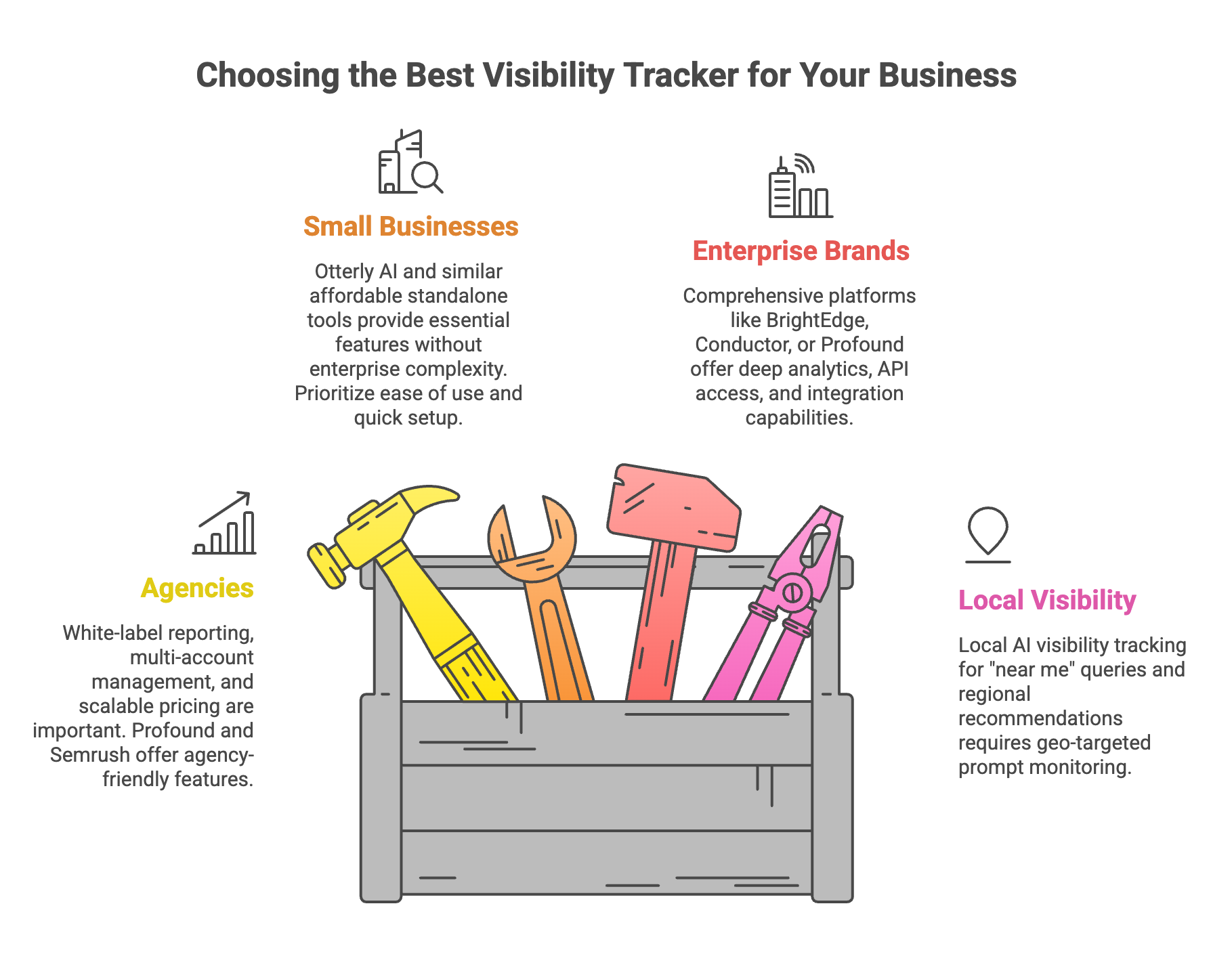
Infographic titled Choosing the Best Visibility Tracker for Your Business, showing four business types: small businesses suited to affordable tools like Otterly AI, enterprise brands suited to platforms like BrightEdge and Profound, agencies requiring white-label reporting and multi-account management, and local businesses needing geo-targeted prompt monitoring.

For Agencies Managing Multiple Clients

Look for white-label reporting, multi-account management, and scalable pricing. Profound and Semrush both offer agency-friendly features that allow you to brand reports for client delivery.

For Small Businesses and Startups

Otterly AI and similar affordable standalone tools provide essential features without enterprise complexity. Prioritize ease of use and quick setup over advanced analytics you won’t have time to analyze.

For Enterprise and Multi-Location Brands

Comprehensive platforms like BrightEdge, Conductor, or Profound offer the deep analytics, API access, and integration capabilities larger organizations typically require.

For Local Market Visibility in Toronto

Local AI visibility tracking for “near me” queries and regional recommendations requires geo-targeted prompt monitoring.

Start Monitoring Your Brand in AI Search
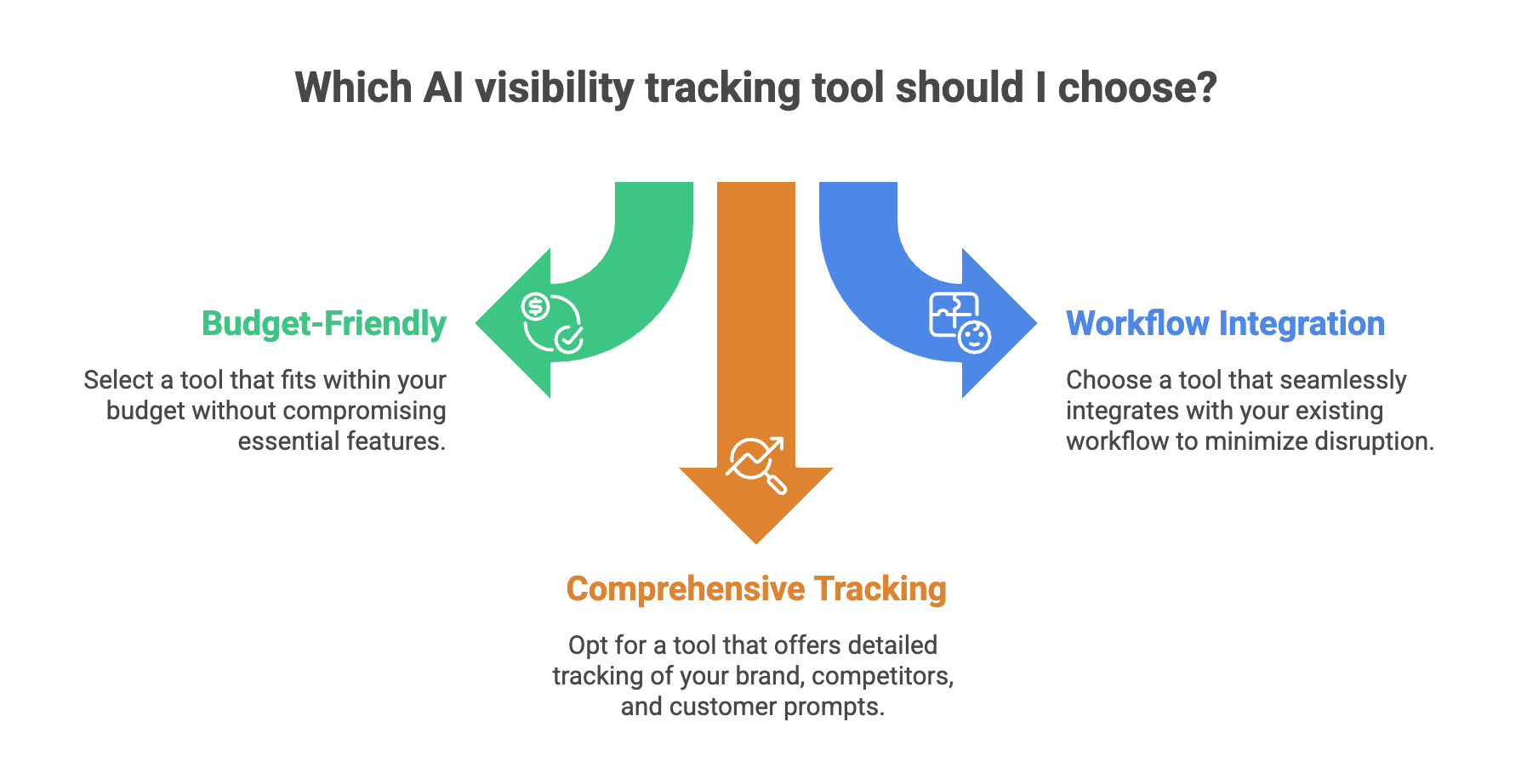
Infographic titled Which AI visibility tracking tool should I choose, presenting three decision criteria: budget-friendly tools that fit your budget without compromising essential features, comprehensive tracking that covers your brand, competitors, and customer prompts, and workflow integration that minimizes disruption to existing processes.

AI visibility tracking gives you data you can’t get anywhere else. Pick one tool from this list that matches your budget and existing workflow. Set up tracking for your brand name, your top competitors, and the prompts your customers actually use.

Within a few weeks, you’ll have baseline data that informs real optimization decisions. For Toronto businesses looking to improve visibility in AI-generated recommendations, Digital 6ix offers AI Search Optimization Services that combine tracking with strategic optimization.

This Blog is written by Simar Singh, Founder of Digital 6ix and a data-driven storyteller with 7+ years of experience helping Toronto businesses grow through performance-led digital strategies. Certified in Google Analytics and Google Search Console, with a strong focus on turning insights into measurable business outcomes.

Frequently Asked Questions

Leave a Comment

Your email address will not be published. Required fields are marked *